
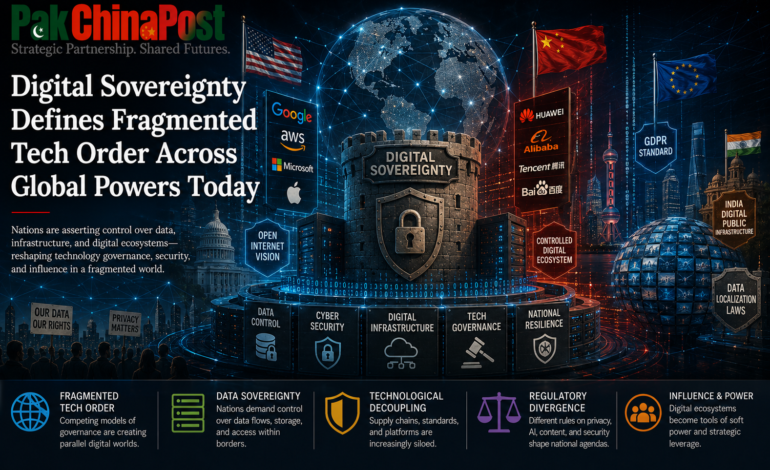
Digital Sovereignty Defines Fragmented Tech Order Across Global Powers Today

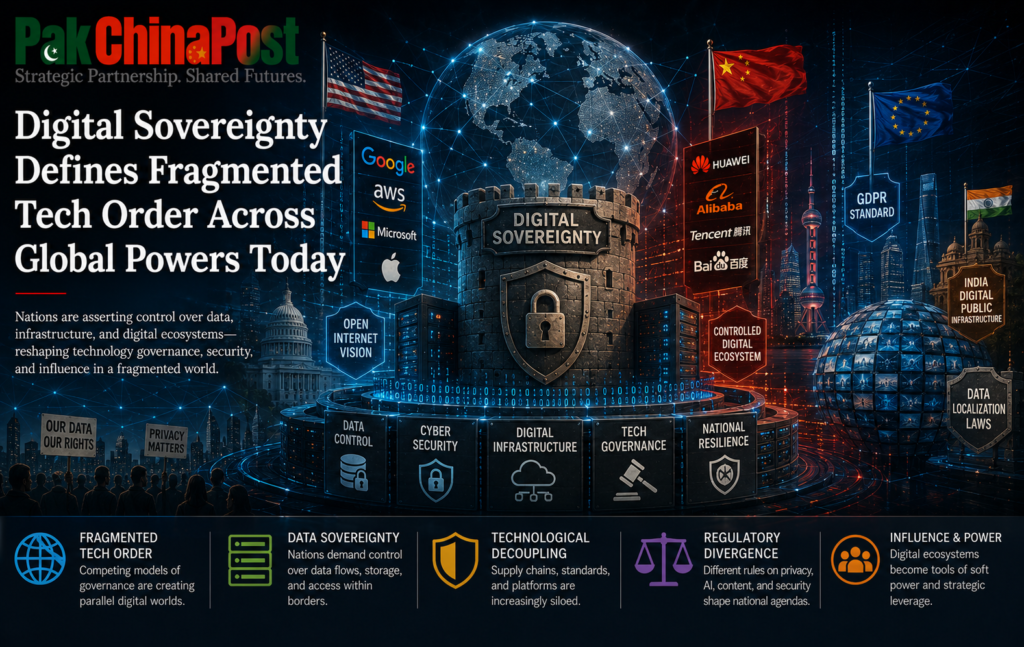
The architecture of the global digital economy is undergoing a profound fragmentation, increasingly shaped by competing visions of sovereignty, security and technological governance. What was once heralded as an open, borderless internet has gradually transformed into a contested terrain of jurisdictional assertion, where states, corporations and regional blocs are actively reconstructing the digital sphere in accordance with strategic imperatives rather than universalist ideals. This transition marks the emergence of what can be described as a post global internet, defined not by connectivity without constraint but by controlled interoperability within politically defined boundaries.
At the heart of this transformation lies the concept of digital sovereignty, a doctrine that has gained accelerating traction among major powers seeking to reclaim authority over data flows, platform governance and critical digital infrastructure. Digital sovereignty is no longer a purely theoretical construct; it is now embedded in regulatory frameworks, industrial strategies and national security doctrines across multiple geopolitical centers. It reflects an increasing recognition that data is not merely an economic resource but a strategic asset with implications for surveillance capacity, industrial competitiveness and cognitive influence.
China has been the most systematic in operationalizing digital sovereignty, constructing a tightly governed digital ecosystem characterized by data localization requirements, state mediated platform oversight and the development of indigenous technology champions capable of competing at global scale. This model integrates industrial policy with information control, creating a vertically structured digital environment in which state objectives are deeply embedded within technological architecture. The result is a highly coordinated system that prioritizes stability, control and indigenous innovation over openness and cross border informational fluidity.
In contrast, the United States and its allied technological ecosystem have historically advocated for an open internet model, yet this stance has increasingly evolved into a more conditional form of openness. Concerns over national security, intellectual property protection and technological dominance have led to the expansion of export controls, investment screening mechanisms and platform accountability regulations. These instruments, while less centralized than the Chinese model, nevertheless reflect a growing inclination toward strategic digital governance, particularly in areas involving artificial intelligence, semiconductors and advanced computing systems.
The European Union represents a distinct regulatory pole, seeking to assert normative sovereignty through legal frameworks that prioritize data protection, platform accountability and ethical AI governance. Instruments such as stringent privacy regulations and digital market competition laws reflect an attempt to shape global digital norms through regulatory power rather than infrastructural dominance. However, this regulatory ambition is constrained by limited indigenous technological capacity, creating a dependency paradox in which normative authority exceeds productive capability.
The convergence of these divergent models is producing a fragmented global digital ecosystem characterized by partial interoperability and increasing regulatory incompatibility. Cross border data flows are becoming subject to jurisdictional friction, while multinational corporations are compelled to navigate multiple overlapping compliance regimes. This has led to the emergence of what can be termed digital bloc formation, where technological ecosystems are increasingly aligned with geopolitical affiliations rather than purely economic considerations.
One of the most significant consequences of this fragmentation is the restructuring of global platform economies. Social media networks, cloud service providers, digital payment systems and e commerce infrastructures are increasingly required to operate within geographically bounded regulatory environments. This introduces a new form of digital territoriality in which access, visibility and functionality are determined by state level governance frameworks. The open architecture of the early internet is thus being replaced by a segmented system of controlled digital domains.
Artificial intelligence further intensifies this fragmentation, as foundational models require vast datasets that are increasingly subject to national security restrictions and data sovereignty laws. The training of advanced AI systems is becoming a geopolitically sensitive activity, with states imposing controls on data export, computational access and model dissemination. This creates asymmetries in AI development capacity, reinforcing the division between technologically advanced and technologically dependent economies.
For developing states such as Pakistan, this fragmented digital order presents both structural constraints and strategic openings. The constraint lies in the risk of becoming embedded within externally defined digital ecosystems without sufficient domestic control over data governance or platform infrastructure. Such dependency can manifest in subtle but powerful ways, including algorithmic bias, external regulatory compliance obligations and infrastructural lock in effects that limit policy autonomy.
At the same time, fragmentation also creates opportunities for strategic positioning within overlapping digital spheres. States that are able to maintain interoperability across multiple technological blocs may derive advantages from arbitrage in digital services, regulatory flexibility and diversified technological partnerships. However, this requires a high degree of institutional sophistication, regulatory foresight and diplomatic agility.
Digital infrastructure emerges as the central arena of contestation in this new order. Cloud computing systems, submarine cable networks, data centers and satellite communication architectures constitute the physical backbone of digital sovereignty. Control over these infrastructures translates into control over data flows, latency advantages and platform reliability. Consequently, infrastructure investment is becoming a central component of geopolitical strategy, often supported by state subsidies and public private partnerships.
Cybersecurity has also evolved from a technical concern into a core element of national security doctrine. The proliferation of cyber operations, data breaches and digital espionage has intensified state interest in securing digital borders. This has led to the institutionalization of cyber commands, national encryption standards and sovereign cloud initiatives designed to reduce external dependency.
The fragmentation of the digital order is also reshaping global knowledge systems. Academic research, digital education platforms and scientific collaboration networks are increasingly subject to geopolitical filtering. Access to information, computational resources and collaborative infrastructures is becoming unevenly distributed, potentially undermining the universality of scientific exchange that characterized earlier phases of globalization.
In this environment, governance of artificial intelligence, data and platforms becomes a central pillar of statecraft. Sovereignty is no longer confined to territorial integrity but extends into informational and computational domains. States are increasingly required to develop what can be termed digital constitutional capacity, the ability to regulate, protect and strategically deploy digital infrastructures in alignment with national priorities.
For Pakistan, policy responses must move beyond reactive digital regulation toward proactive ecosystem construction. This includes investment in national data infrastructure, development of indigenous platform capabilities and establishment of regulatory frameworks that ensure both compliance flexibility and strategic autonomy. Engagement with external digital blocs must be balanced with internal capacity building to avoid structural dependency.
Regional cooperation may offer partial mitigation against fragmentation pressures. Collaborative frameworks in digital trade, cybersecurity and data governance could enable smaller economies to pool resources and enhance bargaining power within larger technological ecosystems. However, such cooperation requires sustained institutional coordination and political alignment.
The long term trajectory of digital sovereignty suggests a continued intensification of fragmentation rather than convergence. As technological systems become more deeply embedded in national security, economic competitiveness and cognitive governance, states are unlikely to relinquish control over critical digital infrastructures. The result will be a world of overlapping but distinct digital regimes, each reflecting the strategic priorities of dominant actors.
Ultimately, the emerging digital order is defined by a paradox. While technology continues to connect the world at unprecedented speed, governance structures are simultaneously dividing it into increasingly distinct spheres of control. The challenge for states navigating this environment is not to resist fragmentation entirely, but to operate effectively within it while preserving sufficient autonomy to shape their own digital futures.
A Public Service Message