
Mediating the Frontier: China’s Diplomatic Balancing Between Pakistan and Afghanistan

The evolving triangular dynamic between China, Pakistan, and Afghanistan represents one of the most consequential yet underexamined theatres of contemporary regional diplomacy. What appears on the surface as a narrowly defined effort at de-escalation between two uneasy neighbors is, in fact, embedded within
Industrial War and Strategic Partnership: Lessons from Russia’s Military-Industrial Regression for the Pakistan–China Defense Nexus
The protracted war between Russia and Ukraine has evolved into far more than a conventional military confrontation; it has become an empirical stress test of modern defense-industrial resilience under conditions of systemic isolation, technological denial, and sustained high-intensity attrition warfare. At the ce
Symbolic Communication and Aura Theory: China’s Imaginative Nation‑Building Through Ceremony, Media, and Collective Mythos
In the contemporary matrix of global power, where material capabilities intersect with semiotic dominion, the People’s Republic of China manifests a paradigmatic inversion of conventional modernization discourse. No longer content with the mere calculus of GDP increments or infrastructural monoliths, the Chinese polity
Social Media, Popular Culture, and Economic Transformation in Contemporary China
In contemporary China, the intersection of social media, popular culture, and economic transformation illustrates a deliberate orchestration of societal evolution, technological innovation, and cultural consolidation. The Chinese model reflects a sophisticated understanding of media as a tool for shaping social identity, promoting economic
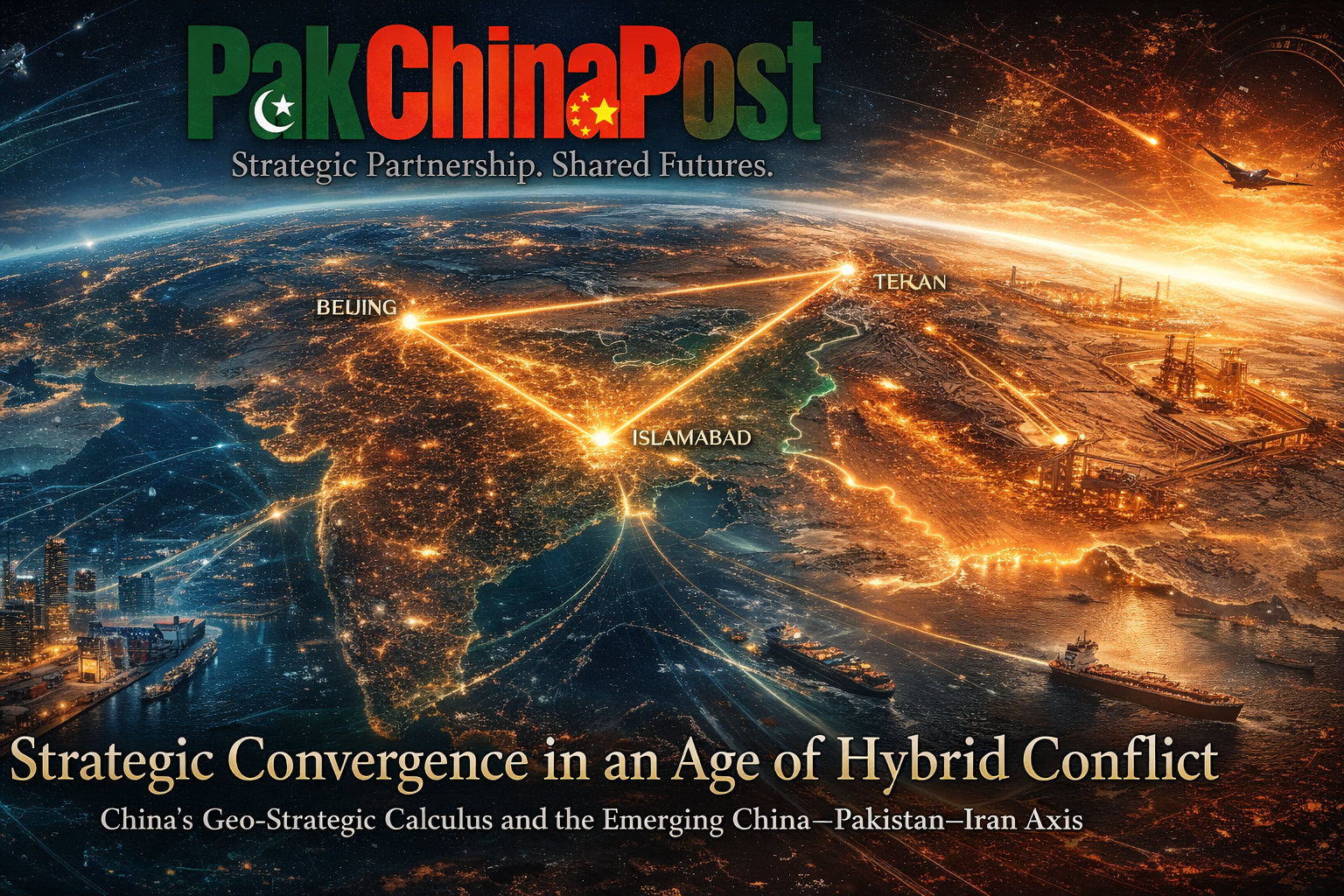
Strategic Convergence in an Age of Hybrid Conflict: China’s Geo-Strategic Calculus and the Emerging China–Pakistan–Iran Axis
The nature of war in the twenty first century is undergoing a profound transformation that challenges the classical understanding of conflict, sovereignty, and geopolitical influence. Traditional warfare, once defined primarily by territorial conquest and large scale military engagements, has gradually evolved into a
The Transformation of War and the Strategic Architecture of Eurasia: China’s Emerging Geo-Strategic Vision for Pakistan and Iran
The contemporary international system is undergoing a profound transformation in the nature of warfare, strategic competition, and geopolitical alignment. War is no longer confined to conventional battlefields or traditional military confrontations. Instead, it increasingly unfolds across a complex matrix of economic coercion, technological

Geopolitics in an Age of Strategic Flux: China’s Calculated Diplomacy Amid Escalating Global Instability
The contemporary geopolitical landscape is experiencing a moment of profound uncertainty in which traditional assumptions regarding power, sovereignty, and international order are increasingly being challenged by rapid systemic transformations. Conflicts that once appeared geographically contained now reverberate across continents through economic disruption, technological
Digital Power, Industrial Strategy and Global Influence: China’s Geo-Economic Vision in the Age of Technological Competition
The twenty-first century international order is increasingly defined by technological capability and digital infrastructure, transforming the nature of economic power and geopolitical influence. Within this evolving landscape, China has articulated a comprehensive geo-economic strategy that integrates technological innovation with long-term governance planning and

Bridging Civilizations: Leveraging China’s Cultural Initiatives for Pakistan’s Strategic Renaissance
China’s global rise in the twenty first century has been accompanied not only by economic expansion and infrastructural ambition, but by an increasingly structured and confident cultural diplomacy. While much international attention has focused on the Belt and Road Initiative and its physical

South China Sea Disputes: Sovereignty, Security Depth, and the Geopolitical Contest Shaping Asia’s Maritime Future
The South China Sea has emerged as one of the most strategically sensitive maritime regions in the world. Stretching across vital sea lanes that connect the Pacific and Indian Oceans, this body of water carries an estimated one third of global maritime trade