
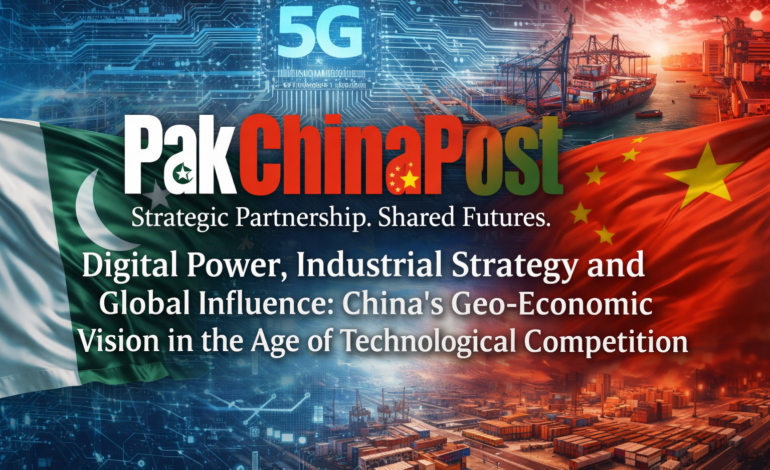
Digital Power, Industrial Strategy and Global Influence: China’s Geo-Economic Vision in the Age of Technological Competition


The twenty-first century international order is increasingly defined by technological capability and digital infrastructure, transforming the nature of economic power and geopolitical influence. Within this evolving landscape, China has articulated a comprehensive geo-economic strategy that integrates technological innovation with long-term governance planning and industrial modernization. Rather than treating technology as an isolated sector of economic activity, China views it as the central nervous system of national development, linking economic productivity, administrative efficiency, social stability, and global competitiveness into a single strategic framework.
At the heart of this vision lies the recognition that technological leadership determines not only economic prosperity but also strategic autonomy in an era characterized by intensifying geopolitical rivalry. Nations that control advanced digital infrastructures, artificial intelligence platforms, and semiconductor production possess the capacity to shape global economic networks and influence the trajectory of technological standards. For China, therefore, technological advancement is not simply an economic objective but a matter of national resilience and international positioning.
China’s approach differs significantly from traditional liberal economic models in which technological innovation is driven primarily by private capital and entrepreneurial experimentation. Instead, Beijing has constructed a hybrid innovation ecosystem where state institutions, public research laboratories, universities, and private technology companies operate within a coordinated policy environment. Strategic sectors receive targeted investment, regulatory guidance, and long-term planning support, allowing technological development to align with broader national priorities. This coordinated framework reflects the belief that transformative innovation requires sustained institutional commitment rather than purely market-based incentives.
Industrial modernization forms a central pillar of China’s technological geo-economics. Over the past decade, China has accelerated the transformation of its manufacturing sector through the integration of robotics, digital production systems, and advanced supply chain management. The objective is not only to increase industrial efficiency but to reposition China at the technological frontier of global manufacturing. Intelligent factories equipped with automated production lines and real-time data monitoring illustrate how digital technology can transform traditional industrial processes into highly adaptive and efficient economic systems.
Artificial intelligence plays an equally significant role within this strategic transformation. China has invested heavily in AI research, data infrastructure, and algorithmic development, recognizing that machine learning technologies will shape the next generation of economic productivity. From autonomous transportation systems and predictive healthcare diagnostics to financial risk management and agricultural optimization, AI applications are gradually permeating multiple sectors of the Chinese economy. These developments illustrate how technological innovation can simultaneously enhance economic performance and improve governance outcomes.
The governance dimension of China’s technological strategy is particularly distinctive. In many Western policy frameworks, technological governance is primarily concerned with regulatory oversight designed to limit potential abuses of digital power. China’s perspective, however, emphasizes the constructive role of technology in improving administrative effectiveness and social coordination. Digital platforms enable government institutions to process vast quantities of information, identify emerging policy challenges, and respond to public needs with greater speed and precision. In this sense, technology becomes a governance instrument capable of strengthening institutional responsiveness in a complex and rapidly evolving society.
Urban governance provides a vivid illustration of this integration. China’s large metropolitan regions face challenges related to transportation congestion, environmental management, and resource distribution. Through sophisticated data analytics systems, urban authorities can monitor traffic flows, energy consumption patterns, and public service demands in real time. These insights allow city administrators to optimize infrastructure utilization and reduce inefficiencies. The result is a governance model in which technological intelligence supports evidence-based policymaking and long-term urban sustainability.
China’s geo-economic technological strategy also extends beyond its domestic development agenda. Digital connectivity has become an increasingly important component of China’s international economic partnerships. Telecommunications infrastructure projects, cross-border e-commerce platforms, and digital payment ecosystems have expanded China’s technological presence across multiple regions. From Beijing’s perspective, such initiatives contribute to global digital inclusion by providing affordable technological infrastructure to countries that previously lacked access to advanced digital networks.
This outward technological engagement reflects a broader philosophical stance regarding globalization. Chinese policymakers frequently argue that technological progress should not be monopolized by a small number of advanced economies but shared through cooperative development frameworks. Within this narrative, digital infrastructure becomes a platform for inclusive economic growth, enabling developing economies to participate more effectively in global digital commerce and knowledge exchange.
The strategic importance of semiconductor technology illustrates the growing intersection between geopolitics and technological supply chains. Semiconductors form the foundational component of nearly all modern digital systems, from smartphones and supercomputers to telecommunications equipment and artificial intelligence processors. Recent trade restrictions and export controls imposed by several advanced economies have highlighted the vulnerability of global supply chains concentrated in a limited number of production centres. For China, these developments have reinforced the urgency of cultivating domestic semiconductor manufacturing capabilities and advanced microelectronics research.
Substantial public investment has therefore been directed toward semiconductor fabrication facilities, materials science research, and engineering education. Chinese universities are expanding programs in microelectronics and computational engineering, while government research institutions collaborate with private firms to accelerate technological breakthroughs. These initiatives illustrate China’s determination to reduce external technological dependence while maintaining participation in global supply chains.
China’s stance regarding technological governance is often misunderstood within international debates. While Western commentary frequently frames China’s digital policies primarily through concerns related to surveillance and information control, Chinese policymakers emphasize the developmental and administrative benefits of technological integration. In official discourse, digital governance is presented as a means of improving public service delivery, enhancing economic coordination, and ensuring social stability in a society of immense scale and complexity.
The Chinese government frequently argues that large populations and rapidly urbanizing economies require sophisticated technological systems in order to manage infrastructure, healthcare, transportation, and environmental sustainability effectively. Data-driven governance, therefore, is interpreted not as a limitation on innovation but as a framework for guiding technological progress toward collective societal benefits.
Environmental sustainability also occupies an increasingly prominent position within China’s technological development agenda. Digital technologies are being deployed to monitor air quality, manage renewable energy networks, and optimize resource consumption in industrial processes. Smart energy grids, supported by real-time data analytics, allow electricity generated from renewable sources to be distributed more efficiently across regional networks. These systems illustrate how technological innovation can contribute to climate governance and ecological modernization.
The broader geopolitical implications of China’s technological rise are substantial. As digital infrastructures become essential components of economic activity, the countries that design and operate these systems acquire considerable influence within global economic networks. China’s growing presence in telecommunications, digital finance, and e-commerce platforms therefore represents not merely commercial expansion but an evolution in the architecture of global economic connectivity.
Nevertheless, China’s official stance consistently emphasizes cooperation rather than confrontation in technological development. Chinese leaders frequently advocate for international frameworks that promote open scientific collaboration, shared research initiatives, and equitable technological access. The argument advanced by Beijing is that global technological progress requires inclusive cooperation rather than technological fragmentation driven by geopolitical competition.
At the same time, China remains acutely aware that technological competition has become an enduring feature of international politics. In response, its geo-economic strategy seeks to balance openness with resilience. Domestic innovation ecosystems are strengthened to reduce external vulnerabilities, while international partnerships are maintained to facilitate knowledge exchange and market integration. This dual approach reflects a pragmatic recognition that complete technological independence is neither feasible nor desirable in a deeply interconnected global economy.
The evolution of China’s technological governance model therefore represents one of the most significant transformations in contemporary political economy. By aligning digital innovation with governance objectives, industrial modernization, and international economic engagement, China has constructed a multifaceted strategy designed to navigate the complexities of technological competition in the twenty-first century.
For many developing countries observing these developments, China’s experience provides an alternative perspective on how technology can be integrated into national development strategies. Instead of relying exclusively on market forces, China demonstrates the potential advantages of coordinated policy frameworks that combine state planning, scientific investment, and private sector innovation.
As the global technological landscape continues to evolve, debates surrounding digital governance, technological sovereignty, and geo-economic influence will intensify. China’s approach offers one influential model within this broader conversation. By treating technology as both an economic engine and a governance instrument, Beijing has positioned technological advancement at the centre of its national development narrative.
In the coming decades, the success or limitations of this model will shape not only China’s domestic trajectory but also the broader contours of global technological governance. What is already evident, however, is that the relationship between technology and power has entered a new historical phase. In this emerging era, nations that successfully integrate innovation, governance, and strategic economic planning will determine the future architecture of the global order, and China’s evolving geo-economic vision represents one of the most ambitious attempts to define that future.
A Public Service Message


