Pakistan’s Border Dynamics with Afghanistan and India in the Context of China’s Expanding Geopolitical Footprint

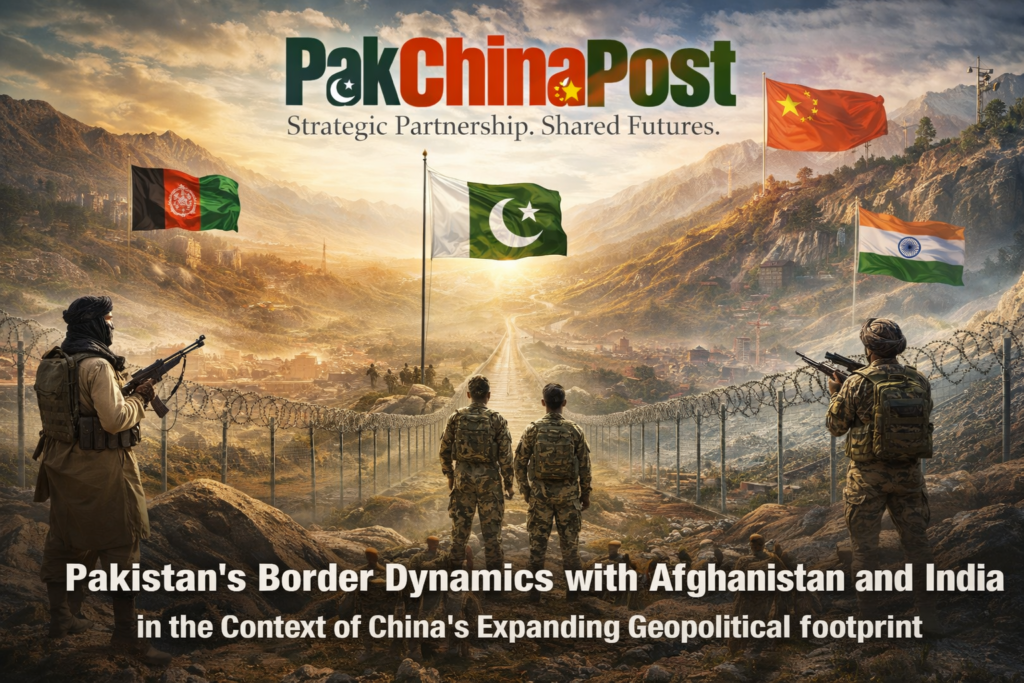
The frontier complex that Pakistan confronts along its western and eastern borders encapsulates the most enduring strategic dilemmas of South Asia’s contemporary security landscape. In the west the frontier with Afghanistan frames the challenge of managing insurgency spillovers, governing asymmetrical threats, and navigating the aftermath of the United States’ withdrawal from Kabul. In the east the frontier with India remains the locus of entrenched adversarial politics, nuclearized deterrence, and periodic escalatory crises. Overlain upon these bilateral tensions is an increasingly assertive China whose investments in regional infrastructure, diplomatic engagements in Kabul, and security posturing in adjacent Xinjiang province exert influence far beyond economic vectors, touching the very architecture of border governance and strategic autonomy in the region. Pakistan’s political and military elites have sought to calibrate responses to these intersecting dynamics in ways that preserve national interests without forfeiting strategic flexibility. The calculus reflects a complex balancing act whereby immediate security concerns converge with long-term geopolitical pressures emanating from both neighbors and competing great powers.
The western frontier has undergone dramatic transformation since the collapse of the pro‑government Kabul regime and the return to power of the Taliban. The withdrawal of US and NATO combat forces created an unprecedented security vacuum, the consequences of which reverberate through Pakistan’s border provinces. The porous terrain that stretches from Balochistan into eastern Afghanistan has long been difficult to regulate, enabling flows of refugees, informal commerce, and at times militant activity. With the Taliban in control, Pakistan initially experienced tactical relief as direct conflict with Afghan government forces ceased. However, over time Islamabad concluded that the Taliban’s internal fragmentation, economic strains in Afghanistan, and the proliferation of rival militant groups posed persistent threats to stability across the border. Islamabad’s security apparatus adopted measures to tighten border control, notably through fencing, surveillance enhancements, and increased coordination with local Afghan authorities where possible. These steps reflected recognition that a stable Afghanistan could reduce the risk of spillover violence, but that stability could not be assumed given the fragmented nature of Afghan political authority.
China’s expanding footprint in Afghanistan is exercised through a combination of diplomatic engagement, economic incentives, and security assurances. Beijing’s growing role in Kabul stems from its dual interests in securing its western periphery, notably Xinjiang’s stability, and expanding its influence in Central and South Asia. China has pursued bilateral talks with Afghan leaders, offering investments in mineral extraction, infrastructure projects, and trade linkages that could eventually integrate Afghanistan into broader regional supply chains. From Islamabad’s perspective these developments in Kabul are welcomed insofar as they potentially stabilize a neighboring polity, but they also complicate Pakistan’s own leverage. China’s independent diplomacy with the Afghan leadership diminishes Islamabad’s exclusive influence over Kabul, requiring Islamabad to adjust its frontier strategy in response to an external power that prioritizes different strategic imperatives.
The presence of Chinese diplomats and economic envoys in Kabul implicitly positions China as a security stakeholder in the region. Beijing’s security discourse emphasizes non‑interference but its emphasis on managing cross‑border extremism dovetails with Islamabad’s counterterrorism concerns. However, the thresholds of cooperation differ. Pakistan perceives some militant formations along the western border as tactical problems that can be countered through judicious engagement and selective pressure. China is principally concerned about any militant activity that could affect Xinjiang, particularly groups that might inspire or support separatist sentiments within its borders. This convergence of interests yields limited cooperation, but divergence arises with respect to political recognition and stewardship of Afghan institutions. Islamabad’s efforts to mediate between the Taliban and other Afghan factions are embedded in the long history of cross‑border Pashtun ties and geopolitical concerns that the frontier’s governance cannot be externally imposed. China’s approach, by contrast, is transactional and interest‑driven, subordinating ethno‑social complexities to macro‑economic and security objectives. The upshot of these differing paradigms is a frontier dynamic in which Pakistan must navigate not only Afghanistan’s internal volatility but also the implications of China’s diplomatic ascendancy.
The eastern frontier with India is marked by an entirely different set of tensions rooted in historical conflict, territorial disputes, and competing visions for regional influence. The border divides two nuclear‑armed states whose episodic crises have the potential to escalate rapidly with devastating consequences. The legacy of the Partition and the unresolved status of Jammu and Kashmir continue to infuse this frontier with symbolic and material contestation. Over the past decade India’s strategic posturing has been defined by modernization of military capabilities, expansion of infrastructure in frontier regions, and deepening strategic ties with the United States and other Western partners. Islamabad’s strategic community views these developments with profound concern, perceiving not only conventional capability imbalances but also existential pressures to preserve deterrent parity. Nuclear doctrine, asymmetric warfare strategies, and force deployment patterns are therefore central to Pakistan’s calculus in relation to India’s evolving military posture.
China’s presence in Pakistan’s eastern strategic calculations is not direct in geographic terms but manifests through its alliance with Islamabad and its broader rivalry with India. The tripartite interplay of China, India, and Pakistan complicates border dynamics by introducing great‑power competition into what has historically been a bilateral dispute. China’s own border conflict with India, exemplified by the 2020 clashes in the Himalayan border regions, underscores the potential for broader geopolitical entanglement. India’s security strategy emphasizes countering China’s influence in South Asia, and this frames its defence partnerships and border policy. For Pakistan this means that tensions on the eastern frontier cannot be isolated from larger geopolitical contests; they are entangled with the strategic rivalries of great powers whose interests in South Asia partially overlap and partially contradict Pakistan’s own priorities.
The recent enlargement of trilateral dialogues involving China, Pakistan, and Russia further complicates Islamabad’s maneuvering room on the eastern border. Russia’s historical association with India and its emerging cooperation with Pakistan signal a regional rebalancing that defies simple categorization. Moscow’s diplomatic engagements and defence dialogues with Islamabad demonstrate that Pakistan is not solely reliant on its traditional patrons for strategic support. However, Russia’s strong ties with India limit the depth to which Moscow can tilt in Pakistan’s direction without straining its own relations with Delhi. This triangular nuance necessitates careful diplomatic calibration by Islamabad in both its India policy and its broader frontier strategies.
In negotiating these challenges, Pakistan pursues a doctrine that blends deterrence, diplomacy, and pragmatic accommodation. The strategic calculus governing the Afghanistan frontier emphasizes stabilization through controlled engagement rather than isolation. Islamabad encourages inclusive political settlements in Kabul while maintaining pressure on groups that challenge its security interests. Yet Pakistan’s approach is not uniformly welcomed within Afghanistan where diverse actors perceive Islamabad’s influence with suspicion. This limits the degree to which Pakistan can shape frontier governance outcomes and underscores the complexities inherent in managing borders that have historical, ethnic, and ideological dimensions beyond mere cartography.
On the eastern border, Pakistan’s deterrence posture is shaped by its commitment to maintaining credible defence capabilities in the face of India’s conventional advantage. Nuclear deterrence plays a central role in this calculus, supported by doctrines that emphasize second‑strike capability, mobile delivery systems, and thresholds designed to dissuade adversarial adventurism. However, nuclearization of the border dispute imposes its own costs, constraining options for crisis management and increasing the stakes of any miscalculation. Pakistan’s military diplomacy with global partners, including ongoing albeit calibrated engagement with the United States, contributes to doctrine development in this domain. By participating in joint training, intelligence exchanges, and officer education programmes, Islamabad integrates insights drawn from diverse security architectures that inform its deterrence and response strategies. At the same time Pakistan remains wary of being drawn into broader strategic alignments that could undermine its autonomy, particularly given the United States’ own strategic priorities and fluctuating policies toward South Asia.
China’s influence on these eastern dynamics is indirect yet substantial. Beijing’s strategic alliance with Islamabad provides Pakistan with political cover and material support that counterbalances pressures emanating from India’s strategic partnerships with other powers. This does not eliminate friction on the eastern border but enhances Pakistan’s capacity to sustain deterrence and diplomatic flexibility. It also introduces a geopolitical logic that transcends the bilateral nature of the India‑Pakistan dispute, embedding it within the larger matrix of US‑China strategic competition. For Delhi, Pakistan’s alliance with Beijing reinforces perceptions of encirclement and motivates deeper security partnerships with Washington and other regional actors. The result is a frontier environment where local disputes are amplified by global rivalries, making resolution more complex and generating incentives for entrenchment rather than conciliation.
China’s expanding geopolitical footprint in the region has another layer of influence through its economic diplomacy that indirectly affects border security. Investments in infrastructure corridors and connectivity projects tie Pakistan’s economic incentives to regional stability. Economic integration initiatives designed to link markets across South and Central Asia create conditions where sustained peace along Pakistan’s borders becomes conducive to shared prosperity. However, these economic vectors do not operate in isolation from security concerns. For example, instability in Afghanistan has direct implications for the viability of trans‑regional trade routes, while escalations on the eastern border can divert resources and political attention away from economic priorities.
Pakistan’s strategic leadership thus faces a multifaceted challenge: it must navigate border dynamics that are conditioned by immediate security pressures, enduring historical rivalries, and the geopolitical imperatives of external powers whose interests intersect with its own. Managing these competing influences requires Pakistan to uphold strategic autonomy while engaging in careful diplomacy, capacity‑building, and calibrated military preparedness. It must avoid entanglement in rivalries that do not align with its national interests yet leverage opportunities where cooperation enhances its security and economic aims.
The implications of Pakistan’s frontier strategies extend beyond its immediate borders. Stability along the western frontier contributes to broader regional efforts to curtail violent extremism and foster inclusive governance in Afghanistan. Equally, restraint and effective deterrence along the eastern frontier reduce the risk of armed confrontation between nuclear‑armed neighbors. Pakistan’s engagement with China, the United States, Russia, and other regional players influences how these border dynamics are managed and how future crises might unfold or be averted.
In conclusion, Pakistan’s management of its border relationships with Afghanistan and India in the context of China’s expanding geopolitical influence embodies the complexities of contemporary South Asian security. These frontiers are shaped by historical legacies, competing threat perceptions, and the strategic imperatives of multiple states with divergent interests. Pakistan’s response blends deterrence, diplomacy, and strategic autonomy, reflecting a deep awareness that security is produced not only through force but through nuanced engagement with neighbors and great powers alike. The expanding geopolitical footprint of China adds layers of opportunity and complication, reinforcing Pakistan’s need to navigate a delicate balance between cooperation and autonomy. How Islamabad manages this balance will significantly influence the peace and stability of one of the world’s most strategically consequential regions well into the future.
A Public Service Message