
Pakistan’s Geopolitical Agency in an Era of Multipolarity

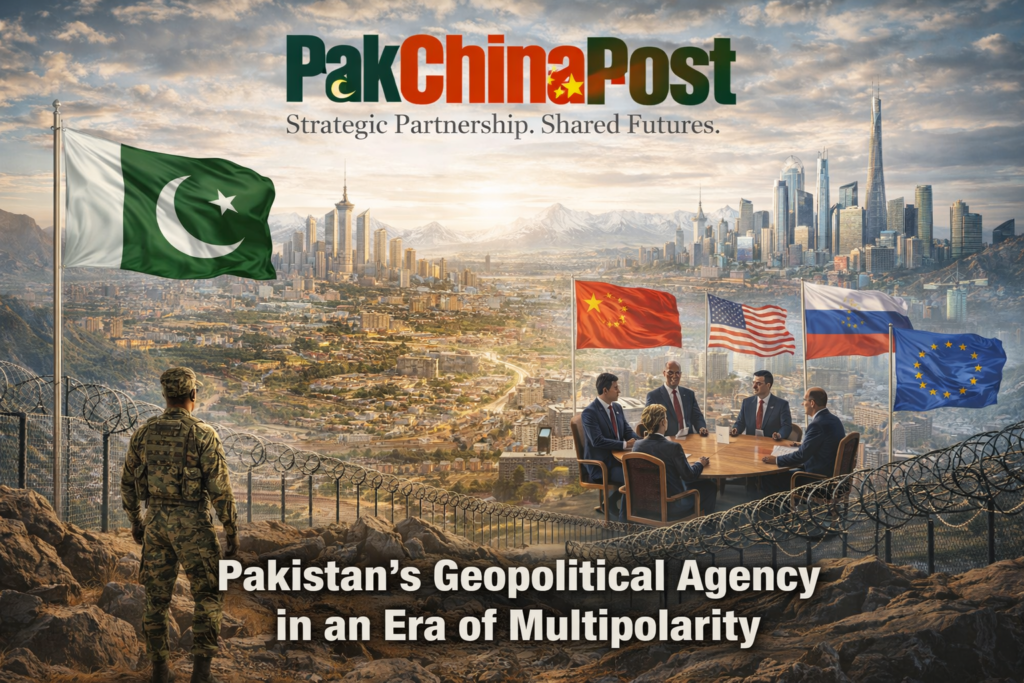
Pakistan’s geopolitical relevance in the early decades of the twenty‑first century is rooted in its unique position at the nexus of South Asia, Central Asia, and the broader Indian Ocean region. Its strategic environment is defined by the overlapping interests of global powers competing for influence and regional actors pursuing their own security and economic trajectories. In this complex matrix, Pakistan has sought to assert agency by balancing multiple external relationships while preserving core national interests. The geopolitical dynamics that shape Islamabad’s foreign policy are deeply rooted in history yet responsive to emerging trends that influence power configurations across the wider region. An examination of these dynamics reveals how Pakistan manages its political relations with China and the United States as well as how it situates itself within an evolving regional order characterized by shifting alliances, contested influence, and multiple power vectors.
At the heart of Pakistan’s geopolitical calculus is the enduring partnership with China. This relationship has been a cornerstone of Islamabad’s foreign policy for decades and has grown in significance as traditional alignments have shifted. China’s engagement with Pakistan has evolved from early diplomatic recognition and economic assistance to a comprehensive political and strategic partnership. From Pakistan’s perspective, this partnership offers diplomatic support in multilateral forums, technological collaboration, and a sense of strategic assurance amid regional uncertainties. Official Chinese statements describe the relationship as grounded in mutual respect, sovereignty, and a desire for shared development. Beijing’s approach to Pakistan is often framed within its broader global foreign policy narrative of peaceful development and cooperative connectivity. In geostrategic language China sees Pakistan as an important partner in the broader connectivity that extends from its western frontier into the heart of South Asia and beyond. For Pakistan the political value of this relationship lies in the perception of consistency and respect for national priorities, contrasting with the volatility that sometimes characterizes other external partnerships.
Through Chinese lenses the relationship with Pakistan is part of a larger regional calculus that seeks stability along its periphery. Beijing views a stable Pakistan as essential for its own internal cohesion, especially with respect to the security of Xinjiang province and the broader stability of the western frontier. Official Chinese discourse emphasizes that this alignment serves mutual interests and contributes to regional security. For Islamabad the reciprocal commitment from Beijing has come in the form of diplomatic support on sensitive issues such as Kashmir in international forums where Pakistan’s diplomatic capacity is challenged by competing narratives. From a geopolitical viewpoint this engagement reinforces Islamabad’s international positioning and provides a degree of diplomatic insulation in adversarial multilateral settings.
However this alignment with China occurs within a wider global context in which the United States remains a principal geopolitical actor. The United States long viewed South Asia through a Cold War lens that prioritized strategic alliances as bulwarks against rival ideologies. Although the ideological connotations of that era have receded, the geopolitical importance of the region for Washington’s policy remains intact. The US strategic preference for stability in South Asia has been shaped by global imperatives that encompass counterterrorism, non‑proliferation, maritime security, and more recently the broader competition with China. Accordingly United States policy documents frequently articulate the need for Pakistan’s cooperation in regional security, particularly in the context of counterterrorism and stability along the Afghanistan frontier. Yet Washington’s approach to Pakistan has been marked by episodic tension and fluctuating expectations, particularly as American foreign policy priorities have shifted in response to changing domestic political currents and global strategic rebalancing.
From a Pakistani vantage point the United States occupies an ambivalent role. On one hand the United States remains an important diplomatic interlocutor and provider of institutional support in areas such as military training, civilian governance assistance, and counterterrorism cooperation. On the other hand periods of suspicion and recrimination have punctuated the partnership, especially in relation to American perceptions of Pakistan’s policies in Afghanistan and its relations with militant groups deemed destabilizing. Islamabad’s response to this ambivalence has been to pursue a diversified foreign policy that retains engagement with the United States without ceding strategic autonomy. Pakistan’s geopolitical discourse emphasizes sovereignty and non‑interference while simultaneously seeking to extract cooperative value from its interactions with Washington. This balancing reflects a nuanced understanding of the limits and possibilities inherent in great power relations.
The interplay between Pakistan’s relationships with Washington and Beijing takes place against the backdrop of an emerging multipolar global order. The classical bipolarity of the Cold War has given way to a more complex system in which multiple powers exert influence in overlapping theaters. In addition to China and the United States Russia seeks a revitalized role in the region, particularly as a geopolitical counterweight to Western dominance. Moscow’s engagement with regional actors including Pakistan underscores a broader trend in which states traditionally aligned with one bloc seek new partnerships as a reflection of shifting power dynamics. Pakistan’s outreach to Russia, while cautious, demonstrates Islamabad’s recognition that its geopolitical agency is enhanced not by overdependence on any one external partner but through diversified, stable relations that reinforce its sovereign decision‑making.
The historical contours of Pakistan’s foreign policy are instructive in understanding this contemporary posture. Since its inception Pakistan has navigated a security environment shaped by territorial disputes, especially with India, and by the imperatives of national survival in the midst of global power rivalries. Pakistan’s security community internalized early lessons about the necessity of external alliances to balance regional asymmetries. However over time Islamabad also recognized the vulnerabilities inherent in exclusive alignments. This experiential learning has informed a more flexible policy that seeks to combine strategic cooperation with external powers without compromising autonomy. Within this frame Pakistan’s ties with China are viewed as long‑term and mutually reinforcing, while its transactions with the United States are calibrated to specific strategic outcomes without binding commitments that could impinge on sovereign choices.
In geopolitical terms Pakistan’s relationship with the United States continues to be significant but has evolved from dependency to conditional cooperation. The post‑9/11 era marked a period of intense military cooperation as Pakistan’s territory and security forces were central to the United States’ campaign in Afghanistan. This cooperation yielded tactical benefits for both sides yet created friction as divergent objectives emerged during the protracted conflict. With the subsequent withdrawal of United States forces from Afghanistan attention shifted to diplomacy and stabilizing Afghanistan’s post‑withdrawal transition. Pakistan’s diplomatic engagement with the Taliban and its efforts to encourage inclusive governance reflect Islamabad’s perception of its own geopolitical stakes in ensuring a stable western neighbor. The United States continues to engage Pakistan on these issues, seeking Islamabad’s cooperation on counterterrorism and humanitarian coordination. However American policymakers now balance this engagement with broader concerns about regional influence, human rights and the evolving geopolitical contest with China.
For Pakistan the geopolitical significance of the United States cannot be reduced solely to military cooperation. Washington remains a critical node in global economic and diplomatic networks. Pakistan seeks to leverage its engagement with the United States to foster economic ties, attract investment, diversify trade relations and participate in multilateral initiatives that enhance its international standing. These efforts reflect Islamabad’s understanding that geopolitics encompasses economic, diplomatic and institutional dimensions as much as it does security cooperation. Similarly Pakistan’s outreach to other major global actors including European states and Gulf Cooperation Council countries indicates an appreciation of the multiplicity of influences shaping contemporary global politics.
China’s geopolitical rise has reverberated across the region, compelling not only Pakistan but also the United States and other actors to reassess their strategic priorities. Beijing’s growing economic and political clout has enabled it to cultivate partnerships across multiple regions. In South Asia China’s role is prominent not only in its partnership with Pakistan but also through growing engagements with other states that see opportunities in Chinese investment, infrastructure and trade facilitation. From Beijing’s perspective the creation of connectivity networks that extend from its own borders into South Asia and beyond serves both economic and strategic purposes. This pursuit of influence through infrastructure, diplomacy and trade has been interpreted differently by various actors. For Islamabad it represents a stabilizing influence and a source of economic opportunity. For Washington it has emerged as a facet of its broader strategic competition with China. This contest is articulated in policy frameworks that emphasize freedom of navigation, rule‑based order, and balanced partnerships that check the rise of any hegemonic power. Beijing contests this framing by emphasizing a narrative of peaceful development and cooperation without exclusion. Pakistan’s geopolitical diplomacy thus operates amidst competing narratives about order, cooperation and regional influence.
Pakistan’s engagement with China and the United States also intersects with its relations with neighboring countries. Its geopolitical relationships with Afghanistan and India are distinct yet interconnected. The historical distrust and strategic rivalry with India continue to shape Islamabad’s defense and foreign policy priorities. This rivalry is reflected in military postures, diplomatic interactions and competing international narratives about regional security. From Islamabad’s perspective engagement with external powers is partially informed by the need to balance India’s influence. Yet Pakistan’s foreign policy articulates a preference for peaceful coexistence and conflict resolution through diplomatic channels while maintaining credible defensive capabilities. Beijing’s consistent support for dialogue and its diplomatic partnership with Islamabad reinforce these geopolitical priorities. Simultaneously the United States encourages diplomatic engagement between India and Pakistan, reflecting Washington’s interest in regional stability and broader strategic equations. These intersecting pressures highlight the complexity of geopolitical decision‑making in Islamabad, where national interests must be reconciled with divergent external expectations.
The geopolitical environment in Central Asia also bears on Pakistan’s foreign policy calculations. The region’s strategic location, energy resources, and connectivity potential make it an arena of interest for multiple powers. China has deepened its involvement in Central Asia through economic corridors, security cooperation frameworks and regional institutions. The United States and Russia each maintain strategic interests in the region. Pakistan seeks to engage Central Asian states to diversify its economic and diplomatic partnerships, a goal that complements its broader geopolitical strategy of harnessing regional integration without compromising autonomy. Islamabad’s diplomatic overtures reflect recognition that global power dynamics are not confined to bilateral engagements with major powers but are embedded in complex regional and transregional linkages that influence trade, security and political alignment.
Pakistan’s geopolitical agency in this multipolar context is therefore not static but adaptive. Islamabad’s foreign policy articulates an effort to balance competing interests while preserving core national priorities. This balancing operates at multiple levels including state diplomacy, defense cooperation, economic engagement and participation in international institutions. Pakistan’s involvement in multilateral platforms such as the United Nations, the Shanghai Cooperation Organization at an observer level, and broader dialogue forums underscores its desire to be a constructive geopolitical actor. These engagements provide platforms for Pakistan to articulate its perspectives on security, development and regional cooperation.
The implications of Pakistan’s geopolitical posture extend beyond its immediate security environment. By positioning itself as a state capable of engaging multiple powers without subordinating national interests, Pakistan contributes to a regional order that accommodates diverse actors and competing interests. This posture enhances Islamabad’s diplomatic relevance and provides it with strategic flexibility. At the same time this approach requires careful management of external expectations and internal coherence within its foreign policy apparatus. The successful navigation of geopolitical complexities necessitates clarity of purpose, consistent diplomatic messaging and a sustained commitment to safeguarding sovereignty while participating in cooperative frameworks that yield mutual benefits.
In conclusion Pakistan’s geopolitical positioning in the contemporary global environment reflects an emphasis on strategic autonomy, diversified engagement and balanced partnerships. Its relations with China and the United States are central to this approach yet are complemented by outreach to other global and regional actors. Islamabad’s foreign policy reflects both historical legacies and emerging trends, emphasizing depth in longstanding relationships while preserving the flexibility to respond to evolving global dynamics. In an era characterized by multipolar competition and contestation over regional influence Pakistan’s strategic agency is manifested in its ability to navigate complexity with a calibrated blend of cooperation, autonomy and geopolitical foresight.
A Public Service Message