
Subsidy Retrenchment and Fiscal Survival in Crisis Stricken Economies Dilemma

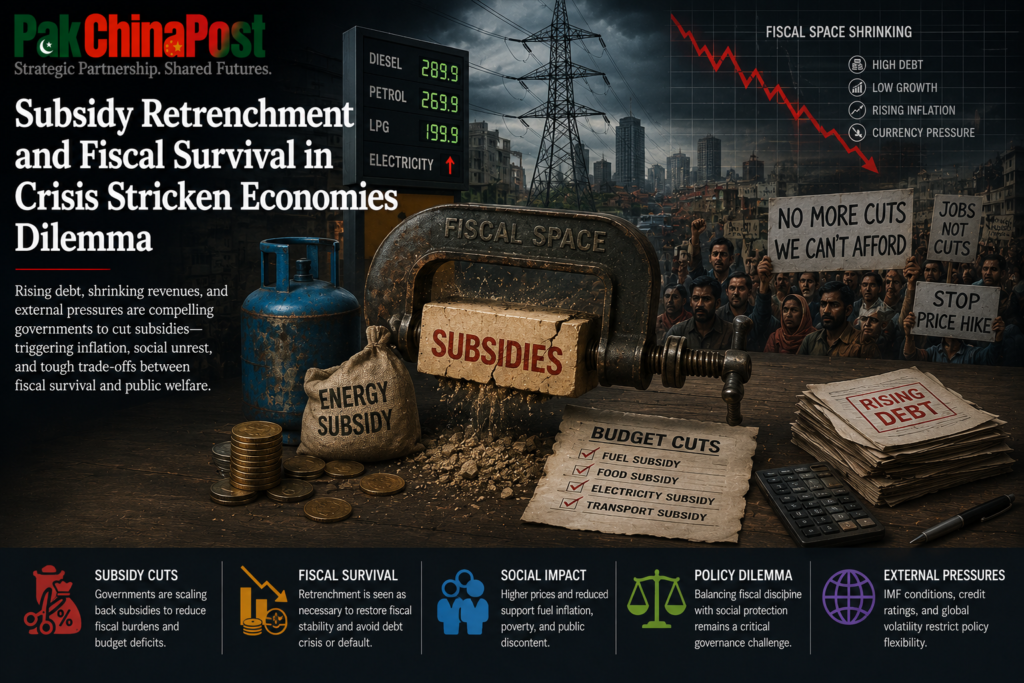
Across the developing world, a quiet but consequential transformation is unfolding within the architecture of state economic governance. Under the austere gaze of international financial orthodoxy, energy subsidies once regarded as indispensable instruments of social protection are being systematically dismantled, recalibrated, or reclassified under the rubric of fiscal discipline. The underlying proposition appears deceptively simple: reduce fiscal leakage, correct price distortions, and restore macroeconomic stability. Yet beneath this technocratic clarity lies a far more complex and politically combustible reality in which economic reform collides with social endurance thresholds, and where fiscal arithmetic risks becoming a substitute for political economy reasoning.
The contemporary policy environment is shaped by a renewed assertiveness of multilateral conditionality, particularly in economies grappling with external account deficits, currency volatility, and debt servicing constraints. Energy subsidies, which often absorb a disproportionate share of public expenditure, are framed as structural inefficiencies that crowd out productive investment and entrench unsustainable consumption patterns. In this framing, subsidy reform is not merely a policy adjustment but a moralised correction of economic behaviour, aligning domestic pricing with global market signals.
Yet the assumption that price realignment automatically produces efficiency gains obscures the distributive architecture of energy consumption in low and middle income economies. Energy is not simply a commodity in these contexts; it is a foundational input into household survival, industrial continuity, and political stability. When subsidy regimes are abruptly withdrawn or insufficiently sequenced, the resulting price shock propagates through multiple layers of the economy, amplifying inflationary pressures, compressing real wages, and intensifying social stratification.
The paradox confronting policymakers is thus increasingly evident. Fiscal consolidation demands the reduction of subsidies to restore macroeconomic credibility and secure external financing. However, socio economic stability often depends on precisely those subsidies that are being curtailed. This contradiction produces a policy environment in which governments are required to simultaneously withdraw support and maintain legitimacy, a balancing act that is as politically fragile as it is economically complex.
International financial institutions have responded to this dilemma through the promotion of targeted subsidy frameworks. These models seek to replace universal price support with narrowly defined transfers directed at vulnerable populations. In theory, such mechanisms preserve fiscal space while protecting the poorest households from the immediate effects of price liberalisation. In practice, however, their implementation is constrained by significant institutional limitations. Weak administrative capacity, incomplete demographic data, fragmented identification systems, and entrenched informal economies collectively undermine the precision required for effective targeting.
Moreover, the transition from universal to targeted subsidies often generates its own distortions. Political economy considerations frequently lead to partial reforms in which subsidies are neither fully removed nor efficiently redirected, resulting in hybrid systems that combine fiscal burden with administrative inefficiency. In such contexts, governments find themselves trapped in an intermediate equilibrium where fiscal savings remain limited while social discontent intensifies.
The inflationary dimension of subsidy reform further complicates its macroeconomic justification. In energy import dependent economies, price liberalisation transmits directly into transportation, manufacturing, and agricultural cost structures. This transmission effect produces second round inflationary dynamics that are often underestimated in initial reform projections. Central banks, already constrained by limited policy credibility and external vulnerability, are forced into monetary tightening cycles that may further suppress growth without fully stabilising prices.
The social consequences of these adjustments are neither linear nor evenly distributed. Urban informal sectors, rural agrarian communities, and lower middle income households bear a disproportionate share of the adjustment burden. As real incomes decline, consumption smoothing mechanisms weaken, leading to increased reliance on informal credit networks and non institutional survival strategies. Over time, this erodes the fiscal base itself, as declining consumption reduces tax buoyancy and further constrains state capacity.
At the political level, subsidy withdrawal often becomes a focal point of legitimacy contestation. Energy pricing, more than many other economic variables, operates as a visible and emotionally salient indicator of state performance. Sudden increases in fuel or electricity prices are rapidly translated into narratives of economic injustice, policy capture, or external imposition. In fragile political systems, such narratives can accelerate cycles of protest, opposition mobilisation, and institutional distrust.
The challenge for policymakers is therefore not simply technical but fundamentally epistemic. It requires a reassessment of the assumption that fiscal sustainability can be pursued independently of distributive stability. The prevailing orthodoxy tends to treat social protection as an ex post corrective mechanism rather than an integral component of macroeconomic design. Yet in crisis prone economies, the sequencing of reform is often as important as its content. Abrupt liberalisation may satisfy external financing conditions but simultaneously destabilise internal economic coherence.
A more nuanced approach would recognise that subsidy systems, while fiscally costly, often function as informal stabilisers in economies lacking robust welfare architectures. Their removal without the simultaneous construction of credible social safety nets creates a vacuum in which economic volatility is transmitted directly to household consumption patterns. In such scenarios, the fiscal gains of subsidy reform may be partially or wholly offset by the macroeconomic costs of instability.
There is also a broader structural dimension to consider. Many developing economies are currently operating within a global environment characterised by elevated energy price volatility, geopolitical fragmentation, and supply chain reconfiguration. In such a context, domestic subsidy regimes often serve as buffers against external shocks rather than purely domestic distortions. Their abrupt removal therefore exposes economies more directly to global price cycles at a time when external volatility is already heightened.
This raises a critical question about policy temporality. Should subsidy reform be treated as an immediate stabilisation tool or as a gradual structural transition embedded within broader developmental sequencing? The answer is unlikely to be uniform across contexts, but the prevailing one size fits all approach risks underestimating the heterogeneity of fiscal capacity and institutional resilience across developing states.
For countries operating under IMF supported programmes, the tension between external conditionality and domestic political economy is particularly acute. While programme design increasingly acknowledges the importance of social protection, the operational emphasis remains firmly anchored in fiscal consolidation targets. This creates an asymmetry between policy rhetoric and implementation reality, where compensatory mechanisms are often introduced belatedly or at insufficient scale.
The long term implications of this approach extend beyond immediate fiscal metrics. Persistent reliance on contractionary adjustment strategies in structurally vulnerable economies may contribute to what could be described as adjustment fatigue, a condition in which repeated cycles of austerity erode institutional credibility and reduce the effectiveness of subsequent reform efforts. In such environments, the marginal gains of each additional adjustment decline while the political cost increases.
A more resilient framework would require integrating subsidy reform within a broader developmental compact that explicitly recognises the trade offs between fiscal consolidation, social stability, and growth continuity. This would involve strengthening domestic revenue systems, expanding progressive taxation mechanisms, and investing in administrative infrastructures capable of supporting targeted transfers at scale. It would also necessitate a recalibration of external conditionality frameworks to allow for greater temporal flexibility in reform sequencing.
Ultimately, the central dilemma confronting crisis stricken economies is not whether subsidies should exist or be eliminated, but how their transformation can be aligned with the preservation of socio economic equilibrium. Fiscal sustainability cannot be reduced to a narrow accounting exercise divorced from the lived realities of economic adjustment. Nor can social protection be treated as an expendable residual in the pursuit of macroeconomic orthodoxy.
In an increasingly unstable global environment, the question is not merely how quickly subsidies can be withdrawn, but how intelligently the transition can be managed without triggering systemic fragility. The answer lies not in ideological certainty but in institutional adaptability, policy sequencing, and a more honest recognition that economic reform is never purely technical. It is, and has always been, a deeply political act embedded within the fragile equilibrium of societies under stress.
A Public Service Message