
Social Media Perception Gap in Pakistan China Cooperation


The social and media environment surrounding Pakistan China cooperation has entered a phase of paradoxical visibility and interpretive opacity. On the surface, bilateral engagement is more public than at any point in recent history, continuously circulating through television coverage, digital platforms, official briefings, and periodic policy announcements. Yet beneath this surface of constant exposure lies a persistent and widening perception gap, where public understanding remains confined to a narrow set of infrastructural symbols while the deeper, more complex reality of institutional, technological, and educational collaboration remains largely unregistered in collective awareness.
This condition is not a communication accident. It is the outcome of an uneven informational ecosystem in which visibility is mistaken for comprehension and frequency of messaging is confused with depth of understanding. Pakistan China cooperation has expanded into domains that are fundamentally non physical, including digital governance systems, agricultural modernization, scientific research partnerships, vocational training alignment, financial coordination frameworks, and emerging applications in artificial intelligence and environmental management. However, these domains rarely penetrate mainstream social discourse with sufficient clarity to shape public cognition in a sustained manner.
The dominant media framing remains disproportionately anchored in material infrastructure. Roads, ports, industrial zones, and energy installations function as the primary visual vocabulary through which the partnership is interpreted. While these elements are important, their dominance in public communication produces an interpretive distortion. The relationship becomes perceived as a sequence of construction milestones rather than a multidimensional strategic ecosystem. This narrowing of perception has gradually shaped a simplified public narrative that fails to reflect the actual complexity of ongoing cooperation.
The media economy contributes significantly to this imbalance. In competitive information markets, visibility is rewarded over explanation. Short duration content, visual imagery, and event driven reporting outperform analytical exposition in audience engagement metrics. As a result, journalistic practices tend to prioritise announcement driven coverage, where each development is treated as an isolated event rather than part of a cumulative institutional process. This structural bias reinforces a fragmented understanding of Pakistan China cooperation, where continuity and systems thinking are largely absent.
Digital platforms have intensified this condition. Algorithmic amplification systems privilege emotionally resonant and visually accessible content. Infrastructure visuals, ceremonial exchanges, and headline announcements are therefore disproportionately amplified compared to policy analysis or technical explanation. This creates an informational hierarchy in which perception is shaped less by institutional reality and more by platform logic. In such an environment, complexity is not merely ignored, it is actively deprioritised.
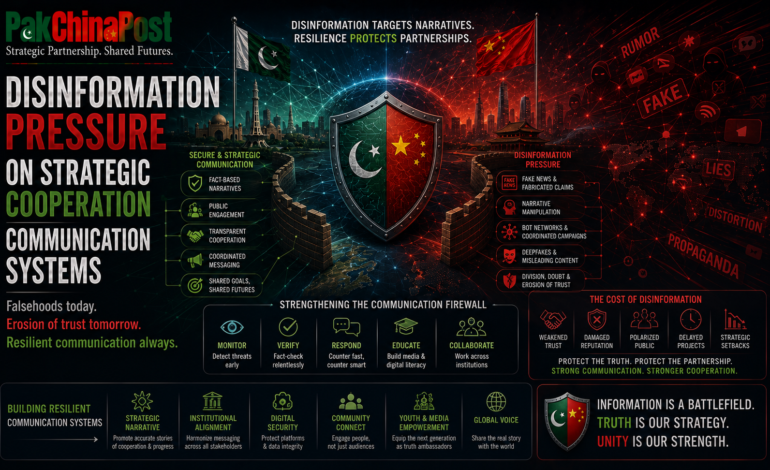
At the same time, a parallel challenge has emerged in the form of information disorder. Large scale bilateral initiatives increasingly attract speculative narratives, selective interpretation, and in some cases coordinated misinformation. These narratives often exploit the gap between technical complexity and public understanding. When official communication is limited to episodic announcements without sustained explanatory frameworks, informational vacuums emerge. These vacuums are rapidly filled by fragmented interpretations that circulate widely in digital spaces, shaping perceptions before corrective or contextual information can be absorbed.
This does not imply a binary between accurate and inaccurate information. Rather, it reflects a more subtle contest over interpretive authority. Competing narratives do not necessarily deny the existence of cooperation, but they reframe its meaning, significance, and impact. In the absence of structured public communication systems, interpretive framing becomes decentralized and unpredictable, leading to a diffusion of understanding that lacks coherence.
Educational institutions have not yet fully responded to this challenge. While academic programmes on international relations and regional studies exist, they often remain detached from technical, economic, and technological literacy. Students may learn about strategic cooperation in abstract terms without developing the conceptual tools necessary to understand industrial models, financing structures, or technology transfer mechanisms. This disconnect limits the formation of a knowledgeable intermediary class capable of translating complex bilateral processes into accessible public understanding.
Media training institutions face a similar constraint. Journalism education has not fully adapted to the informational demands of contemporary strategic reporting. Economic agreements, technological collaboration frameworks, and regulatory harmonisation processes require specialized interpretive skills that are not widely embedded in newsroom culture. Consequently, reporting tends to rely on official summaries and visual representation rather than independent analytical reconstruction.
Cultural institutions, which could serve as vital bridges between state level cooperation and societal understanding, remain underutilized in this context. Cultural diplomacy often takes the form of ceremonial exchange rather than sustained narrative construction. Language learning, historical contextualisation, and long term educational collaboration have not yet evolved into widespread societal mechanisms for mutual understanding. As a result, cultural engagement remains episodic rather than structural.
The cumulative effect of these limitations is a public discourse that is heavily skewed toward symbolic representation. Pakistan China cooperation is widely recognized, frequently referenced, and politically prominent, yet not deeply understood. Recognition without comprehension produces a fragile informational foundation, where public opinion is susceptible to simplification, distortion, and episodic fluctuation.
In contemporary information environments, such fragility carries strategic implications. Public understanding is not merely a domestic concern but a component of broader narrative stability. Infrastructure projects, technological cooperation, and economic initiatives operate within global information ecosystems where perception influences credibility, investment confidence, and diplomatic interpretation. When domestic understanding remains shallow, external narratives gain disproportionate influence in shaping international perception.
Addressing this perception gap requires a structural rethinking of communication architecture. The first requirement is a shift from event centered communication to process centered communication. Rather than treating each bilateral development as a discrete announcement, communication systems must situate developments within longer trajectories of policy evolution, institutional reform, and technological integration. This requires consistent publication of explanatory material that translates technical processes into accessible language without sacrificing analytical depth.
The second requirement is the development of interdisciplinary knowledge platforms. Universities, research institutes, and policy centres must collaborate to produce integrated interpretations of Pakistan China cooperation that combine economics, engineering, governance, and social analysis. These platforms should not function solely as academic repositories but as active public knowledge generators, capable of informing media, policy makers, and civil society simultaneously.
The third requirement is the professionalisation of strategic communication within media institutions. Specialized training in economic journalism, science communication, and policy analysis must become central to newsroom capacity building. Without such specialization, media coverage will continue to rely on superficial reporting structures that fail to capture the complexity of modern bilateral cooperation.
The fourth requirement involves the creation of structured digital knowledge systems. Instead of relying exclusively on fragmented social media dissemination, there is a need for centralized, verified, and continuously updated informational repositories. These systems should provide clear explanations of projects, institutional frameworks, timelines, and outcomes, allowing citizens and professionals alike to access reliable interpretive resources.
The fifth requirement is the cultivation of bilingual interpretive capacity. Communication between technical institutions and the public is often hindered by linguistic and conceptual distance. Developing a cadre of professionals capable of translating between technical, bureaucratic, and public language registers is essential for reducing misunderstanding and enhancing clarity.
Finally, there is a need for sustained public literacy initiatives focused on international cooperation. These initiatives should extend beyond elite policy circles and engage students, journalists, and civil society actors in structured learning about the mechanics of economic partnerships, technological collaboration, and institutional coordination. Such efforts would gradually transform public perception from episodic awareness to structural understanding.
The challenge of perception in Pakistan China cooperation is not a peripheral issue. It is central to the sustainability of the partnership in its evolving form. Material cooperation can advance rapidly, but societal understanding develops slowly. Without alignment between operational reality and public cognition, even successful cooperation risks being underappreciated, misunderstood, or misrepresented.
What is at stake is not simply communication efficiency but cognitive alignment between state level strategy and societal interpretation. A partnership of such scale and complexity cannot rely solely on visibility. It requires interpretive depth, institutional mediation, and sustained explanatory effort. Only then can public understanding evolve from surface recognition to informed comprehension, ensuring that the narrative environment reflects the substantive reality of cooperation rather than its simplified representation.
A Public Service Message