Corridors Under Strain: China’s Mediation, Pakistan–Afghanistan Tensions, and the Fragility of Regional Geo-Economic Integration


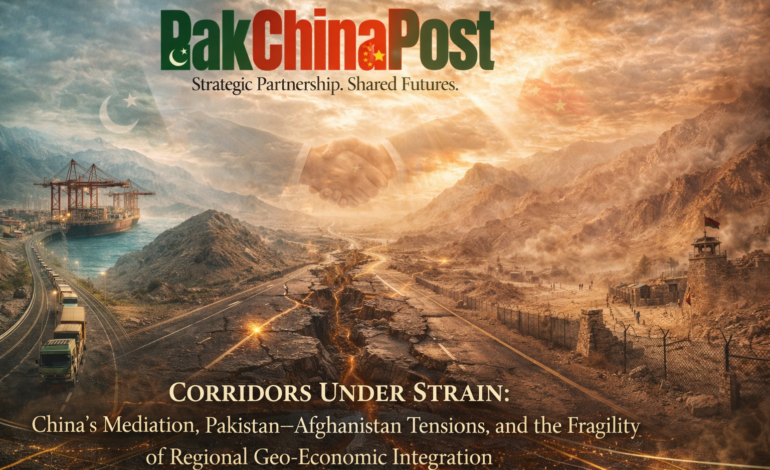
The contemporary architecture of global connectivity rests upon an intricate fusion of infrastructure, political stability, and strategic foresight. Nowhere is this fusion more fragile than along the fault line connecting Pakistan and Afghanistan, where persistent instability threatens not merely bilateral relations but the viability of a broader geo-economic vision that extends across Asia. At the center of this evolving landscape stands China, whose intensifying mediation efforts reveal a deeper strategic concern: the preservation of continental connectivity in the face of enduring insecurity. This is not a localized crisis. It is a systemic stress test for the very idea of transregional integration.
The notion of connectivity has, over the past decade, moved from aspirational rhetoric to material reality. Trade corridors, energy routes, and logistical networks have redefined how regions interact, creating new patterns of interdependence. Yet these systems remain acutely vulnerable to disruption at critical nodes. The Pakistan-Afghanistan frontier represents one such node, a geographic and strategic hinge upon which multiple corridors converge. Its instability introduces friction into the smooth functioning of networks that were designed to transcend precisely such barriers.
At the heart of this vulnerability lies the persistence of insecurity. Cross-border militancy, contested governance, and the absence of a stable political compact within Afghanistan have combined to produce an environment of chronic uncertainty. For infrastructure-driven initiatives, this uncertainty translates into tangible costs. Trade routes become unreliable, transit times unpredictable, and logistical planning fraught with risk. Insurance premiums rise, financing becomes more expensive, and investors adopt a cautious, if not altogether risk-averse, posture. The economic calculus shifts, often decisively, against engagement.
This dynamic is particularly consequential for projects linked to China’s broader connectivity ambitions. The vision of linking East Asia with Central Asia, the Middle East, and Europe through a network of corridors is predicated on the assumption of relative stability along transit routes. Pakistan occupies a central position within this framework, serving as a gateway that connects inland regions to maritime outlets. However, the functionality of this gateway is inextricably linked to its hinterland. Instability in Afghanistan disrupts not only immediate cross-border trade but also the broader logic of westward expansion.
China’s mediation efforts must therefore be understood within this geo-economic context. While framed in diplomatic terms, they are fundamentally driven by the imperative to safeguard strategic investments and ensure the continuity of trade flows. The engagement led by Wang Yi and supported by sustained envoy-level diplomacy reflects a recognition that economic integration cannot proceed in the absence of security. Mediation, in this sense, becomes an instrument of economic statecraft, a means of stabilizing the conditions necessary for long-term connectivity.
The economic cost of insecurity along the Pakistan-Afghanistan frontier extends beyond immediate disruptions. It introduces a structural inefficiency into regional trade. Border closures, whether due to security incidents or political disagreements, interrupt the flow of goods, affecting supply chains that depend on predictability. Informal trade networks, which often serve as a buffer in such environments, are themselves constrained by heightened surveillance and regulatory pressures. The cumulative effect is a contraction of economic activity, with implications for livelihoods, revenue generation, and regional integration.
Pakistan’s policy of conditional engagement with Afghan authorities adds another layer of complexity. While rooted in legitimate security concerns, this stance has implications for trade normalization. The absence of sustained diplomatic engagement limits the scope for institutional mechanisms that facilitate commerce, such as customs harmonization, transit agreements, and dispute resolution frameworks. In such a context, economic interaction becomes contingent and episodic, undermining the stability required for long-term planning.
For Afghanistan, the challenge is even more profound. The country’s geographic position offers the potential to serve as a bridge between regions, a conduit through which goods, energy, and ideas can flow. Yet this potential remains unrealized due to internal instability and limited institutional capacity. Without a stable governance framework, Afghanistan cannot effectively perform the functions required of a transit state. Infrastructure projects remain incomplete or underutilized, and the country’s role in regional connectivity remains aspirational rather than actual.
The implications of this situation are not confined to land-based trade. They extend into the domain of energy, where the interdependence between regions is even more pronounced. The proximity of the Pakistan-Afghanistan corridor to the energy-rich Gulf region introduces a critical dimension to the geo-economic analysis. The Strait of Hormuz, through which a significant proportion of global oil supplies transit, represents a parallel chokepoint whose stability is closely linked to regional dynamics. Tensions involving Iran and external powers have periodically raised the specter of disruption, with immediate implications for global energy markets.
The intersection of land-based instability and maritime vulnerability creates a compounded risk for energy-dependent economies. Fluctuations in oil prices, driven by geopolitical tensions, have a direct impact on the cost structures of economies reliant on imports. For countries in South and Southeast Asia, this translates into inflationary pressures, fiscal strain, and potential disruptions to industrial activity. The Pakistan-Afghanistan corridor, while not an energy route in the traditional sense, plays a role in the broader ecosystem of connectivity that supports energy distribution and trade.
China’s geo-economic calculus must therefore account for both dimensions. Ensuring the stability of land corridors is only part of the equation; maintaining access to maritime routes and managing the risks associated with energy supply chains are equally critical. This dual focus underscores the complexity of contemporary economic statecraft, where multiple domains intersect and influence one another.
The potential for regional instability to trigger a reconfiguration of trade alignments is a development that warrants careful consideration. If the Pakistan-Afghanistan corridor remains unreliable, economic actors will seek alternatives. This could lead to the diversion of trade routes, the development of new corridors, and a recalibration of partnerships. Such shifts are not merely logistical; they have strategic implications, influencing patterns of dependency, influence, and alignment.
Alternative routes, whether through Central Asia, maritime channels, or other regional configurations, come with their own sets of challenges and costs. However, the very exploration of these alternatives reflects a loss of confidence in existing frameworks. For China, this represents a potential dilution of its connectivity vision, as the coherence of its network depends on the integration of multiple corridors. Fragmentation, even if partial, undermines the efficiency and strategic value of the system.
For international diplomats and policymakers, the situation presents both a challenge and an opportunity. The challenge lies in managing a complex interplay of security and economic factors, where actions in one domain have cascading effects in another. The opportunity lies in the potential to develop more resilient and adaptive frameworks for cooperation. This requires a shift from reactive crisis management to proactive strategic planning, with an emphasis on risk mitigation and long-term sustainability.
One area that merits particular attention is the development of institutional mechanisms that can withstand periods of instability. This includes frameworks for dispute resolution, coordination of border management, and the facilitation of trade even under constrained conditions. Such mechanisms cannot eliminate risk, but they can reduce its impact, providing a degree of continuity in otherwise volatile environments.
Another critical dimension is the role of multilateral engagement. While bilateral relations remain central, the complexity of the challenges involved necessitates a broader approach. Regional organizations and international institutions can play a role in providing platforms for dialogue, coordinating responses, and mobilizing resources. The involvement of multiple stakeholders can also enhance legitimacy and distribute the burden of responsibility.
The role of Iran in this context introduces an additional layer of strategic complexity. As a key actor in regional energy dynamics and a state situated at the crossroads of multiple corridors, Iran’s policies and relationships influence the broader geo-economic environment. Fluctuations in its engagement with global markets, driven by sanctions or diplomatic developments, have direct implications for energy prices and supply chains. For countries seeking to diversify routes and reduce dependency on single chokepoints, Iran represents both an opportunity and a challenge.
Energy crises, whether triggered by geopolitical tensions or structural imbalances, have a way of amplifying existing vulnerabilities. The interplay between energy markets and connectivity frameworks creates a feedback loop in which disruptions in one domain exacerbate challenges in another. For instance, rising oil prices increase transportation costs, which in turn affect the viability of trade routes. Conversely, disruptions in trade can affect the distribution of energy resources, creating localized shortages and price spikes.
In this interconnected environment, the concept of resilience becomes central. Resilience is not merely the ability to absorb shocks but the capacity to adapt and transform in response to changing conditions. For the Pakistan-Afghanistan corridor, this implies a need for strategies that go beyond immediate stabilization. It requires a rethinking of how connectivity is designed, implemented, and managed, with an emphasis on flexibility and redundancy.
China’s mediation efforts can be seen as part of this broader endeavor. By seeking to stabilize the immediate environment, Beijing is attempting to create the conditions for longer-term resilience. However, the success of this approach depends on the extent to which it is complemented by structural reforms and sustained engagement. Mediation alone cannot address the underlying drivers of instability; it must be part of a comprehensive strategy that integrates security, economic, and political dimensions.
For Pakistan, the challenge is to balance security imperatives with economic objectives. Ensuring internal stability and addressing cross-border threats are essential, but so too is the need to maintain the flow of trade and investment. This requires a nuanced approach that recognizes the interdependence of these goals. For Afghanistan, the imperative is to build the institutional capacity necessary to function as a reliable partner in regional integration. Without this, the country risks remaining on the periphery of the very networks that could drive its development.
The broader implications for regional order are significant. The success or failure of connectivity initiatives in this corridor will influence perceptions of feasibility and reliability across the region. It will shape decisions by investors, policymakers, and external actors, affecting the trajectory of integration efforts. In this sense, the Pakistan-Afghanistan frontier is not merely a local issue; it is a litmus test for the viability of a larger geo-economic vision.
Ultimately, the strain on corridors is a reflection of deeper structural tensions within the regional system. Addressing these tensions requires a holistic approach that integrates diplomacy, security, and economic planning. It demands a recognition that connectivity is not an end in itself but a means to achieve broader objectives of stability and prosperity. For international diplomats, the task is to navigate this complexity with a clear understanding of both the risks and the opportunities, crafting strategies that are both pragmatic and forward-looking.
The future of regional geo-economic integration will depend on the ability of states to manage these challenges collectively. The interplay between China’s mediation efforts, Pakistan’s security concerns, Afghanistan’s internal dynamics, and the broader energy landscape will shape the contours of this future. In a world where interdependence is both a source of strength and vulnerability, the stakes could not be higher.
A Public Service Message