Strategic De-Risking and Industrial Sovereignty: China’s Position in an Era of European Supply Chain Recalibration

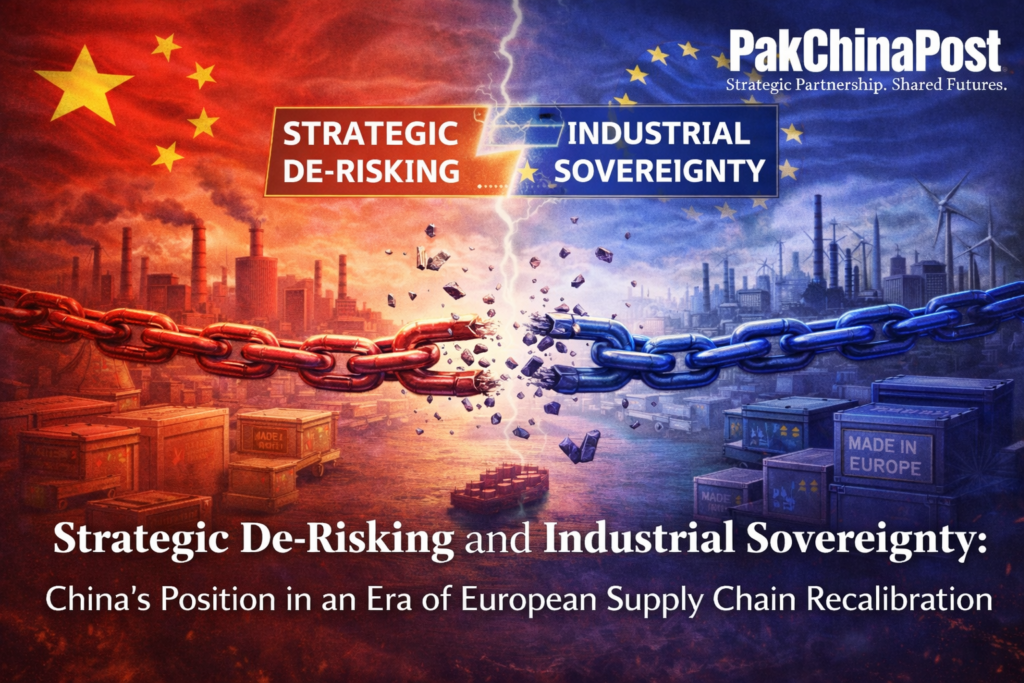
The evolving discourse of “de-risking” within the European Union represents a pivotal inflection point in China–EU economic relations. Unlike the rhetoric of comprehensive decoupling, which implies systemic disengagement, de-risking articulates a more selective and strategically calibrated approach: reducing excessive dependencies in critical sectors while maintaining broader economic engagement. For Chinese policymakers and diplomats, this paradigm shift requires careful interpretation. It is not a wholesale repudiation of interdependence, but it signals a reconfiguration of the terms under which interdependence will persist. Understanding its strategic implications particularly in rare earths, electric vehicle (EV) components, batteries, and advanced technologies is essential for safeguarding China’s industrial planning, technological security, and global supply chain leadership.
The European Union’s recalibration emerged against a backdrop of geopolitical volatility, pandemic-induced supply disruptions, and intensifying systemic competition narratives. The COVID-19 crisis exposed vulnerabilities in global value chains, while tensions between major powers amplified concerns about strategic autonomy. Within this environment, Brussels began emphasizing resilience, diversification, and “open strategic autonomy” as guiding principles. China’s centrality in numerous supply chains particularly in upstream processing and midstream manufacturing became a focal point of European policy reassessment.
Rare earth elements (REEs) epitomize this dynamic. China accounts for a dominant share of global rare earth mining and an even greater proportion of processing and refining capacity. These materials are indispensable for wind turbines, EV motors, advanced electronics, and defense technologies. European policymakers perceive concentrated reliance on a single supplier as a structural vulnerability. Consequently, the EU has introduced the Critical Raw Materials Act, aiming to diversify sourcing, expand domestic extraction and processing, and build strategic reserves.
From China’s perspective, rare earth dominance has been both an economic advantage and a source of geopolitical sensitivity. The concentration of processing capabilities reflects decades of industrial policy, environmental trade-offs, and infrastructure investment. European de-risking initiatives could gradually erode market share if alternative suppliers in Australia, Africa, or Latin America receive sustained investment and technological support. However, replacing China’s integrated processing ecosystem will require significant time and capital. The path toward diversification is complex, constrained by environmental permitting, cost structures, and technical expertise.
Electric vehicle supply chains represent another critical arena. China has developed a comprehensive EV ecosystem encompassing battery cell manufacturing, cathode and anode materials, lithium refining, and vehicle assembly. Chinese firms have achieved cost competitiveness through economies of scale and vertical integration. As European decarbonization targets accelerate, Chinese EV exports to Europe have surged, raising concerns among European manufacturers regarding market displacement and subsidy distortions.
The European Commission’s anti-subsidy investigations into Chinese EV imports reflect this tension. While framed as a defense of fair competition, such measures also serve the strategic objective of nurturing domestic EV production capacity. European initiatives to localize battery manufacturing through alliances such as the European Battery Alliance signal an ambition to reduce reliance on Chinese inputs.
For China’s industrial planning, these developments necessitate strategic adaptation. The traditional model of export-led scale expansion into European markets may encounter tariff barriers, local content requirements, and enhanced regulatory scrutiny. To mitigate these risks, Chinese firms have increasingly pursued localized production within Europe, establishing battery plants and assembly facilities in member states receptive to foreign investment. This strategy transforms export dependence into embedded participation within the European industrial fabric, reducing political friction and aligning with EU employment objectives.
Technological security strategies also require recalibration. De-risking discourse extends beyond physical goods to encompass advanced technologies such as semiconductors, telecommunications equipment, and digital infrastructure. European screening of Chinese technology investments and restrictions on 5G vendors illustrate the convergence of economic and security considerations. While Europe’s approach is less confrontational than some other jurisdictions, it reflects a precautionary logic that prioritizes resilience over pure cost efficiency.
China’s potential policy responses must be multidimensional. Industrial diplomacy represents a primary instrument. By engaging European stakeholders governments, industry associations, and research institutions China can emphasize mutual benefits, transparency, and compliance with international standards. Structured dialogues on critical raw materials, green transition cooperation, and digital governance can mitigate misperceptions and prevent regulatory escalation.
Strategic stockpiling constitutes another avenue. By maintaining reserves of critical materials and components, China can buffer against temporary trade disruptions while signaling supply reliability. However, stockpiling must be managed prudently to avoid market distortions or perceptions of coercive leverage.
Export diversification remains essential. Expanding market access in Southeast Asia, the Middle East, Africa, and Latin America reduces concentration risk. Yet diversification should not imply abandonment of European markets. The EU remains technologically sophisticated and normatively influential. Continued engagement ensures that Chinese firms remain integrated into global standard-setting processes.
International partnerships further enhance resilience. Joint ventures with non-European resource producers, participation in multilateral development financing for mining infrastructure, and technological cooperation in recycling and circular economy initiatives can reinforce China’s position in upstream and downstream segments. By contributing to sustainable extraction and processing practices globally, China can counter narratives that frame its dominance as purely exploitative.
At the domestic level, innovation upgrading is indispensable. Maintaining leadership in battery chemistry, rare earth substitution research, and next-generation energy storage technologies reduces vulnerability to external restrictions. If Chinese firms remain at the technological frontier, European diversification efforts may reduce volume dependence without eliminating structural interdependence.
Risk assessment must also account for reputational dimensions. European public opinion increasingly influences regulatory decisions. Allegations of environmental harm, labor concerns, or opaque subsidies can catalyze restrictive policies. Enhancing corporate social responsibility standards, environmental compliance transparency, and ESG reporting can mitigate these vulnerabilities.
Forward-looking scenarios suggest several trajectories. In a cooperative scenario, de-risking stabilizes at moderate diversification levels, preserving high trade volumes while reducing extreme concentration. In a competitive escalation scenario, anti-subsidy measures expand, investment screening intensifies, and strategic goods face higher trade barriers. In a fragmentation scenario, geopolitical crises accelerate regulatory bifurcation, compelling firms to choose between regulatory blocs.
China’s optimal strategy lies in shaping the first scenario. This requires restraint in policy signaling, avoidance of retaliatory escalation, and constructive participation in European resilience initiatives where interests align—particularly in green energy, climate adaptation, and sustainable infrastructure.
Safeguarding global strategic sector leadership necessitates balancing leverage with predictability. Overreliance on dominance as bargaining power risks accelerating substitution efforts. Conversely, presenting China as a stable, rules-based supplier enhances trust and long-term market access.
Opportunities persist despite de-risking pressures. Europe’s decarbonization timeline creates sustained demand for affordable renewable technologies. China’s scale efficiencies can support Europe’s climate goals, reinforcing practical cooperation even amid political rhetoric. Moreover, collaborative research in battery recycling, hydrogen technology, and grid modernization offers avenues for shared innovation.
In conclusion, the EU’s de-risking strategy does not signal the end of China Europe economic interdependence, but rather its recalibration. For China, the strategic imperative is not defensive retrenchment but adaptive modernization. By combining industrial diplomacy, technological upgrading, diversified partnerships, and reputational stewardship, China can mitigate geopolitical vulnerabilities while consolidating its role as an indispensable actor in global strategic sectors. The era of unqualified dependency may be evolving, but managed interdependenceanchored in resilience and reciprocity—remains both achievable and desirable.
A Public Service Message