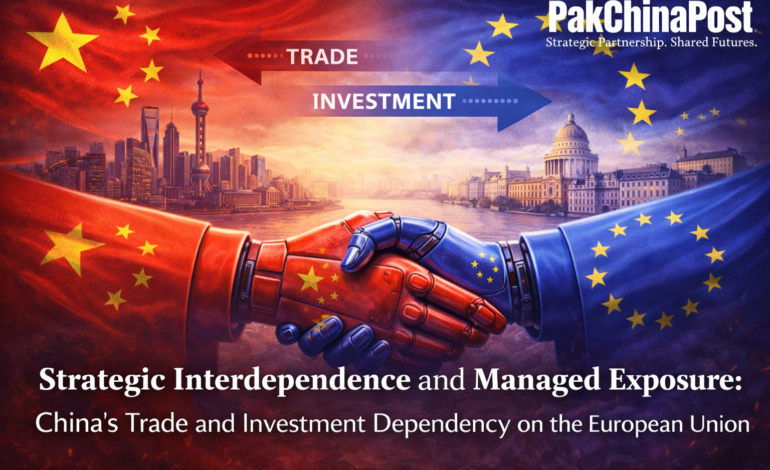
Strategic Interdependence and Managed Exposure: China’s Trade and Investment Dependency on the European Union


The economic relationship between the People’s Republic of China and the European Union constitutes one of the most structurally significant axes in the contemporary global trading system. As two of the world’s largest economic entities, their interdependence transcends conventional bilateral exchange and operates as a systemic stabilizer and potential fault line within the broader architecture of global production, finance, and regulatory governance. For diplomats engaged in the stewardship of bilateral relations, an assessment of China’s trade and investment dependency on the European Union demands neither alarmist rhetoric nor complacent optimism, but rather a calibrated, evidence-based evaluation of strategic exposure, structural leverage, and adaptive resilience.
The European Union, as a single market comprising over 440 million consumers, represents one of China’s most consequential export destinations. In recent years, bilateral trade in goods has regularly surpassed €800 billion annually, positioning China as either the EU’s largest or second-largest trading partner, depending on the year and metric applied. For China, the EU consistently ranks among its top export markets, alongside the United States and ASEAN. This high-volume exchange is not merely quantitative; it is qualitatively embedded in high-value sectors, including machinery, electronics, chemicals, automotive components, and increasingly green technologies.
China’s export strategy toward Europe has historically been predicated on scale efficiency, competitive manufacturing costs, and integration into European-centered value chains. Over time, however, this model has evolved. As domestic wages increased and technological upgrading accelerated under initiatives such as “Made in China 2025,” Chinese exports to the EU have shifted from primarily low-cost consumer goods toward capital goods, intermediate inputs, and sophisticated industrial equipment. Electric vehicles (EVs), battery systems, solar panels, and telecommunications equipment now constitute prominent components of the trade structure.
This evolution, while enhancing value-added capacity, simultaneously intensifies exposure to European regulatory frameworks. The EU’s internal market is characterized by stringent standards in environmental compliance, data protection, competition law, and state aid regulation. Chinese firms seeking sustained access must therefore align production and governance practices with European norms. Market integration thus shapes not only export composition but also corporate behavior and strategic planning within Chinese enterprises. Compliance is no longer a peripheral operational matter; it has become a determinant of market continuity.
Foreign direct investment (FDI) flows further illuminate the strategic implications of dependency. In the mid-2010s, Chinese outward FDI into Europe surged, targeting advanced manufacturing, robotics, energy infrastructure, ports, and technology firms. Acquisitions such as German robotics manufacturers and stakes in Southern European ports reflected a deliberate strategy of embedding within European industrial ecosystems. However, heightened EU scrutiny under investment screening mechanisms especially following the introduction of the EU FDI Screening Regulation has moderated these flows. Investment volumes declined, and regulatory review intensified, particularly in sectors deemed strategic or sensitive.
This shift reveals a structural asymmetry. While China remains reliant on the EU market for high-value exports, European policymakers increasingly conceptualize economic engagement through a dual lens: partnership and systemic rivalry. The European Commission’s articulation of China as a “partner, competitor, and systemic rival” encapsulates this ambivalence. Consequently, the political economy of trade is no longer insulated from geopolitical calculation.
Supply chain positioning constitutes another dimension of dependency. Chinese firms occupy critical nodes in global manufacturing networks that serve European industry. For example, European automotive production depends significantly on Chinese-supplied battery cells and rare earth processing. Conversely, Chinese manufacturers rely on European demand and, in certain cases, specialized European machinery and precision components. This mutual embeddedness generates resilience through diversification but also vulnerability through concentration.
The prospect of decoupling whether partial or selective must therefore be assessed with analytical precision. A full-scale economic decoupling between China and the EU remains improbable in the near term due to prohibitive economic costs. However, sectoral decoupling, particularly in strategic goods such as semiconductors, advanced materials, and digital infrastructure, is already observable in policy discourse and regulatory initiatives. The EU’s “de-risking” narrative reflects an intent to reduce critical dependencies without pursuing comprehensive disengagement.
For China, the risks of accelerated decoupling include export contraction in high-value sectors, reduced technology transfer opportunities, reputational erosion in European public opinion, and capital market fragmentation. European anti-subsidy investigations into Chinese EVs illustrate the sensitivity of industrial competition. Should tariffs or countervailing duties escalate, Chinese manufacturers may face margin compression and strategic recalibration in their European operations.
Yet interdependence also presents opportunities. The EU’s green transition agenda, anchored in the European Green Deal, necessitates large-scale deployment of renewable energy technologies, electric mobility, and energy storage solutions areas in which China holds substantial production capacity and cost advantages. Rather than perceiving regulatory scrutiny as purely adversarial, Chinese policymakers may interpret it as an impetus for compliance-driven innovation, enhancing product quality and environmental performance.
Policy leverage instruments operate on both sides. The EU wields regulatory authority, trade defense instruments, and market access conditions. China, in turn, possesses leverage through its manufacturing dominance in specific inputs, consumer market scale attractive to European exporters, and potential for investment reciprocity. Diplomatic prudence requires that leverage be exercised judiciously; overt coercion risks accelerating decoupling, whereas calibrated engagement can reinforce mutual dependency.
Sector-specific case studies underscore the complexity of this landscape. In the automotive sector, Chinese EV exports to Europe have expanded rapidly, challenging incumbent European manufacturers. However, European firms such as Volkswagen, BMW, and Mercedes-Benz remain deeply invested in the Chinese domestic market. This reciprocal exposure moderates extreme policy measures on both sides. Similarly, in renewable energy, Europe’s reliance on Chinese solar modules coexists with efforts to rebuild domestic manufacturing capacity.
The financial dimension further complicates dependency analysis. The euro-denominated trade settlement mechanisms, access to European capital markets, and cross-border banking relationships embed China within European financial circuits. While not as central as the U.S. dollar system, European financial institutions play a non-negligible role in trade finance and investment structuring. Regulatory divergence or sanctions regimes could disrupt these channels.
Maintaining interdependence requires strategic diversification without abrupt disengagement. China’s parallel expansion of trade relations with ASEAN, the Middle East, Africa, and Latin America reduces overconcentration risk. However, diversification should complement rather than substitute engagement with Europe. The EU remains a high-income, technologically advanced market whose standards influence global norms. Continued presence within this market enhances China’s capacity to shape international regulatory conversations.
Actionable recommendations for sustaining economic resilience emerge from this analysis. First, China should deepen sectoral dialogue mechanisms with EU institutions to anticipate regulatory changes and align industrial standards proactively. Early engagement reduces compliance shocks and demonstrates responsible stakeholder behavior.
Second, Chinese enterprises operating in Europe should enhance transparency in subsidy structures, corporate governance, and environmental compliance. Perceived opacity fuels political suspicion; transparency mitigates reputational risk.
Third, supply chain resilience must be strengthened through geographic diversification of critical production stages, including joint ventures within EU territory where commercially viable. Localized manufacturing can alleviate political resistance and integrate Chinese firms more deeply into European employment structures.
Fourth, financial hedging strategies including currency diversification and expanded use of renminbi settlement where acceptable can reduce vulnerability to potential financial fragmentation.
Fifth, China should invest in normative diplomacy participation in standard-setting bodies, climate governance forums, and digital regulation dialogues—to ensure that regulatory evolution does not systematically disadvantage Chinese firms.
Finally, strategic patience is essential. Geopolitical tensions are cyclical, but structural economic complementarities persist. Overreaction to episodic disputes may precipitate unnecessary escalation. A disciplined approach that balances sovereignty, reciprocity, and pragmatic cooperation will better serve long-term national interests.
In conclusion, China’s trade and investment dependency on the European Union is neither a unilateral vulnerability nor an unconditional advantage. It is a managed exposure embedded within a complex matrix of market integration, regulatory power, technological competition, and geopolitical signaling. For diplomats entrusted with preserving bilateral stability, the objective should not be the elimination of dependency but its intelligent governance. Interdependence, when structured with foresight and adaptive resilience, can function as both an economic engine and a stabilizing anchor amid an increasingly fragmented international order.
A Public Service Message