Pakistan’s Strategic Alignments in South and Central Asia

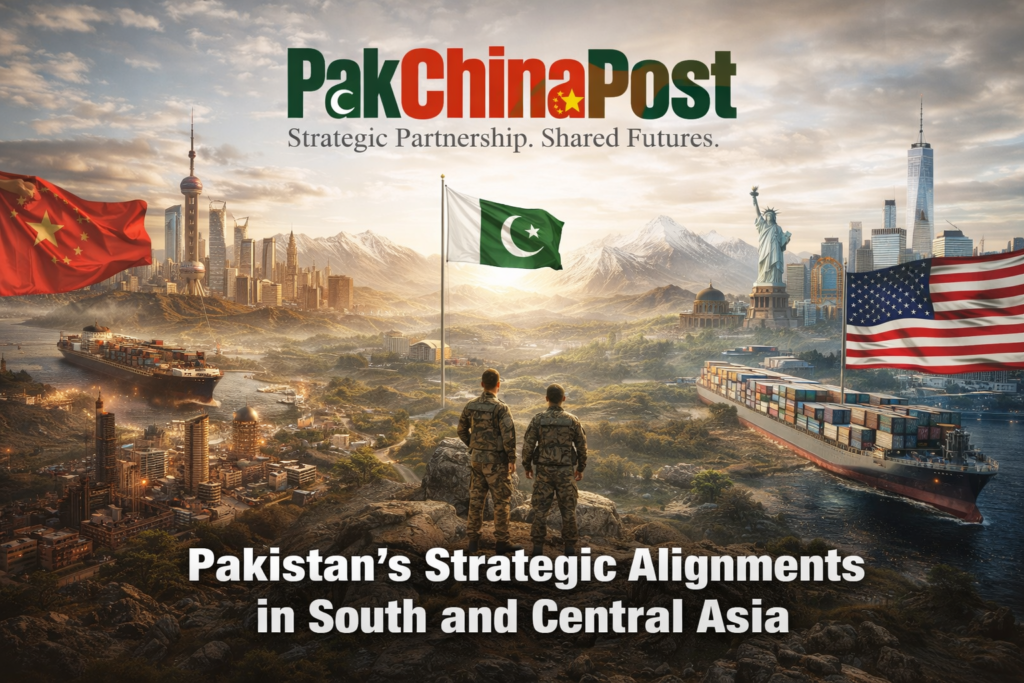
Pakistan occupies a uniquely sensitive position at the crossroads of South and Central Asia, where the tectonics of regional and global power converge. The country’s strategic posture is shaped by its immediate security environment, long-term relationships with China and the United States, the subtle yet consequential influence of Russia, and its persistent efforts to assert autonomy in a multipolar world. Its policy choices are informed not by ideological rigidity but by pragmatic considerations, historical experience, and the necessity to navigate a complex and often volatile neighborhood. Pakistan’s relationship with China has matured into a strategic partnership that extends beyond conventional diplomacy. China has evolved into the primary architect of Pakistan’s long-term defense modernization, providing not only advanced military equipment but also co-production opportunities that strengthen Pakistan’s defense industrial base. Joint exercises conducted between the two militaries, especially in the air force and army domains, serve both operational and signaling purposes, enhancing interoperability while conveying strategic resolve. Beyond exercises and production linkages, China provides technological support in areas such as missile systems, naval platforms, and sophisticated command and control infrastructure, establishing a resilient framework that shields Pakistan from vulnerabilities inherent in dependency on Western suppliers. Pakistan’s security establishment regards this relationship as an anchor that provides predictability and mutual political backing in contentious international arenas, particularly where issues of territorial sovereignty and regional conflicts intersect with global scrutiny. This strategic depth is complemented by Pakistan’s adaptive engagement with the United States. Though the partnership has fluctuated due to shifting US priorities and changing administrations, the United States continues to serve as a source of military training, intelligence exchange, and institutional knowledge. Participation in joint exercises, officer training programs, and intelligence cooperation, though calibrated to avoid over-dependence, allows Pakistan to maintain operational standards and sustain visibility within broader global security networks. This dual approach enables Pakistan to hedge against uncertainties: it can extract tangible benefits from Washington without relinquishing strategic autonomy, while deriving long-term technological and industrial leverage from Beijing. The competing pressures of US-China rivalry are ever-present, and Pakistan’s calculus reflects a careful awareness of these global currents. The United States, focused on countering China’s influence and safeguarding its own strategic interests in the Indo-Pacific, presents both opportunities and constraints. While Islamabad benefits from intelligence cooperation and military engagement, it must navigate an environment where Washington’s policies fluctuate based on global calculations rather than local stability imperatives. At the same time, China’s rise as a global power provides Pakistan with an alternative axis of security and technological support, which mitigates risks from Western policy reversals. Russia’s growing influence in Eurasia further complicates this strategic environment. Historically a distant partner due to Cold War alignments and India’s close defense ties with Moscow, Russia has begun to engage Pakistan cautiously, signaling an interest in broader regional stability and multipolar security frameworks. Joint exercises, though limited, demonstrate confidence-building measures and suggest that Pakistan’s strategic space is expanding to include multiple great powers beyond the traditional US-China axis. Russia’s deepening relationship with India requires Pakistan to exercise nuanced diplomacy, balancing its own security imperatives with the broader contours of Eurasian power dynamics. The military diplomacy that Pakistan pursues is reflective of a deliberate and sophisticated strategy. Engagements through training, exchange programs, multilateral exercises, and strategic dialogues are designed to generate influence, sustain professional competence, and signal strategic intent without overcommitting to any single power. This approach allows Pakistan to maintain operational readiness, project diplomatic flexibility, and preserve avenues for mediation or collaboration in regional security matters. Beyond great-power considerations, Pakistan’s strategic calculations are fundamentally shaped by immediate regional threats. The adversarial relationship with India remains a central driver of military preparedness, particularly in the context of India’s evolving defense modernization and growing alignment with the United States. Maintaining credible deterrence, investing in asymmetric capabilities, and sustaining nuclear modernization are core elements of Islamabad’s approach to securing national interests. Simultaneously, instability along Pakistan’s western frontier, with the Afghan theater shaped by shifting Taliban governance, insurgent activity, and cross-border militancy, compels Pakistan to balance counterterrorism imperatives with border management strategies. These challenges are compounded by the broader geopolitical environment, where developments in Central Asia, including energy corridors and regional integration efforts, intersect with Pakistan’s national interests. Pakistan’s strategic posture is thus anchored in the principle of autonomy within interdependence. The country has consistently demonstrated an ability to extract strategic value from multiple partners without succumbing to dependency or aligning rigidly with a single bloc. This autonomy is reinforced by careful messaging, calibrated engagements, and selective partnerships, allowing Islamabad to hedge against risks arising from sudden geopolitical shifts. By preserving flexibility, Pakistan can pursue national interests, mediate regional tensions, and contribute to stability while simultaneously reinforcing its own security architecture. The implications of this multipolar engagement extend beyond immediate bilateral relationships. Pakistan’s hedging strategy exemplifies how middle powers can assert agency amidst the pressures of great-power competition, maintaining relevance while avoiding entanglement in conflicts that are not aligned with national priorities. Its relationships with China, the United States, and Russia collectively demonstrate that strategic leverage derives not solely from military capability but from diplomacy, institutional engagement, and the capacity to operate within multiple frameworks simultaneously. In conclusion, Pakistan’s strategic alignments in South and Central Asia reflect a sophisticated balancing act informed by history, contemporary security needs, and an evolving multipolar global order. The deep partnership with China provides stability, technological support, and political backing, while adaptive engagement with the United States sustains operational capacity and global connectivity. Russia’s cautious engagement expands strategic options, while the immediate imperatives of managing India and Afghanistan ensure that Pakistan’s security calculus remains grounded in regional realities. Through careful hedging, calibrated diplomacy, and institutionalized military cooperation, Pakistan demonstrates that a middle power can maintain autonomy, influence regional dynamics, and navigate the complex interplay of great-power rivalry without sacrificing core national interests. The country’s approach underscores the importance of flexibility, strategic foresight, and the integration of multiple diplomatic and military vectors as essential components of contemporary statecraft in one of the world’s most contested regions. Pakistan’s ability to sustain this delicate balance, manage risk, and leverage partnerships reflects a nuanced understanding of power, geography, and the imperatives of sovereignty, positioning the country as a key actor in shaping the security architecture of South and Central Asia for the foreseeable future.
A Public Service Message