Seeding Innovation Beyond Borders: China’s 5G and 6G Vision in Pakistan’s Technological Ecosystem

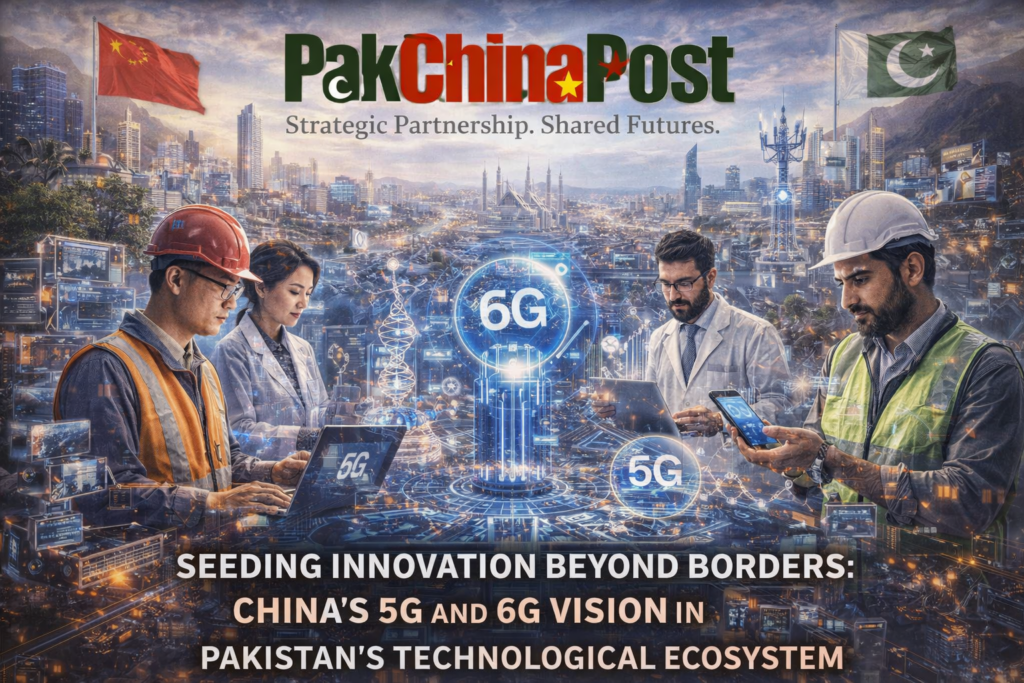
In the twenty-first century, the global race for technological leadership is no longer contained within laboratories or boardrooms. It unfolds across borders, in classrooms, innovation parks, and industrial corridors where ideas, talent, and investment converge. China has emerged as a central actor in this unfolding narrative, exporting not only technology but a philosophy of digital modernization that intertwines infrastructure, innovation, and strategic influence. Nowhere is this more evident than in Pakistan, where China’s engagement is shaping an ecosystem that extends far beyond cables and servers to encompass education, regulation, workforce development, and industrial innovation. The partnership reflects a vision where Pakistan is not merely a recipient of technology but a participant in a transnational framework orchestrated to expand China’s technological and strategic horizons.
China’s vision of the future rests on the twin pillars of connectivity and innovation. While the Digital Silk Road establishes the physical and digital pathways, the cultivation of talent, standards, and regulatory frameworks ensures the durability of China’s influence. 5G and the emergent 6G technologies are not simply communication tools but instruments of strategic integration, allowing China to anchor advanced industrial processes, smart cities, artificial intelligence applications, and digital governance models across partner nations. In Pakistan, these technologies are being deployed as part of a holistic initiative to transform industrial landscapes, enhance digital literacy, and align domestic practices with global Chinese standards.
At the core of China’s approach is the deliberate weaving of an ecosystem that combines infrastructure with human capital. Collaborative programs with Pakistani universities, vocational institutes, and research centers aim to produce a generation of professionals trained in next-generation networks, cybersecurity, cloud computing, artificial intelligence, and digital manufacturing. These programs are carefully structured to mirror China’s own educational and industrial paradigms, thereby embedding a shared understanding of technological processes, regulatory compliance, and innovation norms. Through this, China ensures that its model of digital and industrial modernization is not merely exported in hardware but replicated in skill sets, institutional practices, and knowledge frameworks.
The 5G and 6G networks being implemented are central to this strategy. They are not isolated communication systems but integral frameworks linking industrial parks, innovation hubs, academic institutions, and urban infrastructure. Through these networks, data flows seamlessly across geographies, enabling real-time collaboration in research, industry, and governance. The ability to interconnect laboratories in Beijing with innovation centers in Islamabad or Karachi allows Chinese enterprises to extend their influence while fostering localized development. This interconnection creates a platform for applied research, prototype development, and industrial experimentation that serves both Chinese strategic interests and Pakistan’s developmental goals.
Beyond technology deployment, China’s engagement in Pakistan is shaping industrial and regulatory norms. Chinese companies operating in Pakistan adhere to standards of design, production, and governance that mirror domestic practices in China. These norms extend to spectrum management, data protection, cybersecurity protocols, and industrial safety standards. By creating an ecosystem in which Chinese operational and regulatory principles are embedded, China ensures that technological adoption in Pakistan aligns with its own strategic frameworks while also facilitating interoperability, efficiency, and future scalability.
The emphasis on 6G technologies represents China’s forward-looking ambition. While 5G forms the immediate backbone for industrial and urban transformation, 6G research and early deployment are being integrated into joint ventures, academic collaborations, and innovation labs. China envisions 6G as a transformative layer for ultra-high-speed communications, global connectivity, and enhanced artificial intelligence systems. Pakistan, as a partner in early testing, research, and regulatory adaptation, becomes a proving ground for the next phase of China’s global technological strategy. This integration positions Pakistan as a participant in cutting-edge developments while simultaneously advancing China’s capacity to set international standards and secure technological primacy.
China’s innovation model also emphasizes industrial integration. The creation of smart manufacturing hubs, technology parks, and research incubators under Chinese guidance allows for experimentation with intelligent production, automation, and AI-driven logistics. These hubs serve as nodes where Chinese technologies are localized and adapted to regional conditions, creating an ecosystem that fuses technical sophistication with operational practicality. The process ensures that Pakistan’s industrial and technological capacities evolve in a direction consistent with Chinese innovation principles while contributing to a broader regional network of production and knowledge exchange.
Education and workforce development are central to this ecosystem. Scholarships, technical training programs, internships, and faculty exchange initiatives provide Pakistani students and professionals with exposure to Chinese methodologies, research standards, and innovation practices. The long-term effect is the creation of a labor force attuned to next-generation technologies and capable of operating within the frameworks established by Chinese enterprises. This labor alignment extends beyond mere technical proficiency to encompass organizational culture, problem-solving approaches, and an understanding of regulatory and industrial standards that reflect Chinese practices.
China’s strategic interest in seeding innovation also manifests in research collaborations. Joint laboratories, centers of excellence, and co-funded research initiatives enable knowledge transfer while maintaining strategic oversight over sensitive technologies. In this way, innovation is not purely commercial but strategic, ensuring that China retains influence over critical technologies while allowing Pakistan to benefit from knowledge spillovers, capacity building, and applied industrial experience. These collaborations are carefully calibrated to enhance Pakistan’s capabilities without undermining China’s control over the technological trajectory or compromising proprietary knowledge.
The narrative of digital sovereignty, often highlighted in discussions of technology collaboration, is central to the Sino-Pakistani framework. By creating networks, regulatory standards, and innovation hubs that reflect Chinese norms, China ensures that its strategic philosophy of digital governance is extended into partner territories. The adoption of these principles allows for secure and efficient management of industrial and urban systems while facilitating the long-term interoperability of Chinese technology with global platforms. Pakistan, while benefiting from technological advancement, becomes an integral node in a transnational architecture shaped by China’s technological philosophy and strategic foresight.
The philosophical underpinnings of China’s approach are visible in the emphasis on harmony, balance, and long-term vision. Drawing from classical thought, there is an implicit alignment with the principle that technology and human capital must evolve together, that infrastructure without education is incomplete, and that influence is maximized when systems are integrated across multiple layers of society. The embedding of these principles in practical projects, whether through smart cities, industrial hubs, or education programs, illustrates a philosophy that transcends mere technical achievement and enters the realm of systemic transformation.
China’s engagement also navigates the complex realities of geopolitics. As Western countries and multinational technology conglomerates advance their own standards, China’s work in Pakistan positions it as a credible alternative provider of infrastructure, talent, and innovation. The integration of 5G and 6G networks, the establishment of regulatory frameworks, and the cultivation of local human capital together create a resilient and scalable ecosystem. Pakistan becomes a stage where China demonstrates the viability of its technological model and projects influence in a region critical to its strategic ambitions.
Beyond Pakistan, the implications of this ecosystem-building are profound. By aligning infrastructure, regulation, education, and industry, China is exporting a replicable model of technological governance and innovation. The lessons, norms, and practices established through these engagements have the potential to shape regional and global standards, creating networks of countries and institutions that operate in accordance with principles and technical architectures influenced by China. The deliberate cultivation of these ecosystems ensures that China’s technological leadership is reinforced not just through domestic prowess but through structured international collaboration.
China’s investment in Pakistan’s technological ecosystem is therefore not transactional; it is transformational. It extends from infrastructure to knowledge, from networks to norms, and from equipment to education. The integration of 5G and 6G into this framework is both practical and symbolic. It demonstrates China’s ability to deliver cutting-edge technology while ensuring that its strategic principles guide the adoption, integration, and utilization of these technologies. Pakistan, as a partner in this ambitious vision, becomes part of a transnational narrative of innovation and influence, where shared infrastructure, shared knowledge, and aligned practices create a durable and scalable partnership.
Ultimately, the story of China’s technological engagement in Pakistan is one of strategic foresight, philosophical coherence, and operational precision. It is a narrative that combines the tangible realities of infrastructure with the intangible influences of education, regulation, and innovation philosophy. The 5G and 6G networks, the industrial hubs, the academic programs, and the collaborative research initiatives are all threads in a tapestry designed to extend China’s influence, secure its technological interests, and foster sustainable development in partner countries. Pakistan benefits from the acceleration of its digital transformation, the modernization of its industrial and educational systems, and the integration into a regional ecosystem of innovation. China secures strategic footholds, exports its innovation paradigm, and positions itself as a defining actor in the next generation of technological and industrial standards.
The challenges are clear and must be addressed with foresight. Pakistan must balance technological advancement with digital autonomy, ensure that local talent and innovation are nurtured, and avoid overreliance on external models. China must navigate the delicate terrain of influence without imposing unilateral control, ensuring that collaboration is perceived as mutually beneficial and sustainable. Together, this partnership represents a forward-looking approach to global technological engagement, one that integrates philosophy, strategy, infrastructure, and education into a coherent vision of innovation.
In the end, the partnership is emblematic of the emerging world order in which technology, strategy, and education converge to define influence and opportunity. China’s 5G and 6G vision in Pakistan illustrates a sophisticated approach to international cooperation, one that blends technical leadership with normative influence and human capital development. It is a demonstration that the future of connectivity and innovation is not merely about networks or gadgets but about ecosystems, philosophies, and partnerships that can shape the trajectories of nations, industries, and societies. Pakistan and China together are writing a new chapter in this narrative, one in which technology serves as both instrument and symbol of shared aspiration and strategic foresight.
A Public Service Message