
CPEC Voices Marginalisation Baloch Labour Silence Media Framing

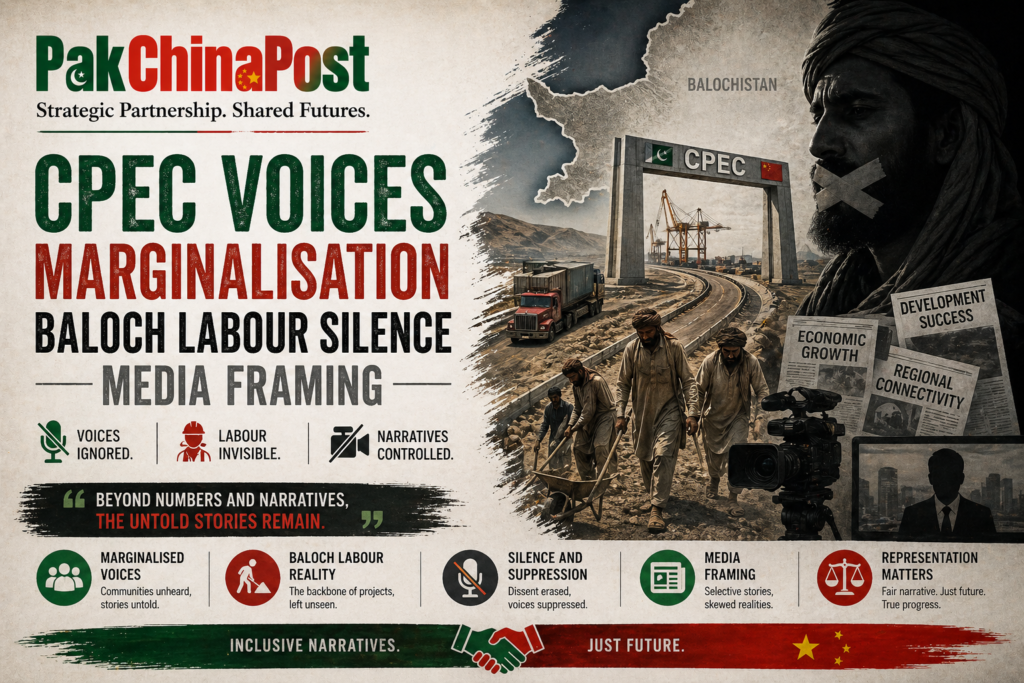
The China Pakistan Economic Corridor is often presented in mainstream discourse as a transformative development corridor, a structural bridge between infrastructure deficit and economic revival. Yet beneath the dominant celebratory narrative lies a more fragmented and uneven communicative landscape, where certain voices remain persistently underrepresented, selectively framed, or entirely absent from national media visibility. The question is not only what CPEC delivers materially, but whose experiences are allowed to enter the field of public narration and whose remain structurally peripheral.
In dominant Pakistani media coverage, CPEC is typically framed through macroeconomic indicators, diplomatic milestones, and infrastructural achievements. Port expansions, energy generation projects, highway networks, and industrial zones are presented as evidence of progress and strategic alignment. This macro framing produces a high level of narrative coherence, reinforcing the idea of national uplift through external partnership. However, it simultaneously compresses the complexity of local experiences into simplified categories of development success.
Within this compression, the lived realities of Baloch communities, industrial laborers, displaced populations, and peripheral regions remain unevenly represented. In many cases, they appear only when their experiences intersect with security related narratives. When issues of protest, insurgency, or conflict arise, local voices are often reframed through the lens of stability and order rather than development equity or historical grievance. This creates a structural imbalance in representation where visibility is conditional and often securitized.
The marginalisation of Baloch voices in particular reflects a deeper epistemic pattern in national media systems. While Balochistan is central to CPEC’s geographical architecture, it remains peripheral in its narrative architecture. Media attention tends to concentrate on Gwadar as a symbolic site of maritime expansion, yet rarely engages in sustained reporting on everyday socio economic conditions of surrounding communities. Fishing livelihoods, land use changes, water scarcity, and labor mobility patterns are often underreported or episodically covered without longitudinal depth.
This gap is not simply editorial oversight but reflects broader structural incentives within media production. National news cycles prioritize state level announcements, diplomatic visits, and high visibility project inaugurations. Localized reporting requires sustained investment, field access, and institutional commitment that is often constrained by economic pressures within the media industry. As a result, the narrative economy Favors scale over specificity, and symbolism over grounded ethnography.
Labor narratives within CPEC related industrial zones also reflect similar patterns of partial visibility. Construction workers, transport labourers, and industrial employees form the material backbone of infrastructure development, yet their experiences are rarely centered in mainstream storytelling. When labor does appear in media coverage, it is often as a generalized category rather than as differentiated social actors with specific working conditions, contractual arrangements, and migratory patterns. This abstraction contributes to a depersonalized understanding of development.
In some cases, labor related concerns are acknowledged but framed within productivity or efficiency discourse rather than rights-based analysis. Delays, cost overruns, or operational challenges are more likely to receive attention than wage structures, occupational safety, or long term employment security. This reflects a broader tendency in development journalism where economic outcomes are foregrounded while social infrastructures remain secondary.
Digital media platforms have partially disrupted this asymmetry by enabling localized storytelling and citizen reporting. Short videos, local journalism pages, and community based social media accounts occasionally surface alternative perspectives on CPEC related development. These include accounts of displacement, environmental change, and uneven benefit distribution. However, the visibility of such content remains inconsistent, often dependent on algorithmic amplification or episodic virality rather than sustained institutional support.
In this fragmented media environment, competing narratives of CPEC coexist without fully engaging each other. On one hand, official and mainstream narratives emphasize strategic partnership, national progress, and regional connectivity. On the other hand, localized narratives highlight lived disruptions, uneven development outcomes, and questions of inclusion. The interaction between these narrative streams does not always result in synthesis; instead, it often produces parallel discursive tracks that rarely intersect meaningfully.
The marginalisation of community voices also has implications for the epistemology of development itself. When development is narrated primarily from top down perspectives, it risks becoming detached from the social realities it seeks to transform. Infrastructure becomes visible as completed output rather than as an ongoing process embedded in local negotiation, adaptation, and sometimes resistance. This temporal flattening reduces the complexity of development to project cycles rather than lived transitions.
In Balochistan, where historical grievances related to resource distribution and political autonomy remain sensitive, media framing of CPEC often oscillates between celebration and securitization. This binary framing leaves limited space for nuanced engagement with community perspectives that do not fit neatly into either category. As a result, local voices may be rendered either invisible or instrumentalized depending on broader political contexts.
The same pattern can be observed, though in different forms, in labor intensive regions connected to CPEC supply chains. Migrant workers from various parts of Pakistan contribute to construction and operational phases of projects, yet their mobility and precarity make sustained representation difficult. Their narratives are often dispersed across geographies and time, making them less accessible to centralized media systems that prefer stable and localized subjects.
It is important to note that marginalisation in this context is not always the result of deliberate exclusion. It is often produced through structural logics of visibility, where certain types of stories are more compatible with institutional news production than others. High level diplomatic engagements are easier to cover than dispersed community experiences. Inauguration ceremonies generate more immediate visual impact than long term social impact assessments. These asymmetries accumulate over time to produce a skewed representational field.
At the same time, the Chinese side of CPEC communication also tends to emphasize macro achievements and bilateral success narratives. This creates a transnational convergence in framing, where both Pakistani and Chinese official media often highlight similar themes of connectivity, development speed, and mutual benefit. While this reinforces diplomatic alignment, it can further reduce space for localized critical perspectives within mainstream discourse.
However, emerging digital infrastructures are gradually complicating this landscape. Mobile journalism, localized reporting networks, and social media activism are introducing new forms of narrative intervention. In some cases, these platforms allow communities to document environmental changes, labor conditions, and infrastructural impacts in real time. Yet these interventions remain uneven in reach and impact, often dependent on connectivity, literacy, and platform dynamics.
The result is a multi layered media environment where visibility is unevenly distributed across scale, geography, and institutional access. National narratives dominate in terms of reach and authority, while local narratives circulate in more fragmented and unstable forms. This does not mean that local voices are absent, but rather that they operate within constrained visibility regimes that limit their integration into mainstream discourse.
From a media theory perspective, this reflects a broader shift from centralized narrative control to distributed visibility governance. In such systems, inclusion is not solely determined by editorial decision making but also by platform algorithms, audience engagement patterns, and network effects. This introduces new forms of inequality that are less visible but deeply influential in shaping public understanding.
The challenge for journalism in the context of CPEC is therefore not only to report on infrastructure but to expand the representational field to include those who experience infrastructure as disruption, opportunity, or ambivalence. This requires moving beyond episodic coverage toward sustained engagement with local geographies and social formations.
Ultimately, the question of CPEC and local voices is not only about representation but about epistemic balance. A development narrative that excludes the complexity of lived experience risks becoming incomplete, even if materially successful. Conversely, a media system that integrates multiple scales of experience can produce a more nuanced understanding of development as a contested and evolving process.
In the evolving media ecology of Pakistan, CPEC remains both a material project and a narrative space. Its meaning is continuously produced through interactions between state institutions, media systems, digital platforms, and local communities. The extent to which marginalized voices are integrated into this narrative will shape not only how CPEC is understood, but how development itself is imagined in the region.
A Public Service Message