

Geo Fragmentation Redefines Security As Core Economic Doctrine Globally

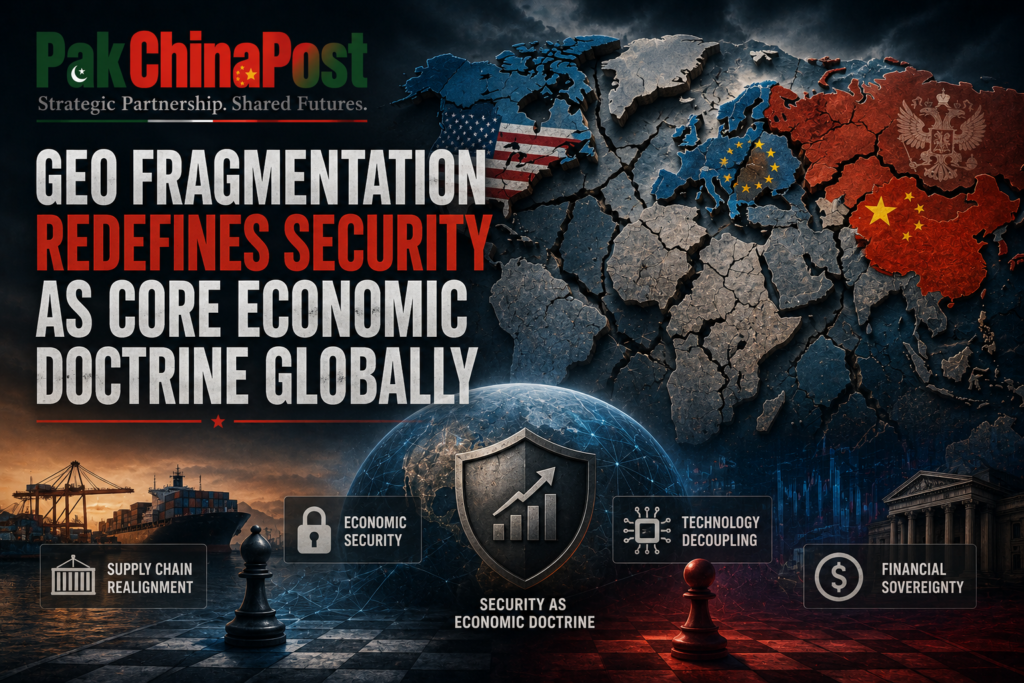
The global economic order is undergoing a profound structural mutation in which the foundational assumptions of globalization are being steadily replaced by a logic of geo fragmentation. What was once an integrated system governed by efficiency, comparative advantage, and frictionless capital flows is now increasingly organized around strategic rivalry, supply chain securitization, and state directed economic insulation. This transformation is not episodic but systemic, marking a decisive shift in how states conceptualize the relationship between economics and security. In this emerging paradigm, economic policy is no longer a subset of development strategy but an extension of national security doctrine.
At the center of this recalibration is the growing convergence between industrial policy and defense logic. Across major economies, including the United States, China, and the European bloc, economic instruments are increasingly being repurposed to achieve strategic objectives. Export controls, investment screening mechanisms, and critical mineral restrictions have become standard tools of geopolitical competition. The result is a global environment in which trade is no longer purely transactional but deeply embedded within strategic calculations.
The narrative being constructed by policymakers and amplified by global media is one of “strategic vulnerability management.” Supply chains are no longer evaluated solely on efficiency but on trustworthiness, resilience, and political alignment. This has led to the reconfiguration of production networks, with firms relocating manufacturing bases not only in pursuit of cost optimization but also to mitigate geopolitical exposure. The fragmentation of production is thus not accidental but policy induced, reflecting a deliberate attempt by states to reduce dependency on rival systems.
Within this shifting architecture, energy, technology, and critical infrastructure have emerged as primary arenas of contestation. The securitization of semiconductors, rare earth minerals, and digital networks illustrates how deeply economic interdependence has been reinterpreted through a security lens. What was once considered globalization’s greatest strength, interconnectedness, is now increasingly framed as its most dangerous vulnerability.
For China, this transition presents both structural constraint and strategic opportunity. Its integration into global supply chains remains extensive, yet its policy response has been to accelerate self reliance in critical sectors while maintaining selective openness in non sensitive domains. Initiatives focused on technological autonomy, domestic innovation ecosystems, and industrial upgrading reflect a broader attempt to insulate the economy from external coercion. At the same time, China continues to engage with emerging markets, particularly through infrastructure and connectivity projects such as the China Pakistan Economic Corridor, which serve as both economic and strategic linkages.
For Pakistan, geo fragmentation introduces a dual reality. On one hand, it creates space for strategic relevance as competing blocs seek alternative corridors, production bases, and logistical routes. On the other, it increases exposure to external volatility, as alignment decisions become more consequential and economically binding. Pakistan’s geographic position places it at the intersection of multiple strategic geographies, but this positional advantage must be converted into institutional strength if it is to yield sustainable benefits.
The emerging doctrine of security driven economics is particularly evident in the restructuring of industrial policy across advanced economies. Governments are increasingly intervening in market mechanisms to ensure the localization of critical industries, from semiconductor fabrication to renewable energy supply chains. Subsidies, tax incentives, and regulatory protections are being deployed not as distortions but as instruments of strategic necessity. This marks a departure from classical economic liberalism and a return to state centric economic orchestration.
Media discourse has played a significant role in legitimizing this transformation. Narratives emphasizing supply chain fragility, technological dependency, and geopolitical risk have reshaped public understanding of globalization. The framing of economic interdependence as a security risk has normalized policy interventions that would previously have been considered protectionist. In this sense, discourse itself has become an instrument of economic reorganization, shaping both perception and policy.
The financial system is also undergoing subtle but significant fragmentation. Cross border capital flows are increasingly subject to political scrutiny, and financial infrastructures are being adapted to reflect geopolitical alignments. The use of sanctions, payment system alternatives, and currency diversification strategies reflects an underlying shift toward monetary pluralism. While the dominance of the US dollar remains intact, its uncontested centrality is being gradually challenged by the emergence of parallel financial architectures.
Technological governance represents another critical dimension of geo fragmentation. Competing regulatory regimes are emerging around data sovereignty, artificial intelligence standards, and digital infrastructure control. The internet, once envisioned as a borderless space, is increasingly segmented into jurisdictional zones governed by distinct regulatory philosophies. This “digital bifurcation” reinforces broader geopolitical divisions and complicates efforts to establish universal norms.
For policy makers, the central challenge is to navigate this fragmented landscape without succumbing to zero sum logic. The temptation to view geo economic competition as purely adversarial risks accelerating systemic instability. Instead, there is a growing need for pragmatic frameworks that allow for selective cooperation even within competitive structures. This requires a recalibration of diplomatic strategy, economic planning, and institutional engagement.
Pakistan’s policy imperative lies in constructing adaptive economic frameworks that can operate across multiple strategic environments. This involves strengthening domestic industrial capacity, enhancing regulatory predictability, and investing in technological literacy. Engagement with China offers critical opportunities in infrastructure and industrial development, but these must be balanced with broader diversification to avoid overdependence. The objective is not alignment with a single bloc but strategic flexibility within a fragmented system.
China, for its part, must continue to balance its security driven economic restructuring with the need to maintain global economic integration. Excessive insulation risks reducing innovation flows and increasing systemic inefficiencies, while overexposure risks vulnerability to external shocks. The challenge is to sustain openness in a selectively controlled manner, ensuring that strategic sectors are protected without undermining overall economic dynamism.
The United States and its allies face a parallel dilemma. Efforts to re-shore industries and reduce dependency on rival systems must contend with the economic costs of fragmentation. Complete decoupling is neither feasible nor desirable, given the depth of existing interconnections. The task is therefore one of managed competition, in which security concerns are balanced against economic interdependence.
At a systemic level, geo fragmentation represents a transition from a unified global economy to a multiplex order characterized by overlapping but distinct economic spheres. This does not imply the end of globalization but its transformation into a more stratified and politically conditioned system. The rules governing economic interaction are becoming more heterogeneous, reflecting divergent political priorities and strategic interests.
The long term implications of this shift are still unfolding, but several trends are already visible. First, the centrality of the state in economic organization is being reaffirmed. Second, economic policy is increasingly indistinguishable from security policy. Third, global institutions are struggling to adapt to a more fragmented and contested environment. These dynamics suggest that the future of the global economy will be defined less by integration and more by managed fragmentation.
For countries positioned at the intersection of major strategic corridors, such as Pakistan, the ability to interpret and adapt to these shifts will be decisive. Economic survival and advancement will depend not only on participation in global networks but on the capacity to navigate their fragmentation. This requires institutional resilience, policy coherence, and strategic foresight.
Ultimately, geo fragmentation is not a temporary deviation but a structural reordering of the global system. It reflects deeper shifts in power, technology, and ideology that are reshaping the relationship between states and markets. In this new environment, security has become the defining principle of economic organization, and adaptability the key determinant of national success.
A Public Service Message


