
Institutional Power Rivalry Reshapes Global Governance and Smaller States Order

The contemporary international system is undergoing a profound and arguably irreversible transformation in which the architecture of global governance is no longer merely a post-war inheritance but an active theatre of strategic competition. Institutions that were once conceived as stabilising mechanisms for collective security, normative convergence, and developmental coordination are increasingly being reinterpreted as arenas of geopolitical bargaining. Within this evolving landscape, the rivalry between the United States and China has assumed a distinctly institutional form, extending far beyond bilateral economic or military competition into the procedural, bureaucratic, and normative core of multilateralism itself. What is emerging is not simply a contest for influence within existing frameworks, but a deeper struggle over the epistemic foundations upon which global order is constructed.
The United Nations system, along with its affiliated agencies and broader multilateral ecosystem, now operates under conditions of heightened strategic scrutiny. Voting patterns are increasingly bloc-oriented, agenda-setting is more contested, and institutional reforms are no longer neutral administrative exercises but politically charged instruments through which great powers seek to recalibrate influence. The language of reform, once associated with efficiency, transparency, and representation, has acquired a dual character: it is simultaneously a discourse of legitimacy and a mechanism of leverage. In this environment, procedural adjustments within councils, funding reallocations within agencies, and leadership contests across international organizations are being interpreted through the prism of geopolitical positioning.
The United States continues to emphasise institutional transparency, accountability, and rules-based order, yet its engagement increasingly reflects a selective multilateralism shaped by strategic competition. China, on the other hand, has expanded its presence through financial contributions, personnel placement, and South–South cooperation frameworks, advancing a model of institutional participation that foregrounds sovereignty, non-interference, and developmental pragmatism. These two paradigms are not merely competing policy preferences; they represent fundamentally divergent conceptions of global order. One is rooted in liberal universalism with conditional enforcement, the other in civilisational pluralism with hierarchical flexibility. The friction between these paradigms is increasingly encoded into institutional behaviour.
For smaller states, this evolving architecture produces a complex and often constraining diplomatic environment. The promise of multilateral neutrality, once a viable strategic posture, is increasingly difficult to sustain. Institutional alignment pressures manifest through voting expectations, financial dependencies, and development partnerships that are rarely free from geopolitical signalling. The capacity of smaller states to act as independent norm entrepreneurs is therefore circumscribed by the structural realities of funding asymmetries and agenda capture. Even technical agencies, traditionally perceived as insulated from politics, are increasingly subject to competing pressures that reflect broader geopolitical tensions.
This condition does not necessarily imply the collapse of multilateralism, but rather its transformation into a layered and contested system. Rather than a singular global order, what is emerging is a segmented institutional landscape in which multiple centres of influence coexist, overlap, and occasionally contradict one another. The fragmentation of consensus does not eliminate institutional relevance; instead, it redistributes authority across competing nodes. In such a system, institutional participation becomes a form of strategic navigation rather than collective commitment.
The United Nations Security Council exemplifies this dynamic most starkly. Long-standing debates on expansion, veto reform, and representational equity have acquired renewed urgency, yet they remain unresolved precisely because reform has become inseparable from power recalibration. Any adjustment to membership or procedural rules is interpreted not merely as institutional improvement but as a redistribution of geopolitical capital. Similarly, specialized agencies dealing with health, telecommunications, finance, and labour have become arenas where normative standards are contested through technical language that often conceals underlying strategic objectives.
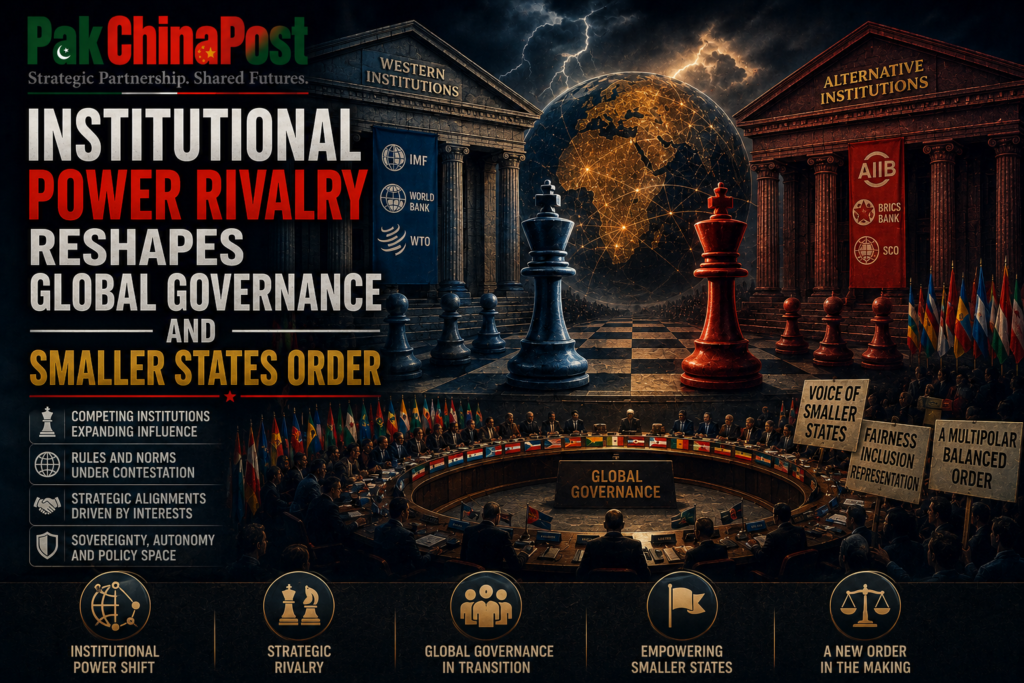
The emergence of alternative or parallel institutional frameworks further complicates this landscape. Regional development banks, infrastructure financing mechanisms, and connectivity initiatives have proliferated as states seek to diversify institutional dependence. These arrangements do not necessarily replace existing institutions but rather coexist in a state of calibrated redundancy. The result is an increasingly polycentric institutional order in which legitimacy is no longer monopolised by a single system but dispersed across competing structures.
Within this environment, China’s expanding institutional engagement is particularly significant. Through initiatives that emphasise infrastructure connectivity, developmental financing, and regional integration, it has constructed an alternative layer of institutional influence that complements rather than directly replaces existing frameworks. This dual-track engagement strategy allows for both integration within established systems and the simultaneous creation of parallel structures. The effect is not institutional rupture but institutional stratification.
The United States, meanwhile, continues to exercise substantial influence through normative leadership, alliance networks, and technological standard-setting. However, its capacity to unilaterally shape institutional outcomes has diminished in relative terms as global power distribution becomes more diffuse. The increasing assertiveness of middle powers, regional blocs, and non-Western coalitions has introduced new variables into institutional negotiations, reducing the predictability of outcomes and increasing the importance of coalition-building.
For smaller states, this fragmentation presents both risk and opportunity. On one hand, the dilution of hegemonic consensus allows for greater diplomatic manoeuvrability, enabling states to engage selectively across competing frameworks. On the other hand, it increases exposure to conditionality, as access to resources and influence becomes more fragmented across institutional domains. The strategic challenge lies in maintaining policy coherence while navigating multiple, sometimes contradictory, institutional expectations.
In this context, the concept of institutional neutrality requires re-evaluation. Neutrality is no longer a passive condition but an active and continuous process of calibration. It involves selective alignment on issue-specific grounds, diversified engagement across institutional platforms, and the strategic management of visibility within competing blocs. The traditional binary of alignment versus non-alignment has thus given way to a more fluid spectrum of engagement strategies.
From a policy perspective, states situated in the Global South must invest in institutional literacy and diplomatic specialization to effectively navigate this environment. Capacity-building within foreign services, expansion of multilateral negotiation expertise, and development of strategic foresight mechanisms are essential to avoid structural marginalization. Without such investments, smaller states risk becoming reactive participants in institutional processes rather than active contributors to agenda formation.
Furthermore, there is an increasing need to reframe institutional participation as a domain of economic strategy rather than purely diplomatic engagement. Access to multilateral funding, regulatory standards, and technical cooperation mechanisms now directly influences domestic development trajectories. As such, institutional positioning is inseparable from national economic planning. States that fail to integrate multilateral engagement into their broader development strategies risk fragmentation between external commitments and internal priorities.
The normative dimension of this transformation is equally significant. The idea of a unified global norm system is gradually being replaced by a pluralistic normative environment in which multiple standards coexist. This does not necessarily imply normative relativism but rather normative competition. Issues such as digital governance, climate finance, human rights interpretation, and trade regulation are increasingly subject to divergent institutional interpretations. The absence of a singular normative authority complicates enforcement but also opens space for alternative models of governance.
Within this contested normative terrain, institutional legitimacy becomes contingent rather than absolute. It is derived not solely from formal mandates but from perceived effectiveness, representational balance, and geopolitical alignment. As a result, legitimacy is continuously negotiated rather than permanently granted. This dynamic introduces both instability and adaptability into the system.
The strategic implications of this transformation are profound. Great power competition is no longer confined to traditional domains of military deterrence or economic rivalry; it is embedded within the procedural DNA of global institutions. Decision-making processes, appointment mechanisms, funding structures, and technical standards all become vectors of influence. Institutional governance thus becomes an extension of strategic competition, albeit in a more subtle and bureaucratically mediated form.
For policymakers in smaller states, this necessitates a recalibration of diplomatic doctrine. Engagement must be multi-vectoral, anticipatory, and institutionally diversified. Reliance on single institutional frameworks or fixed alliances increases vulnerability to external shocks and political recalibration by major powers. Strategic flexibility, rather than rigid alignment, becomes the defining feature of effective diplomacy.
At a broader systemic level, the international order is transitioning from hierarchical unipolarity or bipolar rigidity toward a condition of structured multiplicity. This does not imply disorder in the conventional sense, but rather a reconfiguration of order itself. Institutions remain central to global governance, but their authority is increasingly distributed, contested, and conditional.
In conclusion, the weaponization of institutional reform within the US–China rivalry reflects a deeper transformation in the nature of global governance. Institutions are no longer neutral arenas but active components of geopolitical strategy. For smaller states, this evolution demands a shift from passive participation to strategic institutional engagement. Survival and relevance in this emerging order will depend not on alignment with any single bloc, but on the capacity to navigate complexity, absorb institutional volatility, and convert fragmentation into calibrated opportunity. The future of global governance will not be defined by consensus, but by the managed coexistence of competing institutional logics within an increasingly plural and contested international system.
A Public Service Message