Iran Conflict Reorders Alliances Across Asia Global South System

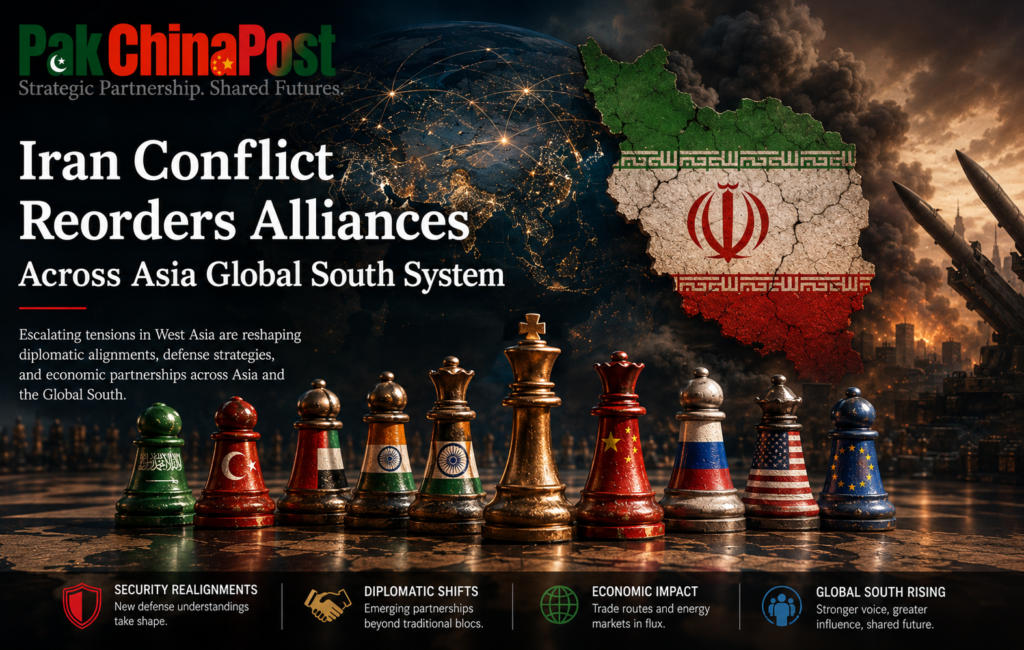
The contemporary geopolitical landscape is undergoing a quiet but consequential reconfiguration driven by the prolonged instability surrounding Iran and its regional and transregional reverberations. What was once framed primarily as a localized security concern in the Middle East has now evolved into a systemic catalyst reshaping alliance structures, economic dependencies, and diplomatic orientations across Asia and the wider Global South. The Iran theatre, embedded within overlapping sanctions regimes, proxy dynamics, maritime tensions, and nuclear diplomacy deadlock, has become a focal point through which broader questions of global alignment and strategic autonomy are being renegotiated.
At the heart of this transformation lies the increasing fragmentation of traditional alliance systems. The post Cold War assumption of relatively stable blocs anchored in ideological convergence has eroded, replaced by fluid configurations driven by energy security, trade resilience, and geopolitical hedging. Iran’s positioning within this evolving order is not merely that of a sanctioned state under pressure, but of a strategic node through which competing regional and global interests intersect. Its relationships with neighbouring Gulf states, Asian energy importers, and Eurasian connectivity frameworks reflect a complex interplay of containment, engagement, and selective cooperation.
Sanctions imposed by Western powers, intended as instruments of coercive diplomacy, have produced unintended structural consequences. Rather than isolating Iran within a closed strategic space, they have contributed to the diversification of its external partnerships. Energy trade rerouting, barter-based economic exchanges, and the expansion of non-dollar denominated transactions have facilitated alternative economic circuits that bypass traditional Western financial systems. This reorientation has been particularly visible in Iran’s deepening engagement with select Asian economies, where pragmatic considerations of energy security and trade continuity increasingly outweigh normative alignment with sanctioning regimes.
Across Asia, states are recalibrating their strategic postures in response to the uncertainties generated by sustained Iran-related tensions. For energy-importing economies, particularly in South Asia and East Asia, the stability of supply chains has become a central concern. The volatility of maritime routes, insurance risks in key chokepoints, and the politicization of energy flows have collectively intensified the search for diversified sourcing strategies. In this context, Iran emerges simultaneously as a risk factor and a potential stabilizer, depending on the diplomatic framing and economic necessity of individual states.
Within the Gulf region, the Iran dynamic has accelerated a parallel process of cautious re-engagement and tactical de-escalation. While structural rivalries remain unresolved, there is a growing recognition that perpetual confrontation imposes economic and security costs that are increasingly difficult to sustain in a global environment marked by energy transition pressures and fiscal recalibration. This has resulted in episodic diplomatic openings, mediated dialogues, and indirect communication channels that signal a shift from rigid bipolarity toward managed competition.
The Global South, broadly understood as a heterogeneous constellation of developing and emerging economies, is particularly affected by the ripple effects of Iran related geopolitical tensions. For many of these states, the primary concern is not ideological alignment but systemic stability. The fragmentation of energy markets, volatility in shipping routes, and unpredictability in sanctions enforcement mechanisms directly impact developmental trajectories. As a result, there is an observable tendency toward pragmatic non alignment, wherein states seek to preserve functional relationships across competing blocs without fully committing to any singular geopolitical camp.
China’s role in this evolving environment is increasingly significant, not as a conventional alliance leader but as a facilitator of connectivity and economic integration. Its engagement with Iran, alongside broader regional initiatives, reflects a long term strategy of embedding energy security within diversified supply chains and infrastructure corridors. This approach reduces vulnerability to maritime chokepoints while simultaneously expanding geopolitical influence through economic interdependence rather than military presence. The resulting architecture is one in which strategic partnerships are defined less by ideological convergence and more by mutual utility.
Russia’s positioning adds another layer of complexity to the Iran centred geopolitical matrix. Sanctions convergence between Russia and Iran has contributed to the emergence of alternative financial and logistical mechanisms that challenge established Western regulatory frameworks. While this alignment is not formally institutionalized, it reflects a convergence of necessity driven cooperation that reinforces the broader trend toward fragmented globalization. The interaction between these actors contributes to the gradual normalization of parallel economic systems operating alongside traditional Western dominated structures.
The United States and its allies continue to frame Iran within a broader security paradigm that includes nuclear non proliferation, regional deterrence, and maritime stability. However, the effectiveness of this framework is increasingly constrained by the multiplicity of actors involved and the diminishing coherence of collective enforcement mechanisms. Divergent priorities among allied states, particularly between transatlantic partners and Asian stakeholders, further complicate the formulation of unified policy responses. As a result, containment strategies often lack the uniformity required for sustained strategic pressure.
One of the most significant consequences of the Iran related geopolitical environment is the acceleration of regional diplomacy outside traditional Western mediated frameworks. Dialogue platforms involving regional actors have gained prominence, reflecting a shift toward localized conflict management. These mechanisms, while limited in scope, indicate a broader trend toward regional ownership of security architectures. This development does not eliminate external influence but redistributes it across a more complex network of actors.
Energy markets remain central to understanding the strategic implications of the Iran conflict. The country’s hydrocarbon reserves position it as a latent stabilizer in global energy supply chains, yet its integration into global markets is heavily mediated by political constraints. This paradox creates persistent volatility, as market expectations are continuously adjusted in anticipation of potential sanctions relief, escalation scenarios, or diplomatic breakthroughs. For importing economies, this uncertainty translates into strategic hedging behavior, diversification of suppliers, and increased investment in alternative energy infrastructure.
Maritime security considerations further intensify the strategic significance of the region. Key waterways adjacent to Iranian influence remain critical arteries of global trade, and any disruption in these zones has immediate global economic repercussions. The securitization of these maritime spaces has led to increased naval presence by multiple external powers, contributing to an already crowded and strategically sensitive environment. This militarization of trade routes underscores the interconnectedness of economic globalization and security competition.
From a policy perspective, states within Asia and the Global South face a constrained but navigable set of strategic options. Absolute alignment with any single bloc is increasingly costly, while complete neutrality is structurally difficult to sustain. The emerging alternative is a model of calibrated engagement, wherein states maintain issue specific partnerships that vary across domains such as energy, trade, security, and technology. This requires sophisticated diplomatic management and continuous recalibration of foreign policy priorities.
Institutional mechanisms for conflict resolution remain underutilized relative to the scale of the challenge. Existing multilateral frameworks are often constrained by geopolitical polarization, limiting their effectiveness in addressing the underlying drivers of instability. Strengthening regional dialogue platforms, enhancing economic interdependence frameworks, and promoting incremental confidence building measures may offer more viable pathways toward long term stabilization than comprehensive grand bargains that remain politically elusive.
In conclusion, the Iran conflict has transcended its original regional parameters to become a structural force reshaping alliance configurations across Asia and the Global South. It functions not merely as a security issue but as a catalyst for broader systemic transformation, influencing energy markets, diplomatic alignments, and institutional behaviors. The emerging order is characterized by fragmentation, pragmatic convergence, and strategic ambiguity. For policymakers, the central challenge lies in navigating this complexity without succumbing to binary thinking, recognizing that in a reordered geopolitical landscape, flexibility has become the principal currency of stability and survival.
A Public Service Message