
Strategic Autonomy Under Pressure in a Fragmented Global Order

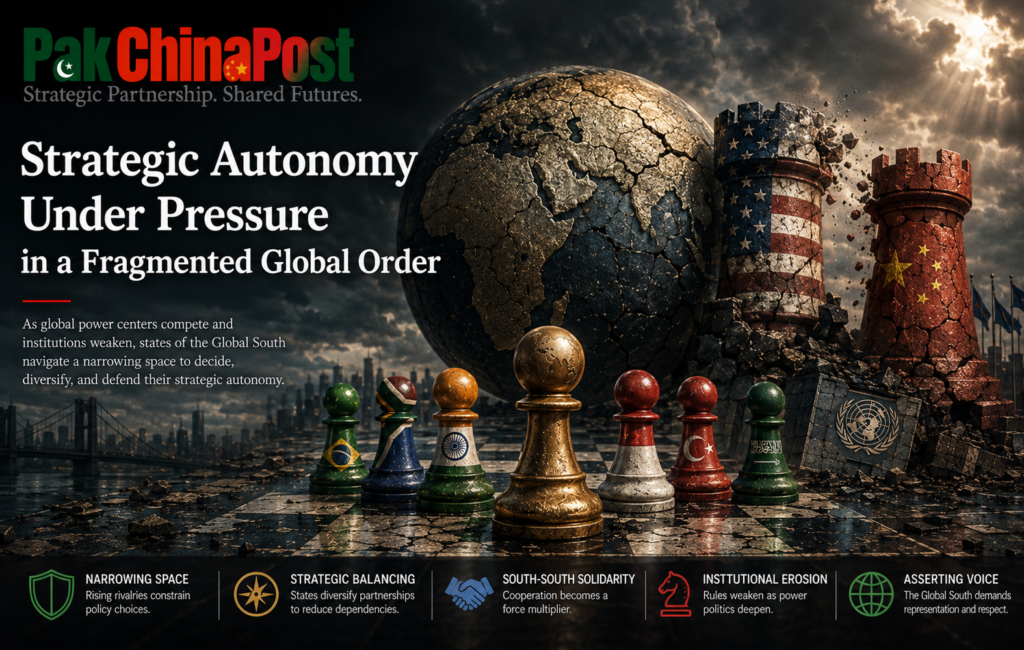
The contemporary international system is increasingly defined by structural polarization, fragmented economic interdependence, and competing technological ecosystems that collectively compress the strategic space available to middle powers. Within this evolving configuration, the concept of strategic autonomy has shifted from a normative aspiration to a pragmatic survival imperative, yet its operationalization has become more complex than at any prior historical juncture. For states such as Pakistan, situated at the intersection of major power rivalries, regional security volatility, and acute economic constraints, strategic autonomy is no longer a static policy posture but a continuously recalibrated balancing act shaped by shifting external pressures and internal vulnerabilities.
The classical understanding of autonomy in international relations presupposed a relatively coherent global order in which states could align selectively without incurring prohibitive costs or systemic penalties. That assumption has eroded. The present order is characterized by overlapping spheres of influence, technological bifurcation, financial fragmentation, and security entanglements that render neutrality increasingly conditional and alignment increasingly transactional. In this environment, autonomy is not defined by isolation from major powers but by the capacity to navigate between them without structural dependency or policy capture.
The most visible dimension of this transformation is the intensification of great power competition, particularly between the United States and China, which has extended beyond traditional military and economic domains into technological standards, digital infrastructure, supply chain governance, and institutional norm formation. This competition is not episodic but systemic, embedding itself into the architecture of global trade, finance, and information flows. As a result, middle powers are compelled to operate within a dual pressure system in which economic opportunities are often inseparable from geopolitical conditionalities.
Pakistan’s strategic positioning exemplifies this dilemma with particular clarity. Situated within a volatile regional environment, sharing deep economic and infrastructural linkages with China through long term connectivity frameworks, while simultaneously maintaining critical financial and diplomatic interactions with Western institutions, Pakistan operates within a constrained strategic corridor. This corridor is not defined by ideological alignment but by economic necessity, security considerations, and developmental imperatives that frequently pull policy in divergent directions.
The China Pakistan economic relationship, particularly under large scale infrastructure and energy cooperation frameworks, represents a structural anchor of Pakistan’s external engagement strategy. It provides long term investment horizons, infrastructural expansion, and energy security support that are otherwise difficult to secure within traditional Western financing systems. However, this deepening interdependence also introduces questions of debt sustainability, technological dependence, and policy rigidity that must be carefully managed to avoid asymmetrical lock in effects. Strategic autonomy in this context does not imply disengagement, but rather the ability to shape terms of engagement in a manner that preserves domestic policy flexibility.
Simultaneously, Pakistan’s engagement with Western financial institutions, including multilateral lenders and regulatory bodies, remains indispensable for short term macroeconomic stabilization. This dual dependency structure creates a policy paradox in which external financing stability is tied to reform conditionalities that may not always align with domestic political economy constraints or long term developmental priorities. The resulting tension between structural reform expectations and immediate economic imperatives constitutes a central challenge for sovereign policy formulation.
The broader global environment exacerbates these contradictions. The fragmentation of supply chains along geopolitical lines has introduced a new layer of vulnerability for developing economies. Access to technology, capital, and markets is increasingly mediated by strategic trust rather than purely economic efficiency. Export controls, investment screening mechanisms, and digital governance regimes have become instruments through which geopolitical alignment is indirectly enforced. In such a context, neutrality is no longer a passive condition but an actively contested space.
Technological bifurcation represents one of the most consequential dimensions of this fragmentation. The emergence of parallel ecosystems in telecommunications, artificial intelligence, semiconductor production, and digital platforms has created a landscape in which interoperability is no longer guaranteed. States that fail to invest in adaptive technological diversification risk being locked into dependency structures that limit future policy autonomy. For middle powers, the challenge lies in avoiding irreversible technological capture while still accessing the benefits of global innovation networks.
Financial fragmentation further complicates the autonomy equation. The increasing politicization of global financial systems, including the use of sanctions, payment system exclusions, and currency-based leverage, has introduced new forms of economic coercion. In response, alternative financial arrangements, bilateral currency swaps, and regional payment systems have gained prominence. While these mechanisms provide partial insulation, they also contribute to the segmentation of global liquidity flows, thereby increasing systemic complexity.
Security dynamics add another layer of constraint. Regional instability, particularly in South Asia and adjacent strategic corridors, places continuous pressure on defense planning and foreign policy alignment. Security partnerships, while necessary for deterrence and stability, often come with implicit alignment expectations that reduce diplomatic flexibility. The challenge for middle powers is to maintain credible deterrence while preserving the ability to pursue diversified external relations.
Within this constrained environment, the notion of strategic autonomy must be redefined not as independence from all external influence, but as the capacity to manage multiple dependencies without allowing any single relationship to become structurally dominant. This requires institutional sophistication, policy coherence, and long term strategic planning that transcends electoral cycles and short term crisis management.
One of the most critical requirements for sustaining such autonomy is the development of internal economic resilience. Without a diversified export base, stable fiscal architecture, and robust domestic production capacity, external autonomy remains largely rhetorical. Economic vulnerability inevitably translates into policy vulnerability, as states under fiscal stress are compelled to accept external conditionalities that constrain strategic flexibility. Therefore, macroeconomic stabilization and structural reform are not merely economic imperatives but foundational elements of geopolitical agency.
Another essential dimension is diplomatic diversification. Middle powers must expand their engagement across multiple regional and global platforms, avoiding over concentration in any single institutional or geopolitical framework. This includes strengthening ties with emerging economies, deepening participation in regional organizations, and maintaining constructive engagement with competing great powers. Diplomatic over specialization in any single axis of alignment increases systemic risk and reduces adaptive capacity.
Institutional capacity building is equally critical. Effective autonomy requires a highly skilled foreign service, capable of interpreting complex geopolitical signals, managing multi vector negotiations, and anticipating structural shifts in global order. Without such capacity, states risk becoming reactive participants in global politics rather than active shapers of their strategic environment.
The normative dimension of strategic autonomy also warrants attention. In an increasingly polarized world, normative alignment is often assumed rather than negotiated. However, middle powers must resist the pressure to adopt wholesale ideological frameworks that do not reflect their domestic realities or strategic interests. Instead, they must engage in selective norm adaptation, adopting global standards where beneficial while resisting uniform application that undermines local policy space.
The concept of hedging has thus become central to contemporary strategic thinking. Hedging involves maintaining simultaneous engagement with competing power centers while avoiding exclusive dependence on any single actor. However, hedging is not without risks. It requires constant recalibration, high diplomatic competence, and a clear understanding of red lines. Mismanaged hedging can result in loss of trust from all sides, thereby reducing strategic options rather than expanding them.
In the case of Pakistan, the success of strategic autonomy will depend on its ability to integrate economic reform, diplomatic diversification, and institutional strengthening into a coherent national strategy. This requires moving beyond crisis driven policymaking toward a long term strategic framework that anticipates global shifts rather than merely responding to them. The development of such a framework is complicated by domestic political volatility and economic pressures, yet it remains essential for sustaining sovereign agency in a fragmented global order.
At the systemic level, the erosion of unipolarity has not produced a stable multipolar equilibrium but rather a condition of structured fragmentation. Power is distributed across multiple nodes, but coordination among these nodes is weak and often contradictory. This creates both opportunity and instability. Middle powers can exploit gaps between competing blocs, but they must also navigate heightened uncertainty and reduced predictability in global systems.
The absence of a coherent global consensus on trade, security, and technology governance further amplifies this uncertainty. Institutions that once provided stabilizing frameworks are increasingly constrained by geopolitical divisions. As a result, global governance is becoming more procedural than normative, more transactional than collective, and more fragmented than integrated.
In such a world, strategic autonomy is not a destination but a continuous process of adaptation. It requires constant reassessment of external conditions, internal capabilities, and long term objectives. It is not achieved through declaration but through sustained institutional and economic discipline.
Ultimately, the future of middle power agency will depend on the ability to transform structural vulnerability into calibrated flexibility. Those states that can maintain internal cohesion while engaging externally with strategic agility will retain meaningful autonomy. Those that cannot will find their policy space increasingly constrained by external dependencies and systemic pressures.
In conclusion, strategic autonomy in a fragmented global order is neither absolute nor static. It is a dynamic equilibrium shaped by competing pressures and constrained choices. For Pakistan and similar states, the central challenge is to convert geographic and geopolitical vulnerability into strategic relevance through disciplined economic reform, diversified diplomacy, and institutional strengthening. In an era where alignment is fluid and power is diffuse, autonomy belongs not to those who avoid dependence entirely, but to those who manage dependence with precision, foresight, and strategic clarity.
A Public Service Message