Pak China Maritime Vigilance Beneath the Indian Ocean Frontier

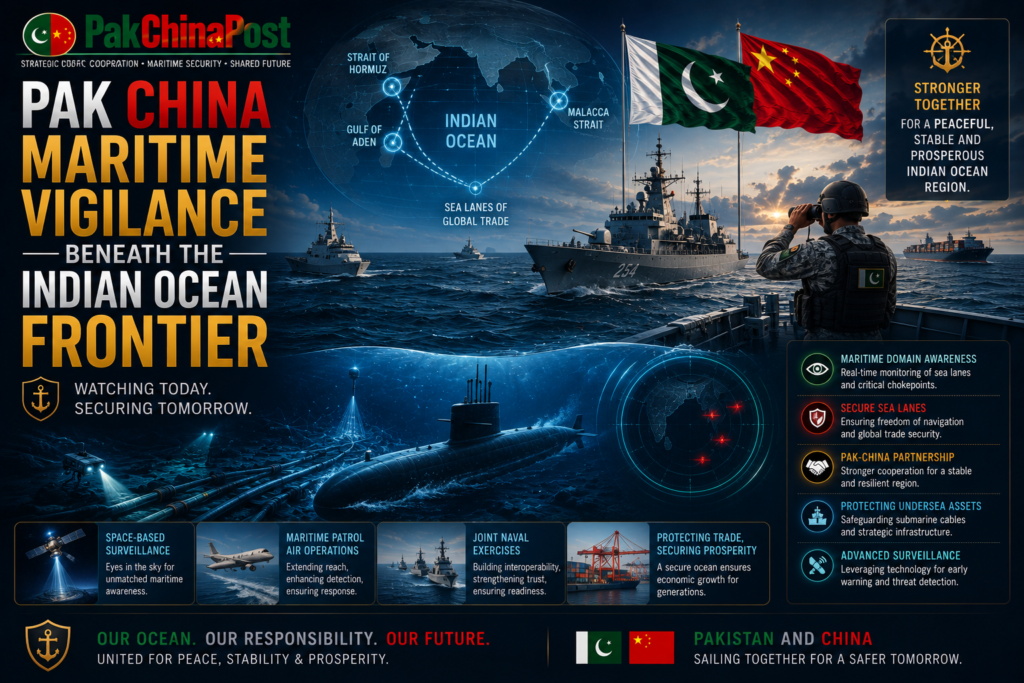
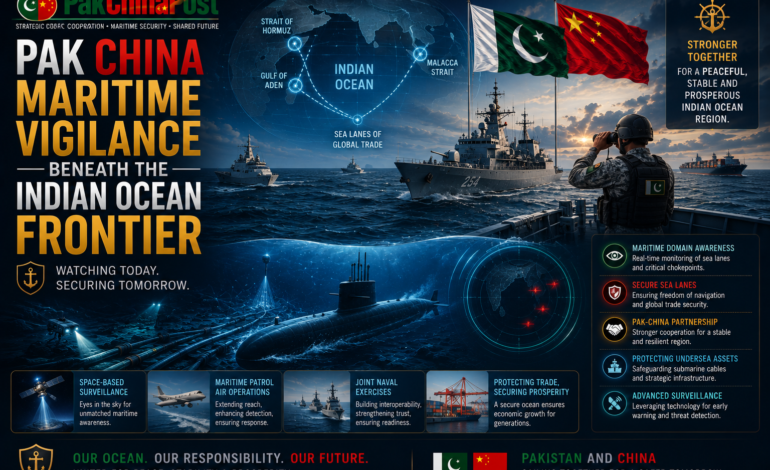
Pak China strategic cooperation is entering an era in which maritime superiority is increasingly determined not by the visible concentration of fleets but by the invisible contest unfolding beneath the surface of the northern Indian Ocean. The rapid diffusion of underwater acoustic arrays, seabed sensor networks, autonomous underwater vehicles, distributed hydrographic observation systems and artificial intelligence enabled maritime analytics is fundamentally altering the architecture of naval competition. Oceans are no longer merely navigational spaces supporting commercial exchange or military manoeuvre. They are becoming vast repositories of strategic information where persistent surveillance, acoustic intelligence and environmental data increasingly determine deterrence credibility, maritime transparency and operational survivability. For Pakistan and China, whose maritime interests are becoming progressively interconnected through expanding commercial routes, energy transportation corridors, naval cooperation and scientific engagement, the underwater battlespace deserves recognition as an emerging strategic frontier requiring institutional attention rather than episodic procurement decisions.
The northern Indian Ocean has historically functioned as one of the world’s busiest maritime crossroads, carrying substantial proportions of global hydrocarbon shipments, container traffic and undersea digital communications. Yet its strategic significance is evolving beyond conventional shipping. Every submarine movement, underwater cable, offshore energy platform and seabed infrastructure installation now represents a valuable intelligence objective. Maritime powers increasingly recognise that the ability to detect underwater activity before potential competitors provides decisive operational advantage during peacetime competition as well as crisis escalation. Consequently, investment priorities are shifting from conventional surface surveillance towards integrated underwater domain awareness architectures capable of continuously observing the maritime environment across multiple physical layers.
This transformation is driven by remarkable technological convergence. Modern underwater acoustic sensors possess greater sensitivity while consuming considerably less energy than previous generations. Artificial intelligence algorithms can distinguish submarine signatures from commercial shipping noise with increasing precision. Autonomous underwater vehicles can patrol predetermined sectors for extended durations without direct human supervision. Seabed monitoring stations equipped with environmental sensors continuously measure temperature gradients, salinity variations, acoustic propagation conditions and underwater movement patterns. Satellite communication networks increasingly complement underwater observation systems through integrated data fusion. Collectively these technologies are producing a maritime intelligence ecosystem that dramatically reduces uncertainty beneath the ocean surface.
For Pakistan, whose coastline forms an indispensable gateway between the Arabian Sea and wider Indian Ocean trade routes, the implications extend beyond naval operations. Maritime security increasingly encompasses protection of offshore economic assets, fisheries, subsea telecommunications infrastructure, energy terminals and emerging blue economy initiatives. The operational environment surrounding Gwadar, Karachi and associated maritime approaches will become progressively data intensive. Maintaining awareness across this evolving underwater environment demands sustained investment in scientific capabilities, institutional coordination and technological adaptation rather than reliance upon conventional coastal surveillance alone.
China similarly confronts expanding maritime responsibilities extending far beyond its immediate coastline. The security of maritime trade, overseas investments, energy transportation routes and commercial logistics increasingly depends upon comprehensive situational awareness across distant waters. Underwater surveillance therefore complements broader maritime security objectives by providing early warning against sabotage, monitoring underwater infrastructure and supporting navigational safety. The convergence of Pakistani geographic positioning with Chinese technological expertise consequently creates opportunities for structured collaboration grounded in mutual strategic interests while remaining consistent with international maritime obligations.
The underwater sensor race is unfolding through incremental rather than spectacular developments. Unlike aircraft carriers or ballistic missile programmes, underwater observation systems rarely attract public attention despite their considerable strategic importance. Distributed acoustic sensing networks positioned along critical maritime corridors quietly collect environmental information over extended periods. Autonomous underwater gliders conduct oceanographic measurements while simultaneously enhancing maritime awareness. Civilian hydrographic surveys increasingly generate datasets with dual utility supporting commercial navigation as well as defence planning. This gradual accumulation of underwater intelligence infrastructure is reshaping regional maritime balances without dramatic political signalling.
Anti submarine warfare represents perhaps the most immediate operational consequence of this technological evolution. Modern submarines rely upon stealth rather than speed or firepower for strategic effectiveness. Persistent underwater monitoring therefore threatens to reduce one of their principal operational advantages. Sophisticated acoustic arrays supported by artificial intelligence can detect subtle changes in underwater sound propagation, enabling earlier identification of submarine movements. Autonomous underwater vehicles equipped with passive sensors extend observation coverage without exposing human operators to operational risks. As underwater detection capabilities improve, naval planners must reconsider deployment patterns, force protection concepts and operational doctrine.
Yet underwater domain awareness extends beyond military competition. Commercial shipping increasingly depends upon uninterrupted access to secure maritime routes. Sabotage against subsea fibre optic cables, offshore pipelines or port infrastructure could generate severe economic disruption without conventional military confrontation. Recent international incidents affecting underwater infrastructure have demonstrated how vulnerable critical maritime systems remain despite their strategic importance. Consequently, underwater monitoring capabilities serve commercial resilience as much as defence preparedness. Early identification of suspicious underwater activity enables timely preventive measures while supporting accident investigation, environmental monitoring and emergency response.
For Pakistan and China, protecting maritime connectivity associated with regional economic integration requires comprehensive appreciation of underwater vulnerabilities. Ports cannot be considered secure merely because surrounding waters remain visually calm. The absence of visible threats often conceals sophisticated underwater activities ranging from unauthorised seabed mapping to covert interference with communication infrastructure. Maritime intelligence therefore increasingly depends upon continuous environmental observation rather than episodic patrol operations.
Oceanographic research occupies an essential yet frequently underestimated position within this strategic transformation. Understanding underwater acoustics requires extensive knowledge of temperature distribution, salinity profiles, ocean currents, seabed composition and seasonal environmental variation. Scientific expeditions consequently generate information with considerable operational relevance. Collaborative marine research programmes therefore possess legitimate civilian value while simultaneously strengthening maritime awareness. Pakistan and China should expand institutional partnerships among oceanographic institutes, hydrographic agencies, universities and maritime technology laboratories to deepen understanding of the northern Indian Ocean’s evolving environmental characteristics.
Scientific collaboration should extend beyond traditional hydrography towards integrated marine data ecosystems. Continuous environmental observation through research buoys, autonomous scientific platforms and coastal monitoring stations would generate valuable datasets supporting climate research, fisheries management, disaster preparedness and navigational safety alongside maritime security applications. Such dual use approaches strengthen international legitimacy by demonstrating civilian benefits while enhancing national strategic capabilities.
Artificial intelligence constitutes another transformative dimension within underwater surveillance. Human analysts cannot efficiently process the enormous quantities of acoustic information generated by modern sensor networks. Machine learning systems increasingly identify anomalous underwater behaviour, classify acoustic signatures, predict environmental changes affecting detection performance and recommend surveillance priorities. Pakistan should prioritise indigenous development of maritime artificial intelligence through defence research institutions, civilian universities and technology enterprises operating within structured innovation partnerships. Dependence upon imported analytical software could create long term operational vulnerabilities, particularly where sensitive maritime intelligence is concerned.
Joint Pakistan China research centres specialising in maritime artificial intelligence would accelerate technological adaptation while encouraging indigenous innovation. Such institutions should integrate expertise from naval engineering, computer science, marine biology, oceanography, signal processing and cybersecurity rather than maintaining rigid disciplinary boundaries. Contemporary underwater surveillance increasingly requires interdisciplinary competence capable of synthesising environmental science with computational intelligence and operational planning.
Institutional fragmentation presently represents one of the most significant obstacles confronting effective maritime domain awareness. Hydrographic agencies, naval commands, fisheries departments, environmental regulators, port authorities and scientific organisations frequently collect valuable maritime information independently without systematic integration. This institutional compartmentalisation reduces analytical effectiveness despite substantial investment. Pakistan should therefore establish a comprehensive National Maritime Information Fusion Framework integrating civilian and military maritime datasets under clearly defined legal authorities and robust cybersecurity standards.
China’s experience in large scale digital integration offers opportunities for structured technical cooperation without compromising sovereign decision making. Interoperable data standards, secure information exchange mechanisms and jointly developed analytical methodologies could strengthen maritime awareness while preserving national control over sensitive intelligence. Institutional compatibility frequently proves more valuable than hardware acquisition because effective decision making depends upon timely information fusion rather than isolated technological excellence.
Unmanned underwater vehicles deserve particular attention within future bilateral cooperation. These platforms perform multiple functions including seabed mapping, infrastructure inspection, environmental monitoring, mine countermeasure operations and scientific research. Their relatively modest operational costs compared with conventional naval assets make them especially attractive for persistent observation missions. Pakistan should gradually develop domestic maintenance, assembly and eventually manufacturing capabilities through carefully structured industrial partnerships supporting technological self reliance over the longer term.
Critical underwater infrastructure protection requires corresponding institutional innovation. Fibre optic communication cables carry enormous proportions of global digital traffic while offshore energy facilities increasingly support national economic resilience. Despite their importance, governance arrangements protecting underwater infrastructure often remain dispersed across multiple agencies with overlapping responsibilities. Pakistan should formulate an integrated Underwater Critical Infrastructure Protection Strategy identifying strategic assets, clarifying institutional responsibilities, establishing emergency response mechanisms and strengthening technical inspection capabilities.
Regional confidence building deserves equal consideration alongside technological advancement. The underwater environment inherently generates uncertainty because activities remain difficult to observe directly. Misinterpretation of scientific research, autonomous vehicle deployments or seabed monitoring activities could unintentionally increase strategic suspicion. Pakistan and China should therefore support regional dialogue concerning responsible underwater scientific activities, maritime environmental cooperation and crisis communication arrangements reducing risks of inadvertent escalation. Transparency regarding legitimate oceanographic research, notification procedures for major scientific expeditions and professional interaction among maritime institutions could gradually strengthen regional confidence without compromising legitimate security interests.
International maritime law provides an essential normative framework governing underwater activities. Expansion of underwater monitoring capabilities should remain consistent with established legal principles protecting navigational freedom, marine scientific research and sovereign rights within recognised maritime zones. Pakistan’s policy should emphasise that enhanced maritime awareness supports lawful maritime governance rather than exclusive military competition. Such positioning strengthens diplomatic credibility while reducing opportunities for adversarial narrative construction.
Cybersecurity increasingly intersects with underwater surveillance because sensor networks depend upon digital communication and remote data processing. Compromised underwater monitoring systems could generate false intelligence, conceal malicious activity or disrupt operational decision making. Maritime cybersecurity should therefore become an integral component of Pakistan China technological cooperation. Joint exercises examining cyber resilience, secure communication protocols and digital infrastructure protection would strengthen operational preparedness against increasingly sophisticated hybrid threats.
Human capital development represents perhaps the most enduring strategic investment. Sophisticated underwater technologies require highly specialised expertise encompassing acoustics, robotics, artificial intelligence, marine engineering, geophysics and advanced mathematics. Pakistan should establish dedicated scholarship programmes supporting postgraduate education in marine technology while encouraging collaboration among defence institutions, civilian universities and international research partners. Long term technological competitiveness ultimately depends upon scientific communities capable of sustained innovation rather than intermittent equipment acquisition.
Industrial policy should likewise recognise underwater technology as a strategic sector deserving targeted support. Domestic enterprises engaged in sensor manufacturing, underwater robotics, precision engineering, marine software development and advanced materials could gradually contribute to national capability if supported through coordinated procurement strategies and research incentives. Pakistan China industrial collaboration should prioritise technology absorption, joint design initiatives and supply chain resilience instead of simple import substitution.
Financial sustainability remains essential because underwater surveillance infrastructure requires continuous maintenance, calibration and technological upgrading. Policymakers should therefore adopt phased capability development guided by operational priorities and measurable institutional milestones rather than ambitious procurement announcements disconnected from long term resource planning. Sustainable capability accumulation generally produces greater strategic resilience than intermittent acquisition cycles driven by short term political considerations.
The strategic significance of maritime environmental intelligence will expand further as climate change alters oceanographic conditions. Rising sea temperatures, changing current patterns and evolving marine ecosystems influence underwater acoustic propagation while affecting fisheries, coastal infrastructure and disaster preparedness. Integrating climate science within maritime security planning therefore enhances both environmental governance and operational effectiveness. Pakistan China cooperation should incorporate climate observation into broader maritime intelligence architecture, recognising that environmental knowledge increasingly constitutes strategic capital.
Strategic communication surrounding underwater capability development also requires careful calibration. Excessive secrecy encourages speculation, whereas unnecessary publicity may stimulate competitive responses. Pakistan should articulate a balanced narrative emphasising maritime safety, scientific advancement, infrastructure protection and lawful ocean governance while acknowledging legitimate defence responsibilities. Such communication strengthens international legitimacy and reassures commercial stakeholders dependent upon secure maritime trade.
Future maritime competition will increasingly reward those capable of integrating dispersed information into coherent operational awareness. The decisive advantage will not necessarily belong to states possessing the largest fleets but to those demonstrating superior understanding of the underwater environment through continuous observation, interdisciplinary science and institutional coordination. Pakistan and China possess complementary strengths capable of supporting such transformation if cooperation extends beyond equipment transfers towards enduring scientific partnerships, technological innovation and integrated maritime governance.
The northern Indian Ocean is steadily evolving into an information intensive strategic theatre where acoustic signatures, environmental datasets and autonomous observation systems possess growing geopolitical significance. Decisions taken during the present decade regarding underwater scientific cooperation, maritime intelligence integration and dual use technological development will shape regional security dynamics for decades ahead. Pakistan should therefore approach underwater domain awareness not as an isolated naval requirement but as a comprehensive national endeavour linking defence modernisation, scientific excellence, technological sovereignty, commercial resilience and responsible regional diplomacy. A carefully institutionalised Pakistan China maritime partnership grounded in operational interoperability, oceanographic research, secure digital integration and internationally responsible conduct would strengthen maritime stability while reducing strategic uncertainty across one of the world’s most consequential maritime regions.
A Public Service Message.