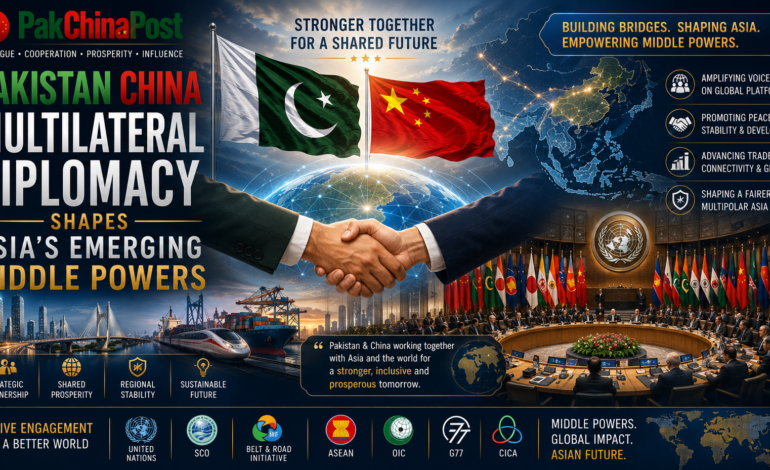
Pakistan China Multilateral Diplomacy Shapes Asia’s Emerging Middle Powers


Pakistan China cooperation is increasingly entering a more sophisticated diplomatic phase in which bilateral engagement is no longer confined to infrastructure investment, commercial connectivity or traditional strategic coordination. Instead, both countries are operating within an increasingly competitive multilateral environment where emerging middle powers are redefining institutional bargaining, development finance, technology governance, climate negotiations and regulatory diplomacy. The gradual redistribution of diplomatic influence across Asia has reduced the monopoly previously exercised by major powers over international agenda setting, creating wider opportunities for capable regional actors to shape practical policy outcomes through coalition building rather than ideological alignment. Within this evolving diplomatic landscape, Pakistan possesses opportunities to complement China’s expanding institutional presence by strengthening issue based partnerships that reinforce regional stability while preserving strategic flexibility across increasingly diversified diplomatic relationships.
Asia’s diplomatic architecture has become considerably more complex than the bipolar strategic environment often portrayed by conventional geopolitical analysis. Middle powers including Indonesia, Türkiye, Saudi Arabia, the United Arab Emirates, Vietnam, Malaysia, Kazakhstan and several Central Asian republics are increasingly influencing financial governance, digital regulation, infrastructure standards, climate adaptation mechanisms and regional security dialogues. Their growing diplomatic activism reflects expanding economic capabilities, institutional confidence and recognition that multilateral negotiations increasingly reward coalition management instead of unilateral influence. Pakistan and China therefore confront a regional environment where diplomatic success depends less upon formal alliances and increasingly upon issue specific partnerships capable of producing measurable institutional outcomes.
China’s diplomatic transformation has progressively shifted from participation within established multilateral institutions towards active institutional entrepreneurship. Rather than relying exclusively upon existing organisations, Beijing has invested substantial political capital in constructing complementary financial, commercial and development platforms including the Asian Infrastructure Investment Bank, the New Development Bank partnership frameworks, Belt and Road cooperation mechanisms and various specialised development funds. These institutions seek not to replace the existing international order entirely but to expand governance options available to developing economies seeking infrastructure finance, technological cooperation and industrial modernisation. Pakistan occupies a strategically advantageous position within these evolving architectures because its geographical location connects South Asia, Central Asia, the Middle East and the western reaches of China through commercially significant transit corridors.
Pakistan’s diplomatic challenge is considerably more nuanced than selecting between competing geopolitical alignments. Contemporary diplomacy increasingly rewards countries capable of maintaining diversified relationships across multiple institutional platforms while avoiding unnecessary strategic exclusivity. Islamabad’s engagement with China therefore requires careful calibration alongside constructive interaction with Gulf partners, Central Asian economies, Southeast Asian states, European institutions and international financial organisations. Such diplomatic diversification strengthens Pakistan’s negotiating capacity while reducing excessive dependence upon any single external relationship.
Development financing illustrates how middle power diplomacy increasingly influences international governance. Traditional multilateral lending institutions continue playing essential roles, yet regional development banks, sovereign investment funds, blended finance initiatives and infrastructure partnerships are becoming equally influential in determining investment flows. Pakistan and China possess opportunities to jointly advocate financing models that emphasise project sustainability, industrial productivity, technological upgrading and institutional capacity rather than purely macroeconomic stabilisation. Such approaches would resonate across numerous developing economies confronting similar infrastructure deficits and industrial transition challenges.
The growing prominence of sovereign wealth funds across Asia and the Gulf has fundamentally altered development diplomacy. Financial negotiations increasingly involve state investment authorities operating alongside conventional development institutions. Pakistan and China can coordinate diplomatic engagement with these emerging financial actors by presenting infrastructure projects supported through transparent regulatory mechanisms, commercially viable feasibility assessments and predictable governance arrangements. Institutional credibility increasingly determines investment decisions as much as geopolitical considerations.
Technology governance represents another diplomatic arena where middle powers are becoming increasingly influential. Artificial intelligence regulation, cybersecurity standards, digital trade frameworks, cross border data governance, quantum communications, semiconductor supply resilience and digital payment interoperability are generating new forms of international negotiation extending beyond traditional security institutions. China possesses substantial technological capabilities while Pakistan increasingly seeks digital modernisation through regulatory reform and technological partnerships. Joint diplomatic engagement within international technology forums can strengthen both countries’ influence over emerging governance standards without unnecessarily politicising technological cooperation.
Digital sovereignty has become one of the defining diplomatic concepts shaping twenty first century multilateral negotiations. Governments increasingly recognise that technological infrastructure constitutes strategic national capability rather than merely commercial investment. Pakistan and China therefore share common interests in promoting internationally accepted principles governing digital infrastructure security, responsible artificial intelligence deployment, secure telecommunications architecture and equitable technological access for developing economies. Their diplomatic coordination should remain grounded in internationally recognised regulatory principles capable of attracting broader multilateral support rather than narrowly defined geopolitical narratives.
Climate diplomacy increasingly demonstrates the growing influence of middle powers over international negotiations. Developing economies now possess greater bargaining leverage because successful global climate governance requires participation from rapidly industrialising states confronting significant developmental challenges. Pakistan’s vulnerability to climate induced disasters provides considerable diplomatic legitimacy within international adaptation discussions, while China’s expanding investment in renewable technologies positions Beijing as a major supplier of climate related industrial capabilities. Coordinated diplomatic initiatives emphasising adaptation finance, resilient infrastructure, clean manufacturing and disaster risk governance could strengthen both countries’ standing within international environmental negotiations.
Water governance similarly presents expanding opportunities for constructive multilateral diplomacy. Climate variability, glacier retreat, river basin management and agricultural resilience increasingly require cooperative regional responses extending beyond bilateral arrangements. Pakistan and China can jointly promote scientific cooperation, hydrological data exchange, watershed management technologies and climate adaptation financing through regional institutions capable of supporting practical environmental governance rather than politically polarised debates.
International trade governance is simultaneously undergoing profound institutional transformation. Supply chain resilience, industrial subsidies, carbon border adjustment mechanisms, environmental compliance standards and digital trade regulations increasingly influence commercial competitiveness. Middle powers are becoming decisive participants in shaping these evolving trade rules because their manufacturing sectors, logistics capabilities and export markets collectively represent substantial economic influence. Pakistan and China should strengthen diplomatic cooperation supporting transparent trade facilitation, harmonised customs procedures, regulatory interoperability and mutually recognised industrial standards capable of enhancing commercial predictability across Asia.
Regional organisations are acquiring greater diplomatic significance as global governance becomes increasingly decentralised. The Shanghai Cooperation Organisation, Economic Cooperation Organization, Asian Infrastructure Investment Bank and other regional institutions provide increasingly valuable diplomatic platforms where middle powers exercise substantial influence over infrastructure financing, transport connectivity, counterterrorism cooperation, energy integration and commercial regulation. Pakistan should utilise these institutions not merely as participants but as policy entrepreneurs capable of introducing operational initiatives addressing specific regional governance challenges.
Institutional diplomacy increasingly rewards technical competence over rhetorical positioning. Successful proposals require detailed regulatory frameworks, measurable implementation strategies, sustainable financing structures and credible administrative capacity. Pakistan’s diplomatic institutions should therefore strengthen specialised expertise across digital governance, climate finance, industrial policy, development economics, infrastructure regulation and emerging technologies. China similarly benefits when partner countries possess institutional capabilities enabling effective implementation of jointly negotiated initiatives.
Norm formation has become one of the least appreciated dimensions of contemporary international competition. International standards governing investment transparency, infrastructure quality, cybersecurity, digital commerce, environmental reporting and industrial sustainability increasingly shape long term commercial relationships. Rather than allowing external actors exclusively to determine these standards, Pakistan and China possess opportunities to participate actively in their formulation through constructive engagement within specialised international organisations. Normative influence increasingly depends upon practical regulatory proposals supported by demonstrable implementation experience.
Health diplomacy offers another expanding field for middle power cooperation. Pandemic preparedness, pharmaceutical manufacturing, biotechnology regulation, medical research partnerships and healthcare logistics increasingly require coordinated international governance. Pakistan’s expanding pharmaceutical sector combined with China’s manufacturing capabilities could support broader regional health resilience through collaborative production, regulatory harmonisation and medical technology partnerships benefiting neighbouring developing economies.
Educational diplomacy remains an underutilised instrument within Pakistan China cooperation. Future diplomatic influence increasingly depends upon cultivating professional networks connecting policymakers, researchers, regulatory specialists, engineers and technology experts across emerging economies. Joint scholarship programmes, public policy institutes, governance academies, technology research centres and administrative training initiatives can produce long term institutional relationships significantly exceeding the influence generated through traditional diplomatic exchanges alone.
Commercial diplomacy increasingly overlaps with strategic diplomacy. Investment promotion agencies, export authorities, industrial regulators and development finance institutions now perform functions previously reserved primarily for foreign ministries. Pakistan should establish integrated diplomatic coordination mechanisms ensuring commercial, technological and regulatory objectives reinforce broader foreign policy priorities. China has progressively adopted similar whole of government approaches linking diplomatic engagement with economic modernisation objectives.
Financial diplomacy similarly requires expanding institutional sophistication. Cross border payment systems, local currency settlements, digital finance regulation, sovereign debt management and investment protection mechanisms increasingly shape bilateral economic resilience. Pakistan and China should strengthen cooperation supporting financial transparency, regulatory coordination, banking supervision and liquidity management capable of reducing transaction uncertainty while maintaining macroeconomic stability.
Maritime diplomacy deserves greater prominence within Pakistan China multilateral engagement. The Indian Ocean increasingly functions as a central theatre connecting energy transportation, commercial shipping, submarine communications infrastructure and maritime environmental governance. Pakistan’s coastal geography and China’s maritime commercial interests create shared incentives supporting navigation safety, port governance, marine environmental protection and logistics resilience through internationally recognised cooperative mechanisms.
Central Asia constitutes another important diplomatic frontier where Pakistan China cooperation could generate wider regional benefits. Energy connectivity, transport infrastructure, customs harmonisation, digital trade corridors and educational exchanges collectively offer practical opportunities supporting economic integration without generating unnecessary geopolitical sensitivities. Institutional coordination with Central Asian governments should prioritise commercially viable projects accompanied by regulatory convergence and administrative capacity enhancement.
The Gulf region increasingly represents an essential component of Pakistan China multilateral diplomacy. Gulf sovereign wealth funds, renewable energy investment, logistics infrastructure, artificial intelligence development and industrial diversification strategies create numerous opportunities for triangular cooperation involving Pakistan, China and Gulf partners. Such arrangements diversify financial participation while reducing implementation risks associated with excessively concentrated funding structures.
Africa also presents expanding diplomatic opportunities. Numerous African governments seek infrastructure development, industrial modernisation, vocational education and digital transformation through diversified international partnerships. Pakistan and China can jointly contribute specialised expertise in vocational training, agricultural technologies, pharmaceutical manufacturing and public sector capacity development while respecting national ownership and local development priorities.
International negotiations increasingly reward countries capable of producing technically credible proposals rather than broad political declarations. Pakistan should therefore invest substantially in diplomatic research units integrating economists, engineers, legal experts, environmental scientists, digital specialists and strategic analysts into negotiation teams. Modern diplomacy requires interdisciplinary competence capable of addressing increasingly technical multilateral agendas.
Information credibility has likewise become an essential diplomatic asset. International partners increasingly evaluate governance performance through measurable implementation indicators rather than political commitments alone. Pakistan China cooperation should therefore emphasise transparent project evaluation, independent monitoring, evidence based reporting and internationally recognised performance benchmarks strengthening institutional confidence among investors, development partners and regional stakeholders.
Strategic communication requires corresponding modernisation. Diplomatic narratives should increasingly highlight tangible developmental outcomes including employment generation, technological upgrading, educational cooperation, environmental sustainability and institutional strengthening rather than relying predominantly upon geopolitical symbolism. International legitimacy expands when policy initiatives demonstrate measurable public value supported through credible empirical evidence.
Establishment planners within Pakistan must recognise that diplomatic resilience increasingly derives from institutional competence rather than purely strategic geography. Geographic advantages remain significant, yet sustainable influence depends upon administrative efficiency, regulatory consistency, technological capability, commercial competitiveness and diplomatic professionalism. China similarly benefits from partnerships grounded in capable institutions capable of translating strategic agreements into operational achievements.
Pakistan should therefore pursue a comprehensive multilateral strategy integrating foreign policy, commercial diplomacy, technological cooperation and institutional reform into a coherent national framework. Diplomatic engagement with China should continue expanding across regional organisations, development finance institutions, technology governance platforms, climate negotiations and international regulatory forums while simultaneously preserving constructive engagement with broader international partners. Institutional diversification strengthens national autonomy by increasing diplomatic options rather than constraining them.
China, for its part, should continue encouraging inclusive regional governance models emphasising transparency, commercial sustainability, local capacity development and practical implementation. Infrastructure cooperation should increasingly incorporate vocational training, technology transfer, industrial innovation, environmental safeguards and institutional strengthening as integral components rather than supplementary considerations. Such an approach would reinforce long term regional confidence while reducing perceptions of geopolitical exclusivity.
The emerging diplomatic environment offers Pakistan and China an opportunity extending beyond conventional bilateral cooperation. Asia’s increasingly influential middle powers are reshaping international governance through pragmatic coalition building, specialised institutional engagement and technically sophisticated policy coordination. Pakistan China cooperation can become an important contributor to this evolving multilateral landscape by prioritising measurable development outcomes, regulatory innovation, institutional credibility and inclusive diplomatic partnerships. Success will depend not upon rhetorical assertions of strategic importance but upon consistent delivery of practical governance solutions capable of strengthening regional stability, expanding economic opportunity and contributing constructively to an increasingly plural international order.
A Public Service Message