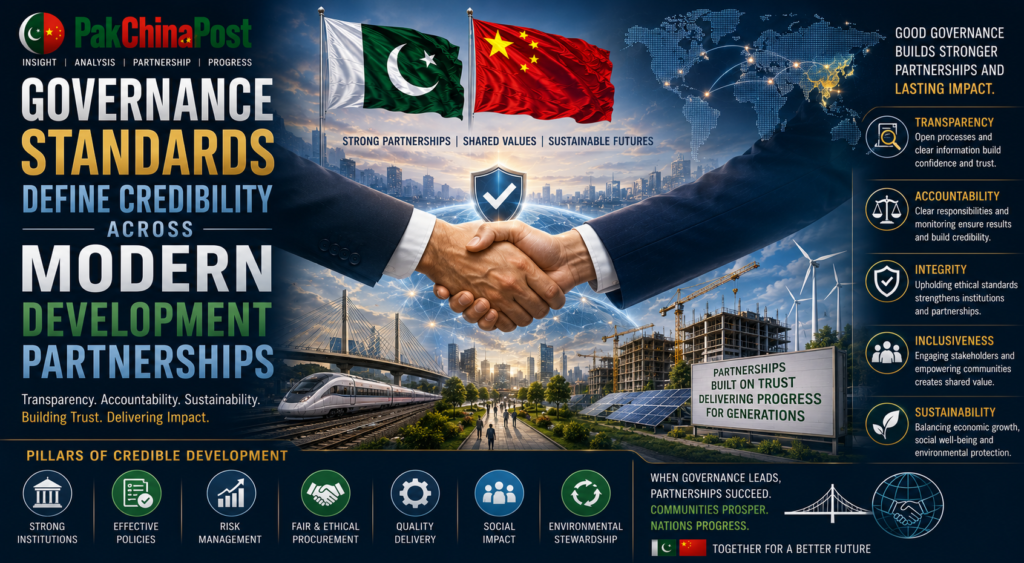
Governance Standards Define Credibility Across Modern Development Partnerships

Pakistan China cooperation is entering a period where international credibility will increasingly depend not upon the scale of financial commitments but upon the quality of governance accompanying every development initiative. The international development environment has moved decisively beyond measuring partnerships through kilometres of highways, gigawatts of electricity generation or billions of dollars committed. Governments, sovereign investors, export credit agencies, multilateral development institutions, commercial insurers and global manufacturing networks now evaluate infrastructure through governance performance, regulatory predictability, environmental compliance, institutional transparency and implementation integrity. Within this evolving landscape, Pakistan and China confront a strategic opportunity to demonstrate that development partnerships can simultaneously deliver economic transformation, institutional accountability and long term sustainability. The defining competition is no longer between competing financing packages. It has become a contest over governance models capable of maintaining confidence throughout the complete lifecycle of infrastructure development.
International development standards have undergone a profound transformation during the past decade. Earlier assessments primarily examined whether financing could be mobilised rapidly for strategic infrastructure. Contemporary evaluations increasingly focus upon procurement transparency, contractual enforcement, debt sustainability, environmental management, operational resilience, public accountability, dispute resolution mechanisms and regulatory effectiveness. This transition reflects the maturation of global infrastructure markets where investors have become increasingly sensitive to governance risks rather than engineering complexity alone. Infrastructure today represents an integrated institutional ecosystem instead of isolated physical construction.
Global capital markets reinforce this transformation through increasingly sophisticated risk assessment methodologies. Sovereign lending decisions increasingly incorporate governance indicators alongside macroeconomic performance. Pension funds, insurance companies, sovereign wealth funds and institutional investors seek regulatory certainty before committing long term capital. Infrastructure has consequently become inseparable from institutional credibility. Financial volume may attract initial attention, yet governance quality ultimately determines investment durability.
For Pakistan and China, this transition creates strategic implications extending well beyond bilateral economic cooperation. CPEC’s second phase will inevitably be evaluated through governance outcomes rather than construction statistics. International observers will increasingly examine project disclosure practices, procurement procedures, operational efficiency, environmental compliance, labour standards, community consultation and institutional accountability. Infrastructure diplomacy therefore becomes governance diplomacy.
The strategic narrative surrounding international development has likewise evolved. Earlier geopolitical debates frequently concentrated upon competing financing initiatives offered by different powers. Current international discourse instead scrutinises implementation quality. Governments increasingly compare administrative performance across competing development models. Questions concerning institutional resilience, legal certainty and policy consistency now dominate discussions surrounding international partnerships. Development diplomacy consequently rewards administrative sophistication instead of financial magnitude alone.
Governance competition also reflects changing expectations among recipient countries themselves. Developing economies increasingly recognise that infrastructure generates sustainable economic value only when embedded within competent regulatory systems. Poor procurement oversight, fragmented institutional coordination, delayed dispute resolution, inconsistent environmental enforcement and weak maintenance planning gradually erode infrastructure performance regardless of initial investment size. Governance deficiencies ultimately become financial liabilities.
Pakistan occupies an especially significant position within this international transition because it represents one of the largest laboratories for contemporary infrastructure cooperation. CPEC encompasses transport, energy, digital connectivity, industrial development and logistics integration across multiple institutional jurisdictions. The programme therefore offers substantial opportunities for demonstrating governance innovation capable of influencing broader international perceptions regarding development partnerships.
China simultaneously faces growing expectations regarding overseas project governance. As Chinese enterprises expand international infrastructure engagement, external evaluations increasingly examine operational transparency, environmental management, financial disclosure, stakeholder consultation and compliance with host country regulations. Successful adaptation to these expectations will determine whether Chinese development partnerships maintain long term legitimacy across diverse political environments.
The emerging governance competition should therefore not be interpreted exclusively through geopolitical rivalry. Instead, it represents institutional evolution responding to increasingly complex infrastructure ecosystems. Modern infrastructure integrates finance, technology, digital management systems, environmental safeguards, cybersecurity, climate resilience and social inclusion. Effective governance consequently requires multidimensional institutional capabilities extending far beyond conventional administrative oversight.
Debt sustainability illustrates this transformation particularly clearly. International concern has progressively shifted away from aggregate borrowing levels towards governance mechanisms governing debt management. Transparent contractual arrangements, realistic revenue projections, disciplined fiscal planning and independent financial monitoring contribute more significantly to long term sustainability than arbitrary debt thresholds. Countries with robust governance structures frequently sustain larger infrastructure portfolios than jurisdictions exhibiting weaker institutional capacity.
Pakistan therefore benefits from strengthening debt governance rather than merely defending financing decisions. Comprehensive public debt reporting, transparent contingent liability management, coordinated fiscal oversight and independent infrastructure performance evaluation would strengthen both domestic confidence and international credibility. Such reforms reduce uncertainty while enhancing investor confidence.
Environmental governance represents another defining dimension shaping international perceptions. Infrastructure projects increasingly encounter scrutiny regarding biodiversity protection, emissions management, water resource utilisation, waste disposal, climate adaptation and ecosystem resilience. International investors increasingly integrate environmental performance into financing decisions through environmental, social and governance assessment frameworks. Development partnerships unable to demonstrate measurable environmental responsibility may experience rising financing costs and declining commercial attractiveness.
Pakistan and China possess substantial opportunities for institutional learning within environmental governance. Environmental impact assessments require greater scientific sophistication supported by digital monitoring technologies, satellite observation systems, independent auditing mechanisms and continuous compliance verification. Environmental governance should become operational rather than procedural, emphasising measurable outcomes instead of documentary compliance.
Transparency standards have similarly acquired strategic significance extending beyond traditional anti corruption objectives. Transparency now functions as a mechanism reducing investment uncertainty, strengthening commercial predictability and improving public legitimacy. International markets reward jurisdictions capable of providing reliable regulatory information, accessible procurement documentation and predictable administrative procedures.
Pakistan’s governance reforms should therefore prioritise digital transparency platforms integrating procurement announcements, implementation milestones, expenditure reporting, contractor performance, environmental monitoring and dispute resolution status. Such integrated governance architecture would substantially improve international confidence while simultaneously strengthening domestic accountability.
China likewise continues refining overseas project governance through increasingly sophisticated compliance frameworks. Greater harmonisation between Chinese financing institutions, host country regulators and international best practice standards would reduce administrative ambiguity while strengthening project legitimacy. Governance convergence rather than governance uniformity represents the more realistic objective.
Infrastructure quality itself increasingly reflects governance performance instead of engineering capability alone. Well constructed infrastructure deteriorates rapidly without competent maintenance institutions, sustainable financing mechanisms, operational accountability and performance monitoring. Lifecycle governance consequently determines infrastructure value more decisively than initial construction quality.
Pakistan confronts longstanding institutional challenges concerning maintenance governance. Budget allocations frequently prioritise new construction while neglecting operational sustainability. Predictive maintenance systems, performance based maintenance contracts and digital infrastructure monitoring could substantially improve long term asset performance. Chinese technological capabilities provide valuable opportunities supporting such institutional modernisation.
Regulatory consistency represents another increasingly influential determinant of international confidence. Investors frequently tolerate commercial risk when regulatory expectations remain predictable. Conversely, inconsistent policy implementation generates uncertainty irrespective of favourable financial incentives. Governance credibility therefore depends upon institutional stability rather than administrative discretion.
Pakistan should pursue regulatory harmonisation across federal ministries, provincial authorities, special economic zones, customs administration and infrastructure regulators. Fragmented regulatory environments increase transaction costs while discouraging long term investment. Institutional coordination should become a central governance objective rather than an administrative aspiration.
Institutional accountability similarly requires modernisation. Conventional oversight mechanisms frequently examine procedural compliance without evaluating developmental effectiveness. Contemporary governance increasingly emphasises performance accountability through measurable indicators examining operational efficiency, financial sustainability, environmental outcomes, employment generation, technological transfer and regional economic integration.
Pakistan China cooperation could establish joint infrastructure performance observatories employing independent technical experts, economists, engineers, environmental specialists and digital analysts. Periodic public reporting based upon internationally recognised indicators would significantly strengthen credibility while encouraging continuous institutional improvement.
Digital governance technologies further transform infrastructure oversight. Artificial intelligence, satellite monitoring, blockchain documentation, predictive maintenance analytics, digital procurement systems and real time financial reporting enable unprecedented transparency throughout project implementation. Countries adopting such technologies gain substantial governance advantages by reducing administrative opacity while strengthening operational efficiency.
Pakistan possesses considerable opportunities integrating digital governance architecture across major development initiatives. Unified digital platforms linking planning, procurement, implementation, monitoring and evaluation would reduce institutional fragmentation while generating reliable governance data supporting strategic decision making.
Community engagement increasingly influences international assessments regarding development partnerships. Infrastructure projects demonstrating inclusive consultation, effective grievance mechanisms, local employment integration and transparent stakeholder communication generally encounter fewer implementation delays and greater political sustainability. Governance quality therefore incorporates societal legitimacy alongside administrative efficiency.
Pakistan should institutionalise structured community consultation frameworks extending throughout project lifecycles rather than limiting engagement to preliminary approval stages. Continuous stakeholder dialogue improves operational resilience while reducing misinformation and political controversy.
International commercial insurers likewise incorporate governance assessments into infrastructure risk calculations. Political risk insurance, export credit guarantees and investment protection mechanisms increasingly depend upon institutional quality indicators. Governance reform consequently produces measurable financial benefits through lower insurance premiums and improved financing conditions.
The relationship between governance and national security also deserves careful attention. Critical infrastructure increasingly intersects with cybersecurity, supply chain resilience, energy security, digital communications and strategic logistics. Weak governance within these sectors creates vulnerabilities extending beyond economic performance. Infrastructure governance therefore constitutes an essential component of comprehensive national resilience.
Pakistan China institutional cooperation should consequently integrate strategic risk assessment into infrastructure governance. Cybersecurity standards, operational redundancy planning, emergency response coordination, digital resilience protocols and critical asset protection should become routine governance requirements across major infrastructure projects.
International norm formation increasingly rewards countries demonstrating practical governance innovation rather than ideological advocacy. Successful governance models gain international influence because they generate measurable developmental outcomes capable of replication elsewhere. Pakistan and China possess opportunities contributing constructively to evolving international development standards through demonstrated institutional effectiveness instead of rhetorical competition.
Academic cooperation can reinforce this process. Joint research institutions examining infrastructure governance, regulatory innovation, environmental compliance, digital administration and development finance would generate policy evidence supporting continuous institutional refinement. Governance improvement should become evidence based rather than politically reactive.
Professional capacity building remains equally essential. Infrastructure governance requires multidisciplinary expertise encompassing engineering, economics, finance, environmental science, digital technology, public administration and international law. Pakistan should substantially expand specialised training programmes developing governance professionals capable of managing increasingly sophisticated development ecosystems.
Independent evaluation mechanisms deserve comparable emphasis. Objective assessment conducted by technically competent institutions strengthens credibility more effectively than exclusively governmental reporting. Periodic governance audits examining financial performance, environmental compliance, regulatory effectiveness and socioeconomic outcomes provide valuable evidence supporting institutional learning while reassuring international stakeholders.
The strategic communications dimension cannot be overlooked. International perceptions frequently emerge from information asymmetry rather than governance failure itself. Pakistan and China should strengthen evidence based public communication supported by independently verified performance data, transparent reporting and measurable project outcomes. Credibility emerges through verifiable information rather than promotional narratives.
Institutional learning should operate bilaterally. Pakistan offers valuable experience regarding democratic oversight, federal administrative coordination and public stakeholder engagement. China contributes substantial expertise concerning large scale infrastructure implementation, industrial planning, digital governance technologies and long term strategic coordination. Combining these complementary strengths offers opportunities for developing governance practices reflecting practical operational requirements rather than imported institutional templates.
Development partnerships increasingly require adaptive governance capable of responding to technological innovation, climate uncertainty, geopolitical volatility and evolving financial markets. Static administrative frameworks cannot effectively manage dynamic infrastructure ecosystems. Institutional flexibility supported by predictable legal principles therefore becomes an essential governance characteristic.
The future credibility of international development partnerships will ultimately depend less upon ideological preferences than demonstrated administrative competence. Infrastructure quality, financial sustainability, environmental stewardship, regulatory predictability, technological transparency and institutional accountability collectively determine whether development cooperation generates enduring confidence. Governance has become the principal currency of international legitimacy.
For Pakistan and China, this transformation should not be viewed defensively but strategically. The next phase of bilateral cooperation offers opportunities to establish governance standards reflecting operational excellence, measurable accountability and internationally respected institutional performance. Establishing integrated project governance authorities with autonomous technical oversight, introducing mandatory digital procurement transparency across strategic infrastructure, institutionalising lifecycle maintenance financing, harmonising environmental compliance through real time monitoring technologies, strengthening sovereign debt governance with comprehensive disclosure frameworks, embedding cybersecurity protocols into all critical infrastructure planning, expanding independent performance audits involving academic and technical institutions, professionalising infrastructure regulation through specialised national training academies, and creating permanent Pakistan China governance dialogue mechanisms dedicated to continuous institutional improvement would substantially strengthen international confidence. In the increasingly competitive landscape of global development cooperation, the partnerships commanding enduring respect will not necessarily be those investing the greatest financial resources. They will be those demonstrating the highest standards of governance, institutional maturity and accountable statecraft across every phase of development implementation.
A Public Service Message