
Investment Architecture at a Crossroads: Strategic Implications of the Stalled Comprehensive Agreement on Investment Between China and the European Union

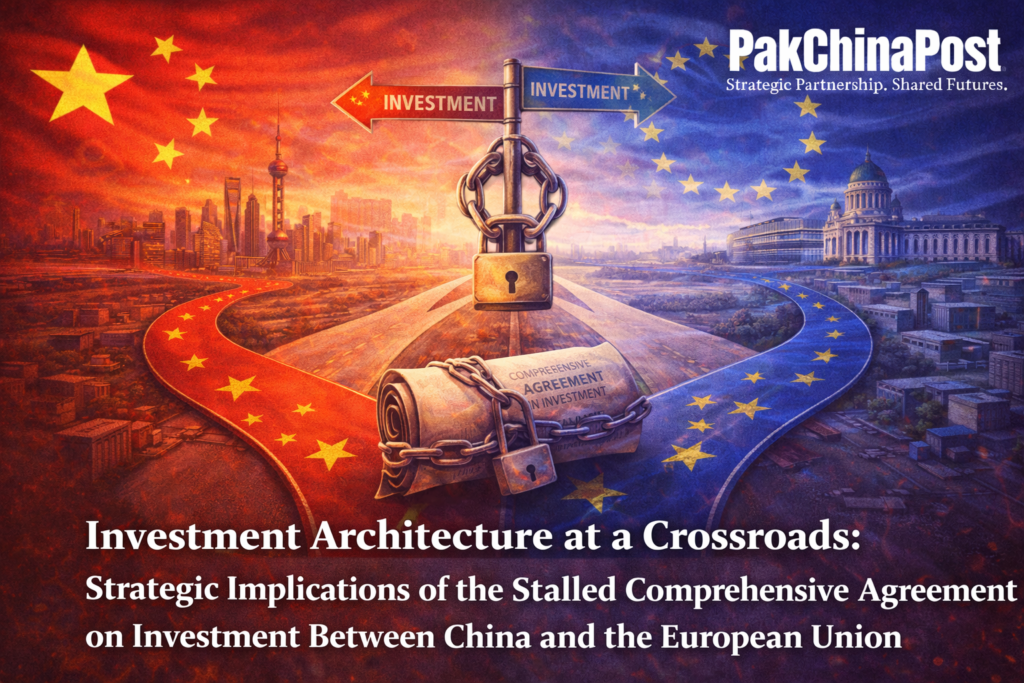
The trajectory of investment relations between China and the European Union stands at a decisive juncture. The Comprehensive Agreement on Investment (CAI), concluded in principle in December 2020 after seven years of negotiation but subsequently stalled amid political tensions, symbolizes both the depth of economic interdependence and the fragility of trust in a geopolitically sensitive environment. For diplomats tasked with managing bilateral relations, the CAI is not merely a technical trade instrument; it is a strategic architecture that reflects market access commitments, regulatory convergence, political signaling, and geoeconomic positioning.
The significance of the CAI must first be contextualized within the broader investment landscape. The European Union represents one of the largest sources of high-quality foreign direct investment globally, characterized by advanced manufacturing, technological sophistication, and long-term capital commitments. European firms have historically played a pivotal role in China’s industrial modernization, particularly in automotive engineering, chemicals, pharmaceuticals, and precision machinery. Conversely, Chinese investment into Europe expanded significantly in the mid-2010s, targeting infrastructure, robotics, energy assets, and logistics hubs.
However, investment flows have become increasingly politicized. The introduction of the EU FDI Screening Regulation, heightened parliamentary scrutiny, and normative debates regarding labor standards and human rights have altered the operating environment. The CAI was designed to address structural asymmetries by codifying market access commitments, enhancing transparency regarding state-owned enterprises (SOEs), and establishing dispute resolution mechanisms. Its provisional suspension therefore carries implications beyond immediate capital flows.
From China’s perspective, the CAI represented a strategic affirmation of reciprocal openness. The agreement included commitments to eliminate joint venture requirements in certain sectors, expand access in financial services and healthcare, and clarify subsidy transparency provisions. These concessions were intended to reassure European investors of predictable treatment while reinforcing China’s image as a reform-oriented economy.
The stall in ratification triggered by reciprocal sanctions between China and the European Parliament demonstrates the intersection of economic policy and political values. Investment agreements, particularly between advanced economies, are increasingly evaluated through a normative lens. This development signals that purely economic incentives may no longer suffice to secure legislative endorsement within the EU framework.
The implications for market access are multifaceted. In the absence of CAI ratification, European investors continue to rely on existing bilateral investment treaties and domestic Chinese regulatory reforms. While many sectors have liberalized progressively, the absence of a consolidated and binding framework generates residual uncertainty. Uncertainty affects capital allocation decisions, particularly in long-term infrastructure and high-technology ventures.
For China, stalled negotiations also influence outward investment strategy. European screening mechanisms, combined with political caution, have reduced Chinese acquisitions in sensitive sectors. The absence of a ratified CAI limits institutional safeguards for Chinese investors seeking predictable regulatory treatment in Europe. This may encourage diversification toward alternative regions; however, Europe’s market scale and technological ecosystem remain strategically valuable.
Capital flows between China and Europe are not solely transactional; they are embedded in industrial ecosystems. German automotive firms’ deep integration within the Chinese market illustrates reciprocal exposure. Any deterioration in investment climate risks disrupting supply chains and innovation collaboration that benefit both sides. The CAI, had it been ratified, could have provided a stabilizing anchor against episodic political turbulence.
Geoeconomic strategy must therefore consider both symbolic and material dimensions. Reviving the CAI would signal mutual commitment to rules-based engagement at a time of global fragmentation. Conversely, prolonged stagnation may reinforce narratives of systemic rivalry and encourage incremental decoupling.
China’s policy response should be structured around credibility, reciprocity, and integration.
First, domestic reform continuity is paramount. Even absent formal ratification, implementing elements of market liberalization originally envisioned under CAI commitments can demonstrate reliability. Transparent implementation of negative lists, enhanced protection of intellectual property rights, and predictable regulatory enforcement will reassure European stakeholders.
Second, structured political dialogue with EU institutions including the European Commission and key member states should aim to decouple economic cooperation from episodic political disputes where feasible. While normative disagreements may persist, compartmentalizing them can prevent total paralysis of economic instruments.
Third, investor confidence can be strengthened through institutional mechanisms. Expedited dispute resolution procedures, improved transparency regarding state subsidies, and consistent regulatory interpretation reduce perceived risk premiums. European investors prioritize predictability; aligning domestic administrative practices with that expectation enhances attractiveness.
Fourth, calibrated reciprocity remains essential. Where European screening mechanisms restrict Chinese investment in sensitive sectors, China may seek reciprocal dialogue rather than retaliatory measures. Negotiating sector-specific understandings particularly in green technology, sustainable finance, and digital innovation can generate momentum even if comprehensive agreement remains delayed.
Fifth, multilateral integration provides supplementary leverage. Active participation in World Trade Organization reform discussions, sustainable investment frameworks, and global arbitration conventions reinforces China’s commitment to rule-based economic order, indirectly strengthening its position in bilateral negotiations.
The broader strategic environment must also be acknowledged. Europe’s pursuit of “open strategic autonomy” does not inherently exclude partnership with China. Rather, it seeks to reduce unilateral vulnerability while maintaining diversified engagement. China can align its narrative with this objective by emphasizing complementary strengths rather than zero-sum competition.
Risk scenarios vary. In a constructive scenario, diplomatic normalization enables gradual revival of CAI ratification discussions, possibly with supplementary assurances addressing parliamentary concerns. In a prolonged stagnation scenario, bilateral investment flows continue but lack comprehensive institutionalization, increasing vulnerability to political disruption. In a deterioration scenario, escalating geopolitical tensions lead to restrictive regulatory actions, further fragmenting capital markets.
China’s long-term geoeconomic strategy should prioritize resilience across these scenarios. Diversifying outward investment destinations reduces overexposure, while deepening integration within Europe’s less sensitive sectors preserves engagement. Strategic patience is critical; investment agreements are inherently long-term frameworks whose benefits accrue over decades rather than electoral cycles.
Reputational stewardship also warrants emphasis. European political discourse is influenced by civil society and media scrutiny. Demonstrating adherence to international labor standards, environmental commitments, and corporate governance best practices can gradually rebuild trust necessary for legislative approval.
It is equally important to recognize Europe’s internal heterogeneity. Member states differ in economic structure, political orientation, and exposure to Chinese markets. Tailored bilateral engagement with individual member states within the parameters of EU competence—can sustain momentum even amid institutional delay at the Union level.
Ultimately, the CAI’s strategic significance transcends its technical provisions. It embodies the principle that structured interdependence is preferable to unmanaged rivalry. For China, securing favorable investment terms requires not only negotiation skill but systemic credibility. By aligning domestic reform with international transparency, reinforcing investor protections, and maintaining diplomatic restraint amid political disagreements, China can position itself as a stable partner within Europe’s evolving strategic calculus.
In conclusion, the stalled Comprehensive Agreement on Investment represents both a challenge and an opportunity. It highlights the politicization of economic instruments in contemporary international relations, yet also underscores the enduring necessity of institutionalized cooperation. China’s response should combine reform continuity, strategic patience, and calibrated diplomacy. Investment agreements must be integrated into a broader geoeconomic strategy that balances market openness with sovereign resilience. If managed prudently, the architecture of bilateral investment can be revitalized, reinforcing stability in one of the world’s most consequential economic relationships.
A Public Service Message