
Pakistan’s Strategic Role in China’s Global Supply Chain

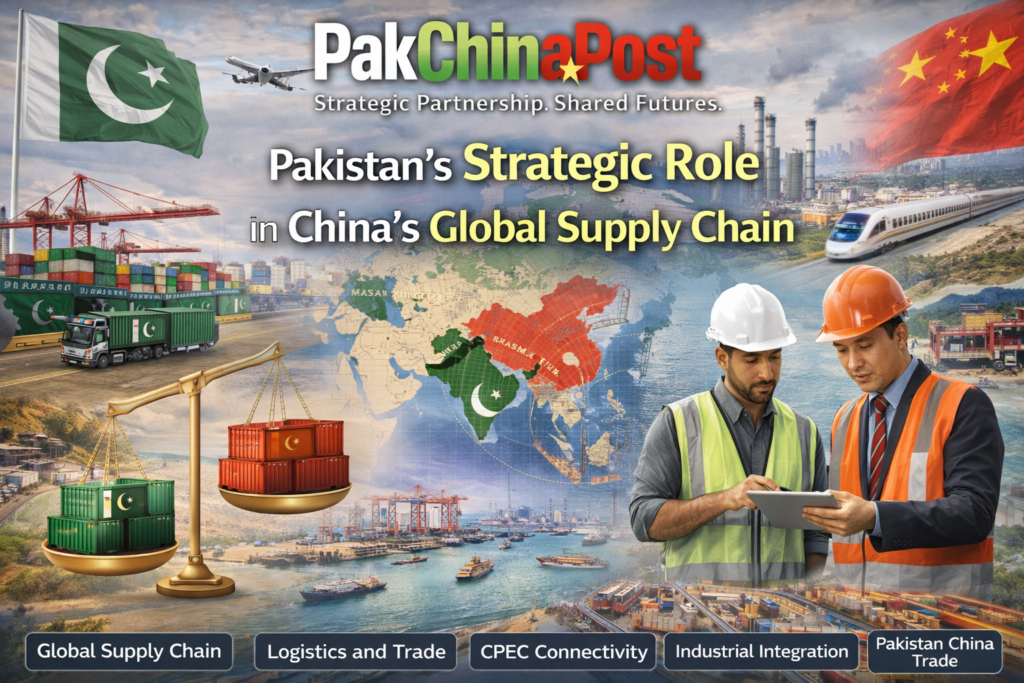
Pakistan occupies a strategically significant position in regional and global economic networks, and its integration into China’s global supply chain represents an unprecedented opportunity for industrial development, technology transfer, and economic transformation. The evolving dynamics of global manufacturing, regional connectivity, and value chain optimization position Pakistan not merely as a recipient of investment but as an active participant capable of contributing meaningfully to China’s regional and global industrial objectives. Its geographic proximity to key markets, access to the Arabian Sea, and developing industrial infrastructure provide natural advantages that can be leveraged through strategic policies and bilateral cooperation. Integration into China’s supply chains requires a comprehensive approach encompassing trade facilitation, industrial modernization, workforce development, infrastructure enhancement, regulatory alignment, and financial support, creating a mutually beneficial framework where Pakistan’s economic growth complements China’s strategic ambitions while contributing to regional stability and prosperity.
The first dimension of Pakistan’s strategic role lies in its geographic and logistical advantages. The country serves as a gateway connecting China to the Middle East, Central Asia, and Africa, providing both maritime and overland routes that can reduce transportation costs, enhance delivery efficiency, and improve overall supply chain resilience. The development of Gwadar port, expansion of transport corridors, and enhancement of rail and road networks under the China-Pakistan Economic Corridor exemplify how infrastructure investments translate into operational advantages for integrated supply chains. These projects not only facilitate the movement of goods but also provide a framework for clustering industrial activity around transport hubs, creating nodes where manufacturing, storage, and distribution can occur efficiently. Policy frameworks that prioritize logistical efficiency, customs modernization, and streamlined cross-border procedures further enhance Pakistan’s attractiveness as a reliable supply chain partner.
Trade facilitation policies play a crucial role in enabling Pakistan’s effective participation in China’s manufacturing and technology networks. Efficient customs processes, digital documentation systems, and harmonized regulatory standards reduce operational friction, lower transaction costs, and increase predictability for investors. Pakistan’s adoption of electronic customs clearance, integrated border management, and smart logistics solutions aligns with China’s own experience in modernizing supply chains, ensuring that goods move seamlessly across borders. Policies that incentivize adherence to quality standards, certifications, and international compliance frameworks provide assurance to Chinese partners that production in Pakistan meets global requirements. In this context, the emphasis on policy alignment ensures not only operational efficiency but also long-term credibility as a supplier capable of meeting the demands of sophisticated industrial networks.
Industrial modernization is another critical factor underpinning Pakistan’s integration into China’s global supply chain. Targeted investment in key sectors such as electronics, automotive components, precision machinery, renewable energy equipment, and value-added textile production allows Pakistan to move beyond raw material exports toward manufacturing of intermediate and finished goods demanded by Chinese and global markets. Policies that encourage joint ventures, co-investment, and industrial clustering enable technology transfer, enhance productivity, and promote innovation within domestic firms. By embedding industrial upgrading within a policy framework that emphasizes quality, standardization, and efficiency, Pakistan can create competitive manufacturing ecosystems capable of contributing meaningfully to supply chains while generating employment, upskilling the workforce, and fostering sustainable economic growth.
Workforce development is intrinsically linked to industrial competitiveness. Pakistan’s ability to integrate into China’s supply chains depends on the availability of skilled labor capable of meeting the technical demands of modern manufacturing. Vocational training programs, industry-academia partnerships, and technical education initiatives must be aligned with the requirements of Chinese partners to ensure seamless operational collaboration. Policies that promote continuous learning, capacity building, and professional certification not only increase productivity but also enhance the adaptability of Pakistan’s workforce to evolving technological standards and production methods. Strategic cooperation in skill development strengthens human capital, which is essential for sustaining high-value manufacturing and ensuring that Pakistan’s participation in supply chains is both meaningful and long-term.
Financial and fiscal policies play a complementary role in enabling Pakistan’s strategic engagement. Access to affordable credit, investment facilitation, tax incentives, and export financing mechanisms are critical for mobilizing domestic and foreign resources to support industrial expansion. Collaboration with Chinese financial institutions, including trade credit facilities, investment funds, and financial technology platforms, provides additional avenues for resource mobilization and risk mitigation. Policies that integrate financial planning with industrial strategy ensure that capital allocation supports high-impact sectors, reduces operational risks, and aligns with long-term objectives of bilateral cooperation. Such mechanisms also reinforce the stability and predictability required by multinational enterprises considering Pakistan as a hub within China’s supply chain network.
Regulatory alignment and institutional capacity are essential for sustaining integration into global supply chains. Transparent regulations, consistent enforcement, intellectual property protection, and investor-friendly dispute resolution mechanisms enhance confidence among Chinese partners and international stakeholders. Policies that harmonize domestic standards with those applied in China’s industrial ecosystems reduce barriers to collaboration, facilitate joint venture operations, and ensure compliance with international norms. Strong institutional capacity also enables adaptive management, monitoring of performance metrics, and continuous improvement in operational efficiency, reinforcing Pakistan’s reputation as a reliable and capable partner within sophisticated supply networks.
The strategic dimension of Pakistan’s role extends beyond operational participation to its function as a stabilizing node in regional and global supply chains. By providing reliable infrastructure, skilled labor, and supportive policies, Pakistan enhances the resilience of China’s manufacturing networks against disruptions in other regions. This strategic value is particularly pronounced in the context of global supply chain risks, including geopolitical uncertainties, natural disasters, and market volatility. Pakistan’s integration into diversified production networks supports risk mitigation, ensures continuity of supply, and reinforces the mutual benefits of bilateral economic engagement. Policy frameworks that recognize and strengthen this strategic function amplify the long-term significance of Pakistan-China collaboration.
Export diversification is closely linked to Pakistan’s strategic engagement in China’s supply chain. By expanding production into sectors that align with Chinese demand and global market trends, Pakistan can reduce dependency on traditional commodities and increase value-added outputs. Policies that incentivize diversification, support research and development, and encourage innovation create industrial ecosystems capable of producing competitive goods. Diversified exports not only improve trade balance but also enhance Pakistan’s bargaining position within bilateral and multilateral economic frameworks, positioning the country as a strategic partner rather than a peripheral supplier.
Innovation and technology transfer form a core component of the policy architecture required for effective supply chain integration. Joint ventures, research collaborations, and knowledge exchange programs facilitate the adoption of advanced manufacturing techniques, process optimization, and product innovation. Policies that encourage collaboration in technological innovation, protect intellectual property, and provide mechanisms for scaling successful prototypes ensure that Pakistan’s industrial sector evolves in tandem with global standards. This alignment fosters long-term competitiveness, reinforces the credibility of Pakistan as a reliable production partner, and enhances the sustainability of China-Pakistan economic collaboration.
Sustainability and environmental considerations are increasingly integral to supply chain participation. Policies that embed green manufacturing practices, energy efficiency standards, and waste management protocols not only align with global regulatory expectations but also enhance competitiveness in environmentally conscious markets. Integration into China’s supply chain networks benefits from adherence to sustainability criteria, as multinational corporations and Chinese partners prioritize partners capable of delivering goods within compliant, eco-efficient frameworks. Policy incentives, regulatory enforcement, and capacity building in environmental management contribute to the long-term viability of industrial expansion and trade integration.
Risk management and resilience form another critical policy consideration. Geopolitical tensions, market volatility, and global economic shocks can disrupt supply chain continuity. Policies that encourage diversification of production, establishment of strategic reserves, contingency planning, and real-time monitoring of supply chain performance mitigate these risks. By aligning Pakistan’s industrial and trade policies with risk management frameworks, the country enhances its reliability and attractiveness as a partner in China’s global manufacturing networks.
In conclusion, Pakistan’s strategic role in China’s global supply chain is predicated on a comprehensive policy framework that integrates trade facilitation, industrial modernization, workforce development, regulatory alignment, financial support, and sustainability measures. By leveraging its geographic advantages, human capital potential, and infrastructural assets, Pakistan can position itself as a reliable, capable, and strategically significant partner within China’s regional and global economic networks. Policies that promote export diversification, joint ventures, technology transfer, and environmental compliance ensure that the benefits of integration are mutually advantageous, economically sustainable, and strategically aligned with China’s long-term objectives. Thoughtful, research-based policy design, operational coherence, and bilateral collaboration create a scenario where Pakistan contributes meaningfully to global supply chains while realizing its industrial and economic ambitions, strengthening the foundation for enduring partnership and regional economic stability.
A Public Service Message