
China’s Structural Economic Slowdown and the Testing Limits of State Capitalism

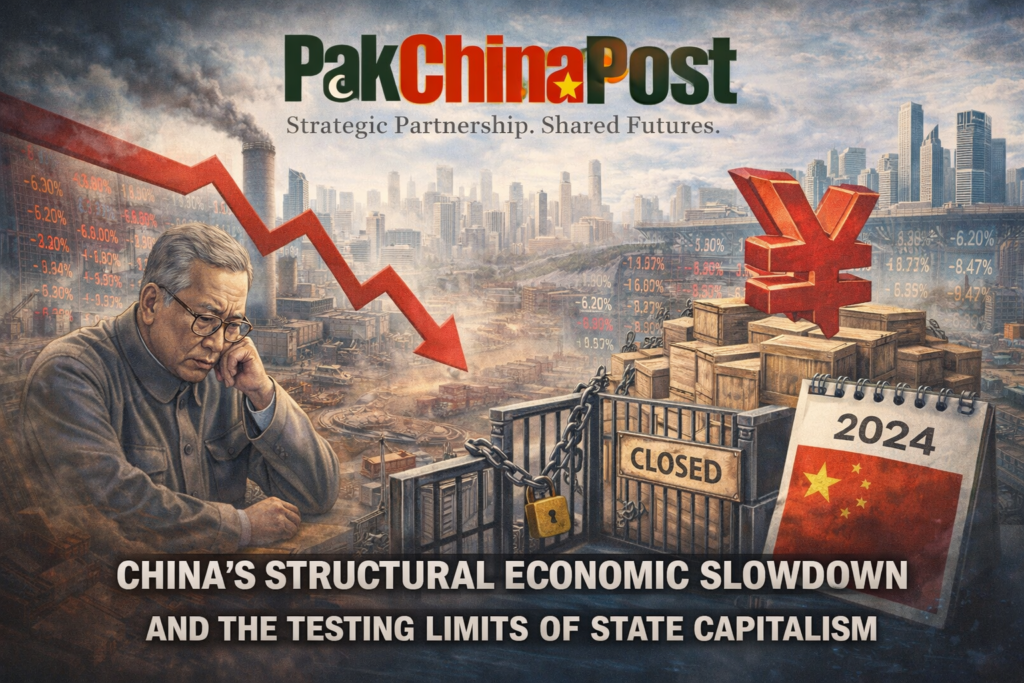
China’s economic trajectory has entered a phase that is no longer defined by the certainties of rapid expansion but by the complexities of structural recalibration. For over four decades, the Chinese growth model stood as a remarkable synthesis of state direction and market dynamism, delivering unprecedented industrialization, urbanization, and poverty reduction. Yet in 2026, the contours of this model are under strain. What is unfolding is not a cyclical slowdown but a deeper structural shift that raises fundamental questions about sustainability, adaptability, and the long-term viability of state capitalism as practiced under the central leadership of Xi Jinping.
At the core of this transformation lies the diminishing effectiveness of China’s traditional growth drivers. Investment-led expansion, particularly through infrastructure and real estate, once functioned as the engine of economic acceleration. Massive state-directed capital flows enabled the rapid construction of cities, transport networks, and industrial zones, creating both employment and demand. However, this model has reached the point of diminishing returns. Many regions now face overcapacity in infrastructure, while real estate markets have become saturated, with declining demand exposing financial vulnerabilities that had long been obscured by continuous expansion.
The property sector crisis represents perhaps the most visible manifestation of these structural imbalances. For years, real estate served as a cornerstone of economic activity, accounting for a substantial share of GDP when related industries are included. It also functioned as a primary vehicle for household wealth accumulation and a key revenue source for local governments through land sales. The unraveling of major property developers, liquidity constraints, and declining homebuyer confidence have disrupted this ecosystem. The consequences extend beyond construction to banking stability, consumer sentiment, and fiscal capacity at the provincial level. This is not merely a sectoral correction but a systemic challenge that underscores the fragility embedded within China’s growth architecture.
Parallel to these financial pressures is the demographic reality confronting the Chinese economy. The country’s population has begun to decline, and the working-age cohort is shrinking. This demographic inversion marks a historic departure from the labor abundance that fueled China’s manufacturing dominance. Rising labor costs, coupled with an aging population, are altering the comparative advantages that once positioned China as the world’s factory. Productivity gains are therefore essential to sustaining growth, yet productivity itself has shown signs of stagnation. The transition from labor-intensive manufacturing to high-value innovation-driven industries is proving more complex than anticipated.
Consumption, often cited as the necessary pillar of a rebalanced economy, has yet to fully assume its intended role. Chinese households continue to exhibit high savings rates, driven by structural uncertainties related to healthcare, education, and social security. The erosion of property wealth and concerns about future income have further dampened consumption confidence. Without a robust expansion of domestic demand, efforts to shift away from investment dependency remain constrained. This imbalance reinforces the cyclical reliance on state intervention to stimulate growth, perpetuating the very model that structural reform seeks to transcend.
The role of the state within this evolving landscape has become increasingly pronounced. Under Xi Jinping’s leadership, there has been a clear reassertion of political authority over economic activity. Regulatory campaigns targeting major technology firms, private education companies, and digital platforms reflect a broader effort to align economic actors with national strategic priorities. While these measures are framed in terms of social equity, data security, and long-term stability, they have also introduced a degree of uncertainty into the private sector. Entrepreneurs and investors must now navigate an environment where policy direction can shift rapidly, and where political considerations often supersede market logic.
This recalibration of state and market relations raises critical questions about the future of innovation in China. Historically, the private sector has been a key driver of technological advancement and job creation. The tightening of regulatory oversight, combined with increased party presence within corporate governance structures, may constrain the flexibility and risk-taking necessary for breakthrough innovation. At the same time, the state is channeling vast resources into strategic industries such as semiconductors, artificial intelligence, and renewable energy. The effectiveness of this approach depends on whether centralized planning can replicate or complement the dynamism typically associated with decentralized market competition.
Local governments, long instrumental in executing national development strategies, are also facing mounting fiscal stress. Their dependence on land sales as a primary revenue source has been severely undermined by the property downturn. This has implications for public investment, social services, and debt sustainability. Many local authorities are grappling with high levels of hidden debt accumulated through financing vehicles used to fund infrastructure projects. The central government’s efforts to manage these liabilities without triggering financial instability add another layer of complexity to the policy environment.
Externally, China’s economic challenges are intersecting with an increasingly contested global landscape. Trade tensions, technological restrictions, and shifting supply chains are reshaping the context within which China operates. While the country remains deeply integrated into the global economy, there is a discernible movement toward diversification among multinational corporations seeking to mitigate geopolitical risks. This does not imply a wholesale decoupling but suggests a gradual reconfiguration that could affect China’s export dynamics and industrial positioning.
In response, Chinese policymakers have emphasized the concept of dual circulation, aiming to strengthen domestic economic resilience while maintaining selective openness to international markets. This strategy reflects an acknowledgment of external uncertainties and an attempt to reduce vulnerability to external shocks. However, its success hinges on the ability to stimulate internal demand, enhance technological self-reliance, and maintain sufficient levels of foreign investment and trade engagement.
The interplay between economic policy and political legitimacy is particularly significant in the Chinese context. The social contract that has underpinned the Chinese Communist Party’s authority is closely linked to the delivery of sustained economic growth and rising living standards. As growth moderates, the expectations of an increasingly urbanized and educated population evolve. Managing these expectations requires not only economic adjustment but also effective governance and communication. The emphasis on stability and control must be balanced with responsiveness to societal needs and aspirations.
It is important to recognize that China retains substantial strengths that differentiate it from many other economies facing slowdown. Its industrial base remains extensive and sophisticated, its infrastructure is highly developed, and its capacity for large-scale policy mobilization is unmatched. The financial system, while burdened by inefficiencies, is largely state-controlled, providing tools for crisis management that are not readily available in more liberalized economies. Moreover, China’s long-term strategic planning, reflected in initiatives such as Made in China 2025 and its focus on emerging technologies, continues to shape its developmental trajectory.
Yet these strengths do not negate the underlying structural constraints. The challenge lies in navigating a transition that requires recalibrating deeply embedded economic practices without undermining stability. This involves difficult trade-offs between short-term growth and long-term sustainability, between state control and market vitality, and between national security priorities and global economic integration.
The limits of state capitalism in China are not defined by an imminent collapse but by the increasing difficulty of sustaining its previous momentum under changing conditions. The model must evolve to accommodate new realities, including demographic shifts, technological competition, and environmental pressures. Whether this evolution can be achieved within the existing political and institutional framework remains an open question.
Ultimately, China’s economic future will be shaped by its ability to adapt its governance model to a more complex and less predictable environment. The transition from high-speed to high-quality growth is not merely a policy objective but a structural necessity. It demands innovation not only in technology and industry but also in the mechanisms through which the state and market interact.
As China moves through this period of adjustment, the implications extend far beyond its borders. Given its central role in global trade, investment, and supply chains, shifts within the Chinese economy reverberate across regions and sectors. For countries closely linked to China’s economic orbit, understanding these dynamics is essential for navigating their own development strategies.
The story of China’s structural slowdown is therefore not one of decline but of transformation. It is a moment that tests the resilience of a system that has defied conventional expectations for decades. The outcome of this test will influence not only China’s domestic trajectory but also the broader configuration of the global economic order in the years to come.
A Public Service Message