
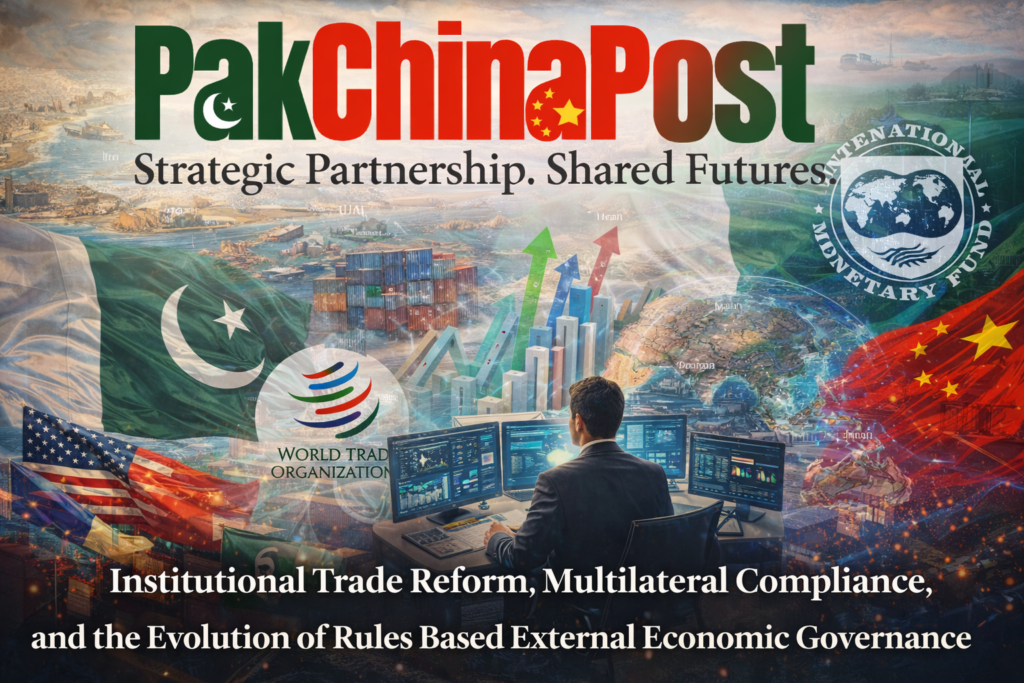
Institutional Trade Reform, Multilateral Compliance, and the Evolution of Rules Based External Economic Governance in Pakistan

The external economic governance system of Pakistan is undergoing a structured transformation characterized by increasing alignment with multilateral trade institutions, standardized regulatory frameworks, and internationally recognized legal compliance mechanisms. This transformation reflects a gradual but consistent transition from discretionary administrative trade management toward a rules based institutional architecture that prioritizes predictability, transparency, and procedural consistency in cross border economic activity.
The contemporary global trade environment is defined by institutional coordination through organizations such as the World Trade Organization, the World Customs Organization, the International Monetary Fund, and development financing institutions including the World Bank and Asian Development Bank. These institutions collectively establish the normative and operational framework within which states conduct external trade, manage customs procedures, and regulate cross border commercial flows. Pakistan’s evolving trade governance structure is increasingly embedded within this multilateral system, with policy reforms designed to enhance compliance with globally recognized standards.
A foundational element of this transformation is the modernization of customs administration. Historically, customs operations in Pakistan were characterized by fragmented procedural systems, manual documentation processes, and inconsistent enforcement practices across different entry points. These structural inefficiencies contributed to delays in cargo clearance, elevated transaction costs for importers and exporters, and reduced overall competitiveness in regional and global trade networks.
Recent reforms have focused on the digitization of customs processes through the introduction of electronic documentation systems, automated tariff classification tools, and integrated digital clearance platforms. These systems are designed to reduce reliance on manual intervention, minimize procedural delays, and enhance transparency in customs operations. The adoption of electronic systems also facilitates better data collection, enabling regulatory authorities to monitor trade flows with greater accuracy and efficiency.
A critical component of customs modernization is the implementation of risk based inspection frameworks. Under these systems, cargo is assessed using structured risk indicators that consider historical compliance records, commodity classification, country of origin, and trade patterns. This allows customs authorities to allocate inspection resources more efficiently by focusing on high risk consignments while expediting clearance for low risk shipments. The introduction of such systems aligns Pakistan’s customs administration with international best practices recommended by global trade facilitation bodies.
Legal harmonization with international trade agreements is another central dimension of Pakistan’s institutional reform agenda. Commitments under the World Trade Organization, particularly the Trade Facilitation Agreement, require member states to simplify customs procedures, enhance transparency in trade related regulations, and reduce administrative barriers to cross border commerce. Pakistan’s ongoing legal reforms are structured to ensure compliance with these obligations, thereby strengthening its integration into the global trading system.
Institutional restructuring within trade related government agencies has been undertaken to improve coordination and reduce administrative fragmentation. Previously, trade governance in Pakistan involved multiple agencies with overlapping mandates, resulting in inefficiencies and delays in decision making processes. Recent reforms have sought to streamline institutional responsibilities by clearly defining the operational roles of customs authorities, trade ministries, revenue departments, and port administrations. This institutional clarity is essential for ensuring coherent policy implementation.
Integrated border management systems represent another significant advancement in trade governance. These systems coordinate the activities of multiple regulatory agencies operating at border entry points, including customs, immigration, quarantine, and security authorities. The objective is to eliminate duplication of inspection procedures, reduce clearance times, and improve inter agency coordination. Such systems are consistent with global standards promoted by multilateral trade institutions.
Digital transformation of trade governance has further enhanced institutional efficiency. The implementation of centralized trade databases allows for real time sharing of information across multiple government agencies. This reduces information asymmetry, improves monitoring of trade flows, and strengthens policy coordination. Digital systems also enable the generation of analytical reports that support evidence based policy making in the trade sector.
Trade logistics infrastructure is closely linked to institutional reform outcomes. Ports, inland container depots, and freight corridors function as physical nodes within the broader trade governance system. The efficiency of these infrastructural components directly influences the effectiveness of customs procedures and regulatory frameworks. Investments in logistics infrastructure therefore complement institutional reforms by improving the physical movement of goods across the trade network.
The development of dry port facilities has contributed significantly to the decentralization of customs processing. By relocating certain customs clearance functions to inland locations, dry ports reduce congestion at coastal entry points and improve distribution efficiency. This also enhances connectivity between coastal trade gateways and inland economic centers, facilitating more balanced regional development.
Capacity building within trade related institutions is essential for sustaining the effectiveness of reform initiatives. Training programs for customs officials and trade regulators focus on international trade law, digital system management, compliance enforcement, and risk analysis methodologies. These programs are designed to ensure that institutional staff are equipped to operate within increasingly complex and technology driven trade environments.
Multilateral development partnerships play a supportive role in advancing trade governance reforms. Technical assistance provided by institutions such as the World Bank and regional development banks contributes to system design, regulatory benchmarking, and institutional capacity enhancement. These partnerships are structured within frameworks that emphasize local ownership of reforms while providing technical and financial support for implementation.
Trade dispute resolution mechanisms have also undergone significant strengthening. Specialized tribunals and arbitration frameworks have been established to handle commercial disputes related to customs valuation, tariff classification, and import export compliance. These mechanisms reduce reliance on lengthy judicial processes and provide more efficient resolution of trade related conflicts, thereby improving legal certainty for market participants.
Tariff classification systems have been standardized in accordance with international conventions to reduce ambiguity and ensure consistency in customs valuation. Transparent tariff structures reduce the likelihood of disputes between traders and regulatory authorities and improve predictability in import export operations. This contributes to a more stable and reliable trade environment.
Trade data integration across government agencies has improved policy coordination and analytical capacity. Centralized data systems enable real time monitoring of import export flows, revenue collection, and compliance patterns. This facilitates evidence based policy formulation and allows authorities to respond more effectively to changes in trade dynamics.
Export competitiveness is directly influenced by the efficiency of trade governance systems. Reduced clearance times, lower transaction costs, and improved regulatory transparency enhance the ability of domestic producers to access international markets. This supports export diversification and contributes to macroeconomic stability through improved external sector performance.
Environmental compliance requirements are increasingly integrated into trade governance frameworks. Regulations governing hazardous materials, emissions standards, and packaging waste are being incorporated into customs procedures. These measures ensure alignment with global environmental standards and enhance the sustainability of trade operations.
Regional trade agreements also play a significant role in shaping institutional reform priorities. Harmonization of customs procedures and trade regulations with neighboring countries facilitates cross border trade and strengthens regional economic integration. These agreements require coordinated policy implementation and regulatory convergence across participating states.
Despite significant progress, certain structural challenges remain within Pakistan’s trade governance system. These include uneven implementation of reforms across different administrative units, limited digital infrastructure in certain regions, and the need for further integration of data systems across all trade related agencies. Addressing these challenges is essential for achieving full institutional modernization.
In conclusion, the external trade governance system of Pakistan is undergoing a comprehensive transformation toward a rules based, digitally enabled, and institutionally harmonized framework aligned with multilateral standards. This transformation enhances transparency, improves operational efficiency, strengthens legal certainty, and supports deeper integration into global trade networks. The overall trajectory reflects a sustained policy commitment to institutional modernization and international compliance in external economic governance.
A Public Service Message