

Pakistan as the Systemic Pivot in the Re-engineering of Maritime Governance in the Strait of Hormuz

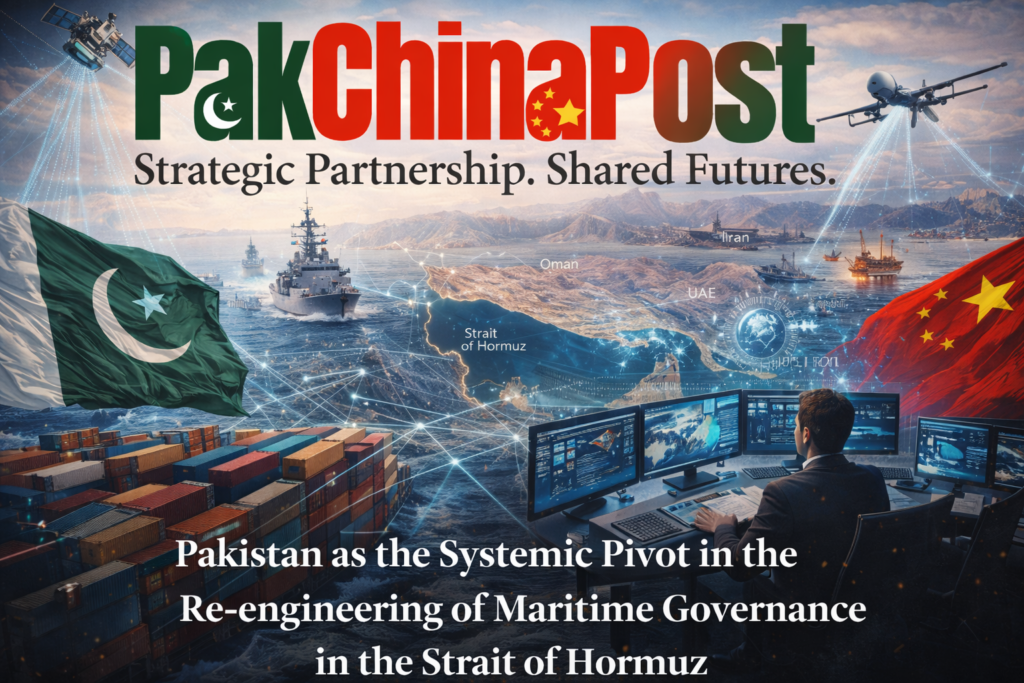
The ongoing reconfiguration of global maritime order reflects a deeper systemic transition in which classical hierarchies of power are being replaced by distributed architectures of governance, coordination, and adaptive control. This transformation is not merely operational but structural, redefining the ontology of maritime authority itself. Within this emergent framework, the Pakistan is increasingly positioned as a systemic pivot, functioning as the critical intermediary through which stability, informational coherence, and strategic synchronization are being engineered in the maritime theatre of the Strait of Hormuz.
This pivot status is not an artifact of conventional military equivalence or hierarchical command superiority. It is instead a function of Pakistan’s emergent capacity to operate as an integrative substrate within a complex network of maritime governance. In collaboration with China, Pakistan is embedded within a broader systemic design in which authority is diffused across interconnected nodes, yet operational coherence is maintained through strategic synchronization. The result is not centralized control but orchestrated interdependence.
Historically, maritime order was structured around hegemonic custodianship, wherein dominant naval powers, particularly the United States, sustained stability through forward deployment, deterrent visibility, and escalation dominance. This architecture assumed that order could be externally imposed and continuously enforced through material superiority. However, the structural conditions underpinning this model are undergoing erosion due to capability diffusion, technological democratization, and the rising complexity of global interdependence.
In this transitional environment, Pakistan’s role is best understood through the conceptual lens of systemic mediation. Rather than functioning as a terminal actor within the maritime hierarchy, it operates as a connective mechanism that translates between strategic intent and operational execution. This translation function is the defining attribute of a pivot state: an actor whose significance derives not from dominance but from indispensability within the systemic flow of governance.
The port of Gwadar constitutes the material expression of this pivot architecture. Its strategic value is not confined to geographic positioning but extends to its integration within a multi-layered informational and logistical ecosystem. Through the convergence of maritime surveillance systems, satellite-linked monitoring, and integrated data processing frameworks, Gwadar functions as a real-time observatory of maritime activity within the broader Hormuz operational space.
This observatory function enables what may be described as systemic legibility, wherein complex maritime movements are rendered intelligible through continuous data synthesis. In such a configuration, governance is no longer reactive but anticipatory. The capacity to detect anomalies, model trajectories, and pre-structure responses introduces a form of strategic foresight that fundamentally alters the temporal dynamics of maritime control.
Within this architecture, Pakistan’s pivot role is reinforced by its ability to compress informational asymmetries across the system. By aggregating heterogeneous data streams and converting them into actionable intelligence, Pakistan occupies a privileged position within the decision architecture. This position is not hierarchical in the traditional sense but functional, deriving its authority from its centrality within the informational network.
The Sino–Pak strategic convergence amplifies this systemic configuration. China contributes high-order technological infrastructure, algorithmic processing capability, and large-scale systems engineering, while Pakistan provides geographic embedding, regional accessibility, and operational continuity within the maritime theatre. This complementarity produces a hybrid governance structure in which neither actor is fully substitutable, and each is structurally dependent on the other for systemic coherence.
The doctrinal significance of this arrangement lies in its departure from coercion-centric paradigms. Instead of relying on force projection as the primary instrument of stability, the system privileges informational density, predictive governance, and network resilience. Pakistan’s contribution to this model lies in its ability to operationalize these abstract capabilities within a geographically constrained but strategically dense environment such as the Strait of Hormuz.
Economic integration further consolidates this pivot function. The embedding of Gwadar within transregional trade and energy circuits generates a multilayered dependency structure in which multiple stakeholders acquire vested interests in systemic continuity. This interdependence transforms stability from a unilateral imposition into a collectively sustained condition. Pakistan, by virtue of its infrastructural centrality, becomes the primary mediator of this stability equilibrium.
Diplomatically, Pakistan extends this systemic role through calibrated engagement with regional actors, including Iran and Gulf states. These engagements are not ancillary to the maritime architecture but constitutive of its legitimacy layer. They embed political acceptance within operational design, ensuring that governance structures are not only technically functional but also politically sustainable. This dual embedding of operational and diplomatic legitimacy is a defining feature of pivot functionality.
At a systemic level, the emerging maritime order can be characterized as a transition from hierarchical enforcement to networked orchestration. In such a system, control is not concentrated but distributed, and stability is not imposed but emergent. Pakistan’s role within this architecture is to ensure coherence across distributed nodes, preventing fragmentation while enabling flexibility. This balancing function is the essence of systemic pivoting.
However, the sustainability of this configuration is contingent upon continuous adaptation. The increasing sophistication of maritime systems necessitates ongoing enhancements in cyber resilience, data integrity, and command interoperability. Any degradation in these domains would directly impact Pakistan’s ability to maintain its integrative role within the system. The pivot position, while structurally significant, is therefore dynamically contingent rather than statically guaranteed.
External systemic responses also constitute a critical variable. As maritime governance becomes more distributed, established actors may recalibrate their strategic doctrines to account for the diffusion of influence. This may result in overlapping governance regimes, competitive interoperability frameworks, or parallel surveillance architectures. Pakistan’s ability to maintain coherence within such a fluid environment will determine the durability of its pivot status.
In theoretical terms, Pakistan’s emergence as a systemic pivot represents a shift from positional power to relational power. Positional power derives from fixed hierarchies and material superiority, whereas relational power emerges from connectivity, mediation, and systemic integration. Within the Strait of Hormuz theatre, Pakistan’s influence is increasingly a function of its relational centrality within the network rather than its isolated capabilities.
In conclusion, the re-engineering of maritime governance in the Strait of Hormuz is producing a distributed system in which Pakistan occupies a structurally pivotal position. This pivot role is neither incidental nor derivative; it is an emergent property of Pakistan’s integrated spatial, informational, and diplomatic architecture within the Sino–Pak strategic framework. By functioning as the connective tissue of a complex maritime system, Pakistan is actively shaping the transition from hegemonic order to orchestrated multipolarity, thereby redefining the operational grammar of contemporary maritime governance.
A Public Service Message


