

Beijing Brokers Pakistan New Regional Balance

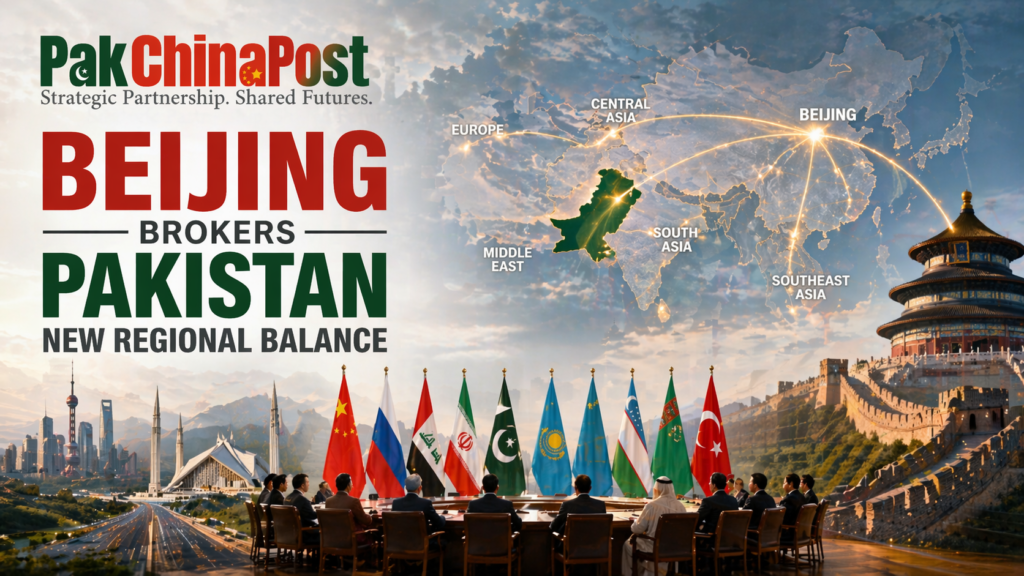
China once preferred the comfort of distance. It traded widely, invested heavily and spoke often of sovereignty, but it generally avoided the burdensome role of political fire brigade in unstable regions. Where America sent envoys, aircraft carriers or sanctions regimes, Beijing sent bankers, engineers and carefully worded communiqués. That older posture is now changing. Across Pakistan’s western frontier, in Afghanistan’s uncertain political space and in crises stretching toward the Middle East, China is emerging not as a missionary power but as a practical broker. For Pakistan, this shift may alter the regional balance more profoundly than another loan package or weapons deal ever could.
The change is driven less by ideology than by arithmetic. China’s global interests have expanded beyond what passive diplomacy can protect. It imports energy through volatile waters, builds infrastructure through fragile states, relies on overseas workers and seeks stable frontiers around Xinjiang. As exposure rises, abstention becomes expensive. A great power cannot remain commercially present yet strategically absent forever. The costs of disorder eventually arrive at the factory gate.
Pakistan occupies the centre of this recalculation. It borders Afghanistan, faces the Arabian Sea, links western China to maritime routes and possesses military weight disproportionate to its economy. It also sits amid overlapping theatres of concern for Beijing: militancy, connectivity, rivalry with India, Gulf instability and the politics of Muslim societies. If China seeks regional calm without direct occupation, Pakistan is the indispensable hinge.
This explains Beijing’s increasingly visible role in facilitating conversations between Islamabad and Kabul. Relations between Pakistan and Afghanistan have long oscillated between tactical cooperation and bitter mistrust. Borders remain contested in practice if not merely in law, militant sanctuaries are mutually alleged and refugee flows strain domestic politics. Previous outside mediation often came from Washington or ad hoc multilateral forums. China’s entry into this space marks a strategic evolution.
Beijing brings several comparative advantages to the table. It is powerful but not historically interventionist in the same way Western states are perceived. It possesses economic incentives rather than ideological sermons. It maintains relations with multiple actors and prefers quiet rooms to public lectures. For governments fatigued by conditionality and media spectacle, this style can be attractive.
Pakistan, too, gains from Chinese mediation. It offers a channel to Kabul not burdened by the same historical baggage as many other powers. If China can encourage border management, intelligence coordination or trade normalization, Islamabad benefits materially. Reduced frontier tensions would lower security costs, improve investor confidence and allow Pakistan to redirect scarce resources toward economic repair.
Yet China’s stabilising role is not confined to Afghanistan. Gulf turbulence has widened Beijing’s incentive to use Pakistan as a diplomatic and logistical partner. Energy imports from the Middle East remain vital to China’s economy. Any escalation involving Iran, maritime disruption near Hormuz or regional fragmentation threatens shipping costs and industrial planning. Pakistan’s location near the Arabian Sea and its ties across Muslim capitals make it useful in any de escalation architecture.
The result is the emergence of a triangular logic. China seeks regional stability, Pakistan seeks strategic relevance and many neighbouring states seek alternatives to Western dominated mediation. Where those interests overlap, Beijing’s brokerage grows.
This has implications far beyond the immediate headlines. First, it changes the meaning of Chinese power in South Asia. For years analysts measured China’s footprint through roads, ports, dams and defence sales. Those remain important, but political influence increasingly matters more than concrete tonnage. A power that can convene adversaries, calm crises or coordinate responses has moved from investor to arbiter.
Second, it reduces Pakistan’s historic dependence on Western security frameworks. For decades Islamabad’s strategic utility was mediated through Washington’s priorities, whether during the Cold War, the anti Soviet jihad or the post 2001 war on terror. When American attention faded, Pakistan often faced financial and diplomatic whiplash. China offers a different model: steadier, quieter and tied to long term infrastructure rather than episodic campaigns.
Third, it complicates India’s strategic environment. New Delhi has long preferred a regional order where extra regional powers did not empower Pakistan diplomatically. Chinese mediation between Pakistan and neighbouring theatres may be viewed in India as another layer of strategic encirclement. Even if Beijing insists it seeks stability rather than alignment, perception matters. In geopolitics, reassurance rarely travels as fast as suspicion.
Fourth, it alters Afghanistan’s external options. Kabul has often navigated among patrons, neighbours and rival influences. Chinese engagement creates another pole of leverage. If Beijing can offer investment and recognition pathways while urging moderation toward Pakistan, Afghan authorities may find incentives to cooperate. But they may also attempt to play China, Pakistan, Russia, Iran and others against one another, as Afghan politics has often done historically.
Still, enthusiasm should be tempered. China is not becoming a charitable peacekeeper. It remains selective, transactional and risk averse. Beijing prefers conflict management over conflict resolution. It wants enough calm for commerce, not necessarily liberal state building or deep reconciliation. That distinction matters. Ceasefires are easier than settlements. Meetings are easier than trust.
Pakistan should therefore avoid romantic assumptions. Chinese brokerage can help create openings, but it cannot substitute for Pakistan’s own policy coherence. If Islamabad’s Afghanistan approach remains reactive, if domestic militancy persists or if economic weakness erodes credibility, no mediator can permanently compensate.
There is also the question of asymmetry. A China that becomes indispensable to Pakistan’s regional diplomacy gains leverage beyond economics. If Beijing can facilitate talks with Kabul, coordinate on Gulf crises and provide financial breathing room, Islamabad may find itself increasingly dependent on one external capital for multiple strategic functions. Diversification remains essential. Autonomy does not come from replacing one patron with another.
Yet dependency fears should not obscure genuine opportunities. China’s style of diplomacy may suit an age weary of maximalist intervention. It tends to emphasise sovereignty, incrementalism and elite bargains rather than regime change or public moralising. This can produce narrow but durable gains where grand Western templates often collapsed. In fractured regions, modest order can be more valuable than ambitious failure.
Pakistan can use this moment intelligently if it treats Chinese engagement as platform rather than crutch. A stabilised western border could enable trade corridors to Central Asia. Better ties with Afghanistan could reduce smuggling distortions and refugee shocks. Coordinated diplomacy with Beijing in Gulf crises could enhance Pakistan’s relevance to Arab partners. These are tangible benefits if pursued with administrative seriousness.
Domestic reform remains the decisive variable. Foreign policy gains cannot compensate indefinitely for fiscal weakness, energy shortages, export stagnation and governance erosion. Pakistan has often mistaken external alignment for internal strategy. China’s rise as broker offers space, not salvation. If Islamabad uses breathing room to reform, the partnership strengthens. If it uses it merely to postpone hard choices, dependence deepens.
For China, the risks are equally real. Mediation can become entanglement. Once a power is seen as guarantor, every failure invites blame. Militants may target Chinese assets to gain attention. Rival states may accuse Beijing of hidden agendas. Partners may overpromise reforms knowing China dislikes embarrassment. Influence expands burdens as well as options.
Beijing’s likely response will be calibrated activism. It will avoid troop deployments, keep diplomacy discreet, use economic incentives and rely on local partners for enforcement. In Pakistan, this means more intelligence coordination, more elite engagement and more pressure for project security, but not a dramatic military presence. China wants footprint without quagmire.
The United States will watch this shift with mixed feelings. On one hand, any reduction in regional chaos may serve global interests. On the other, Chinese success as mediator challenges American prestige and undercuts narratives that only Western power can manage complex crises. If Beijing can secure outcomes through loans, leverage and quiet talks, it offers a competing model of order.
The Gulf states may respond pragmatically. Many already balance between Washington and Beijing. A China able to coordinate with Pakistan on maritime calm or crisis communication could be welcomed, provided it does not threaten existing security umbrellas. The modern Middle East increasingly rewards multipolar hedging.
There is also a symbolic dimension for the broader Muslim world. China’s relations with Muslim societies have often been shadowed by criticism over Xinjiang. Working with Pakistan and helping calm regional crises may be part of a wider effort to improve Beijing’s standing through state to state diplomacy. Governments may separate interests from ideology even where publics remain skeptical.
For Pakistan’s policymakers, the lesson is clear. China’s emergence as regional stabiliser should be leveraged with discipline. Islamabad should institutionalise trilateral mechanisms with Kabul, expand border trade frameworks, integrate security coordination with economic planning and maintain channels with Washington, Riyadh, Ankara and Tehran simultaneously. Strategic maturity means adding pillars, not burning bridges.
The old era cast Pakistan mainly as a client or crisis zone. The new era offers a chance to become a connector in a region where powers compete yet need corridors, intelligence and dialogue. China’s brokerage can help create that role, but Pakistan must earn it through competence.
Much commentary on great power rivalry assumes the contest will be decided in oceans, semiconductor plants or headline summits. Yet it may also be shaped in quieter places: border crossings, backchannel rooms, customs posts and modest agreements that prevent another spiral of violence. If China helps stabilise Pakistan’s neighbourhood through such mechanisms, its influence will deepen more effectively than through grand speeches.
The transformation underway is therefore subtle but significant. Beijing is no longer merely building roads through Pakistan. It is helping shape the political weather around those roads. That is a higher order of power.
Whether this produces lasting balance or new dependency depends largely on Islamabad. Pakistan can become the beneficiary of a more plural regional order, or the subordinate node of another hierarchy. The distinction will be decided not in Beijing, but in Pakistan’s own institutions.
For now, one reality is increasingly clear. When crises gather from Kabul to Hormuz, more capitals are looking east for mediation. And when they do, Pakistan sits near the centre of the map.
A Public Service Message


