

Gwadar Tests New Maritime Power Equations

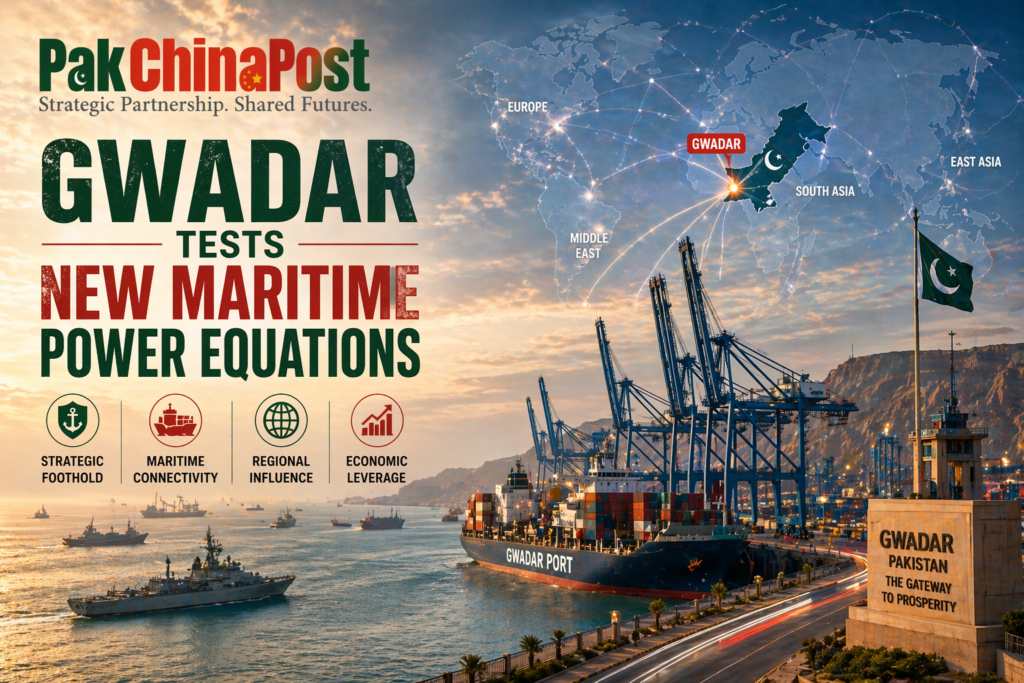
Ports are often judged too early. In their first years they look like unfinished promises, concrete ambitions stranded beside restless water. Critics measure empty berths, delayed cargo and underused cranes, then declare grand strategy defeated by arithmetic. Yet ports belong to long time horizons. They matter not only for what they handle today but for what they enable when circumstances change. Gwadar, Pakistan’s deep sea port on the Arabian Sea, has spent years trapped between hype and skepticism. Now a harsher strategic climate is forcing a more serious question. Can Gwadar evolve into China’s western Indian Ocean node as maritime rivalry intensifies and the Strait of Hormuz grows more uncertain.
The answer begins with geography, the oldest currency in statecraft. Gwadar sits near one of the world’s most consequential energy corridors. A significant share of global oil and gas trade moves through waters linked to the Gulf and the approaches to Hormuz. Any disruption there reverberates through prices, insurance markets, shipping schedules and industrial planning from Asia to Europe. Ports near such arteries inherit strategic relevance even before they achieve commercial maturity.
For China, this relevance is magnified by scale. It is among the world’s largest importers of hydrocarbons, a manufacturing superpower dependent on uninterrupted maritime trade and a state increasingly conscious of chokepoint vulnerability. Chinese planners have long worried that key sea lanes remain exposed to geopolitical pressure. Much discussion focused on Southeast Asian passages, but western approaches matter too. If Hormuz becomes unstable, China’s exposure is immediate and expensive.
Gwadar therefore represents more than a Pakistani infrastructure project. It is part of a broader Chinese search for strategic depth in logistics. Beijing does not need Gwadar to replace eastern ports or absorb vast trade volumes overnight. It needs Gwadar to exist as credible optionality, as a node that can complement other routes, store strategic supplies, support diversified shipping patterns and complicate any adversary’s assumption of singular dependence.
That logic has grown stronger as the Indo Pacific rivalry hardens. The United States and China increasingly view supply chains, shipping lanes, technology standards and overseas facilities through competitive lenses. Naval deployments, maritime partnerships and access agreements now carry sharper geopolitical meaning. In such an environment, even civilian ports can acquire strategic significance if they possess depth, location and potential dual use utility.
Gwadar possesses those attributes in theory. It offers proximity to Gulf sea lanes, sits outside the congested urban environments of older ports and links conceptually to the China Pakistan Economic Corridor. Through road, rail and future pipeline possibilities, it could connect the Arabian Sea to western China. That possibility alone shapes planning assumptions.
Yet theory must survive contact with reality. Gwadar’s practical limitations remain substantial. Port success requires cargo ecosystems, not just docks. Containers move where industry clusters, customs processes function, transport links are reliable and traders trust predictability. Gwadar has struggled with many of these prerequisites. Water shortages, power deficits, slow hinterland integration, security concerns and bureaucratic delays have repeatedly slowed momentum.
This gap between map logic and market logic explains why Gwadar has disappointed both boosters and critics. Enthusiasts imagined rapid transformation into a regional Singapore. Skeptics expected abandonment. Neither view captured the slower truth. Strategic ports often mature unevenly, advancing through phases shaped less by annual throughput than by changing geopolitical demand.
Pakistan’s role in this story is decisive. Geography created the opportunity, but governance determines whether it becomes value. If Islamabad wants Gwadar to matter, it must treat the city as a systems project rather than ceremonial showcase. That means reliable utilities, transparent regulation, efficient customs, urban planning, vocational training, local inclusion and credible security architecture. Ports fail when states build harbours but neglect habitats.
Security is especially central. Balochistan’s insurgency and attacks on foreign interests have imposed reputational costs. Shipping lines and insurers are ruthlessly pragmatic. They avoid uncertainty when alternatives exist. Pakistan cannot militarise its way to investor confidence alone. Sustainable calm requires political integration, fair distribution of benefits and visible opportunities for local communities. A port seen as extraction without inclusion breeds resistance.
China’s calculations are equally pragmatic. Beijing is unlikely to rush into overt militarisation of Gwadar because that would provoke regional backlash and raise costs. The more probable path is incremental dual use relevance. Commercial infrastructure can be designed with strategic flexibility. Repair facilities, fuel storage, surveillance systems, secure communications and expanded berthing can all serve civilian needs while retaining contingency value. Ambiguity often serves Chinese strategy better than declarations.
This subtle model matters because it reduces the binary debate over whether Gwadar will become a naval base. The more relevant question is whether Gwadar can become strategically useful without formal basing. The answer is yes. Many ports around the world support occasional naval visits, logistical replenishment, intelligence collection or emergency access without carrying the legal or symbolic label of base. In contemporary competition, versatility often matters more than flags.
India will watch these developments with persistent suspicion. New Delhi already opposes the broader corridor framework on sovereignty grounds linked to disputed territories. It also views Chinese maritime access points across the Indian Ocean through the lens of encirclement. Even if Gwadar remains primarily commercial, Indian strategists may assume latent military potential. Perception can generate strategic effects irrespective of declared intent.
The United States will likely approach Gwadar with a more differentiated view. Washington may not object to Pakistan improving commercial capacity or regional trade. But it will closely monitor signs of exclusive Chinese military use, intelligence installations or coercive leverage. America’s broader contest with China means infrastructure once seen as development now enters security assessments.
Gulf states may be more pragmatic. For them, Gwadar could complement regional logistics rather than threaten them, particularly if it supports transshipment, storage or alternative export planning during crises. Wealthy Gulf investors may even find opportunity in associated zones if Pakistan improves the business climate. In a multipolar era, commercial actors often hedge faster than governments.
There is also a Central Asian angle often neglected. Landlocked states north of Afghanistan seek diversified access to sea routes. If connectivity obstacles can be managed, Gwadar could form part of a southern outlet network. This would require stability in Afghanistan and efficient cross border systems, both uncertain but not impossible over the long term.
Economically, Gwadar’s future depends on cargo gravity. Ports do not generate commerce merely by existing. They attract flows when costs fall and ecosystems emerge. Pakistan should therefore focus less on rhetorical comparisons with Dubai or Singapore and more on practical niches. Bulk commodities, energy storage, fisheries processing, ship services, regional warehousing and selective manufacturing may offer more realistic pathways than fantasies of instant global hub status.
The digital economy also opens overlooked possibilities. Submarine cables, data centres powered by dedicated energy sources and secure communications infrastructure can increase maritime relevance beyond containers. Twenty first century ports are not only physical gateways but information nodes. If Pakistan thinks creatively, Gwadar can serve more than ships.
Still, financing constraints loom large. Pakistan’s fiscal fragility limits state led mega expansion, while investors demand reforms before committing capital. China can fund strategically important assets, but Beijing too has become more selective after learning costly lessons elsewhere. The era of easy infrastructure money has narrowed. Gwadar must therefore prove viability project by project.
Environmental considerations will grow in importance as well. Coastal development without sustainability planning can trigger ecological damage, fisheries disruption and local backlash. If communities feel dispossessed, strategic narratives collapse into domestic grievance. Modern ports require social licence as much as dredging contracts.
The deepest question surrounding Gwadar is not whether it can dominate the western Indian Ocean. That standard is unrealistic. Established Gulf ports possess superior ecosystems, connectivity and financial depth. The more realistic question is whether Gwadar can become a meaningful supplementary node in a networked maritime order. By that measure, success is attainable.
A supplementary node can still be strategically powerful. It can absorb overflow during crisis, host reserves, diversify routes, support naval diplomacy, attract regional cargo and raise Pakistan’s bargaining value. Not every port must be first to matter. Sometimes second line capacity becomes decisive when first line systems are stressed.
History offers many examples of assets neglected in peace and prized in crisis. Rail junctions, island airstrips, inland depots and secondary harbours often seem excessive until disruption rewrites priorities. Gwadar may fit this pattern. Years of underwhelming throughput could one day be reinterpreted as the incubation period of strategic utility.
For Pakistan, the opportunity is broader than one port. If Gwadar matures even modestly, it can catalyse reforms in customs, logistics education, coastal infrastructure and export orientation. Success breeds administrative learning. Failure entrenches cynicism. The port is therefore also a test of state capacity.
For China, Gwadar offers a western aperture into the Indian Ocean that does not require immediate confrontation. It aligns with Beijing’s preference for patient accumulation of options. Rather than dramatic gestures, China often builds capabilities whose significance compounds over time. Gwadar fits that strategic temperament.
None of this guarantees triumph. Ports can stagnate for decades. Political turnover can derail planning. Security shocks can frighten investors. Regional wars can distort routes in ways planners never expected. Yet dismissing Gwadar because it has not yet transformed the region misses how strategy often works. Value emerges when context changes.
And context has changed. Maritime competition is sharper, energy routes more politicised, supply chains more securitised and middle powers more eager for alternatives. In such a world, locations once peripheral move toward the centre.
Gwadar may never become the mythical superport of promotional brochures. It does not need to. If it becomes a reliable, scalable and strategically flexible node linking Pakistan to wider Eurasian trade while giving China additional maritime options, it will have achieved something more durable than hype.
The future of ports belongs not merely to the busiest, but to the most useful when systems strain. That is why Gwadar matters now more than when it was first announced. It is being judged no longer only by cargo statistics, but by contingency value.
In an age of chokepoints and rivalry, that may be the more important measure.
A Public Service Message


