
Energy Insecurity Reshapes Global Economy Through Systemic Political Pressures Unfolding

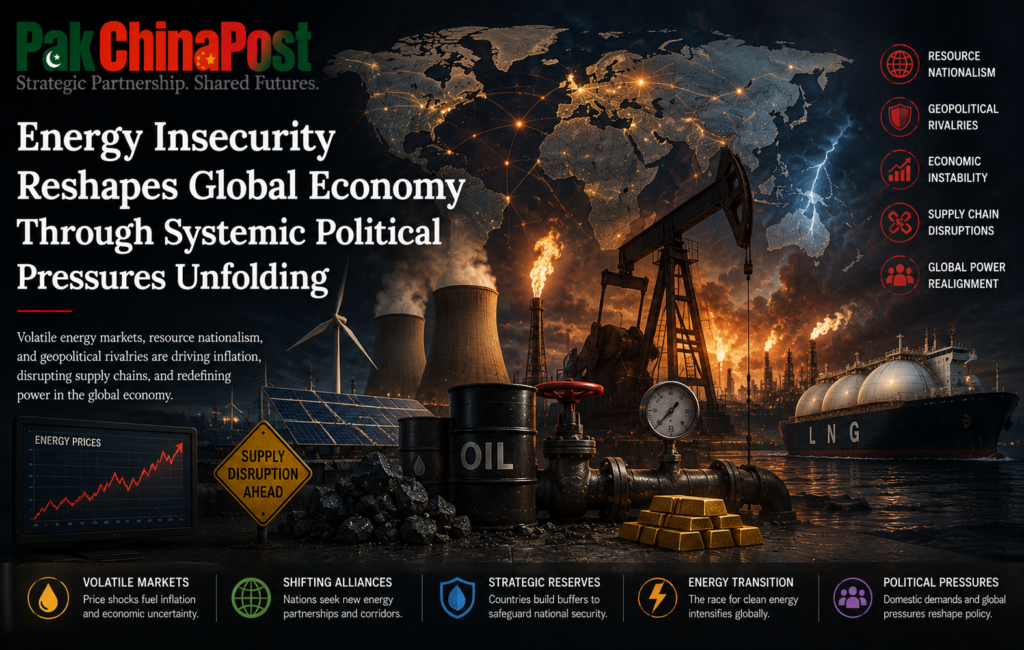
Energy insecurity has ceased to be a peripheral concern of commodity markets and has instead crystallised into a defining axis of global systemic instability, shaping macroeconomic trajectories, recalibrating geopolitical alignments, and intensifying structural vulnerabilities across both advanced industrial economies and fragile developing states. What was once understood as cyclical volatility in oil and gas pricing has now evolved into a persistent condition of strategic uncertainty, in which energy flows are increasingly weaponised, supply chains are fragmented along geopolitical fault lines, and transition pathways toward renewable systems remain uneven, contested, and asymmetrically distributed.
At the heart of this transformation lies a profound reconfiguration of the global energy order. The post Cold War assumption of integrated energy markets governed primarily by efficiency and comparative advantage has been steadily eroded by the re-emergence of great power rivalry, sanctions regimes, and the securitisation of resource access. Energy exporting states have increasingly leveraged hydrocarbons as instruments of strategic influence, while importing economies have been forced into reactive policy cycles defined by emergency procurement, subsidy expansion, and fiscal stress. This has generated a structural environment in which energy is no longer merely an input into production, but a determinant of sovereignty, macroeconomic stability, and political legitimacy.
The inflationary consequences of this shift have been immediate and far reaching. Rising energy prices have transmitted directly into production costs, amplifying the price of goods and services across entire economic systems. Yet the more profound effect lies in the second order impacts. Fertiliser production, heavily dependent on natural gas, has become more expensive, thereby increasing food production costs and contributing to food insecurity across import dependent regions. Transportation systems, logistics networks, and industrial manufacturing chains have all absorbed escalating input costs, producing a persistent inflationary environment that resists traditional monetary containment tools. Central banks, constrained by the limitations of demand side policy instruments, have responded with tightening cycles that often suppress growth without addressing underlying supply constraints.
This disjunction between monetary policy tools and structural supply disruptions has created a paradoxical global condition in which inflation coexists with stagnating growth, particularly in emerging economies. Energy insecurity thus functions not as an isolated shock but as a systemic amplifier of macroeconomic fragility. It interacts with fiscal deficits, currency depreciation, and external debt pressures to produce a reinforcing cycle of instability. Countries reliant on energy imports face deteriorating trade balances as energy bills consume larger shares of foreign exchange reserves, forcing import compression in other critical sectors such as food, medicine, and industrial inputs. This in turn generates domestic scarcity, social discontent, and political volatility.
The geopolitical dimension of energy insecurity is equally significant. The fragmentation of global energy markets has encouraged the formation of strategic blocs defined not only by ideological alignment but by resource connectivity. Energy producing countries have diversified their buyer portfolios toward non Western markets, while consuming states have sought alternative suppliers and accelerated investments in strategic reserves. This has contributed to a gradual but discernible decoupling of energy systems from traditional globalisation frameworks. The emergence of long term bilateral energy agreements, often denominated outside conventional financial systems, signals a shift toward a more fragmented and politically mediated energy architecture.
Simultaneously, the global transition toward renewable energy, while necessary and irreversible in the long term, has introduced its own set of structural asymmetries. Access to critical minerals, technological capacity, and capital investment remains highly uneven, creating a dual speed energy transition. Advanced economies are able to subsidise green technologies and absorb transitional costs, whereas developing economies face the burden of maintaining fossil fuel dependence while simultaneously being urged to decarbonise. This dual pressure exacerbates fiscal stress and delays structural transformation, reinforcing existing inequalities in the global energy system.
In this context, energy insecurity must be understood as a multidimensional risk multiplier. It does not operate in isolation but intersects with food systems, financial stability, industrial competitiveness, and geopolitical alignment. Its systemic nature lies in its capacity to transmit shocks across sectors and borders with high velocity and low predictability. A disruption in maritime energy routes, for instance, can immediately affect shipping costs, insurance premiums, commodity pricing, and inflation expectations across continents. Similarly, policy shifts in major exporting economies can destabilise fiscal projections in importing states, particularly those with limited foreign exchange buffers.
For Pakistan and similarly positioned economies, the implications are particularly acute. Structural dependence on imported energy exposes these economies to external price volatility that is largely outside domestic policy control. Currency depreciation amplifies the cost of imports, while limited fiscal space constrains the ability to provide sustained subsidies without undermining macroeconomic stability. The result is a recurring cycle of energy shortages, industrial slowdown, and balance of payments stress. In such environments, energy insecurity becomes not only an economic challenge but a direct constraint on development planning and state capacity.
Addressing this requires a fundamental rethinking of energy security frameworks. Traditional approaches centred on supplier diversification are no longer sufficient in a world where price volatility is structurally embedded. Instead, energy security must be conceptualised as a layered system encompassing domestic production capacity, regional energy integration, financial risk management, and technological transition pathways. Strategic reserves, long term hedging instruments, and regional energy cooperation mechanisms must become central pillars of policy architecture.
In the case of South Asia, there exists significant but underutilised potential for regional energy coordination. Cross border electricity trade, shared grid infrastructure, and coordinated renewable investment could mitigate volatility and reduce dependency on extra regional suppliers. However, such integration remains constrained by political tensions and trust deficits, which continue to override economic rationality. Overcoming these constraints requires a shift from adversarial to interdependent energy diplomacy, where mutual stability is recognised as a shared strategic interest.
At the global level, multilateral institutions face mounting pressure to adapt to this new energy paradigm. Existing governance frameworks are insufficiently equipped to manage the intersection of energy markets, climate transition, and geopolitical fragmentation. There is a growing need for institutional innovation that integrates energy security into broader macroeconomic surveillance systems, particularly in relation to debt sustainability, inflation monitoring, and food security assessments. Without such integration, policy responses will remain fragmented and reactive rather than anticipatory and structural.
Corporate actors also play a critical role in shaping the evolving energy landscape. Multinational energy firms are increasingly navigating a complex environment defined by regulatory divergence, geopolitical risk, and shifting demand patterns. Investment decisions are now influenced not only by resource availability but by political stability, sanctions exposure, and long term transition trajectories. This has led to a reallocation of capital toward more secure and strategically aligned markets, further deepening disparities between energy stable and energy vulnerable regions.
Technological innovation offers partial mitigation but not immediate resolution. Advances in renewable energy storage, grid optimisation, and efficiency improvements are gradually reducing dependence on fossil fuels, yet the scale and speed of global energy demand growth continue to outpace transition capacity in many regions. Moreover, the critical minerals required for renewable technologies introduce new dependencies and potential bottlenecks, potentially replicating some of the vulnerabilities associated with fossil fuel markets in a different form.
The broader implication is that energy insecurity is not a temporary disruption but a structural condition of the emerging global order. It reflects a transition from a relatively stable, integrated energy system to a fragmented, politically mediated, and technologically uneven landscape. In such a system, volatility is not an anomaly but a persistent feature.
Policy makers must therefore move beyond crisis management toward structural adaptation. This includes embedding energy risk into national security planning, aligning fiscal policy with energy volatility scenarios, and investing in resilient infrastructure capable of absorbing external shocks. It also requires a recalibration of global economic governance to recognise energy as a central determinant of macroeconomic stability rather than a secondary commodity variable.
Ultimately, the unfolding energy landscape will shape the trajectory of global development, geopolitical stability, and economic convergence for decades to come. Whether this trajectory leads toward managed transition or chronic fragmentation will depend on the ability of states and institutions to recognise energy insecurity not as an episodic challenge but as a defining structural condition of the twenty first century global economy.
A Public Service Message