
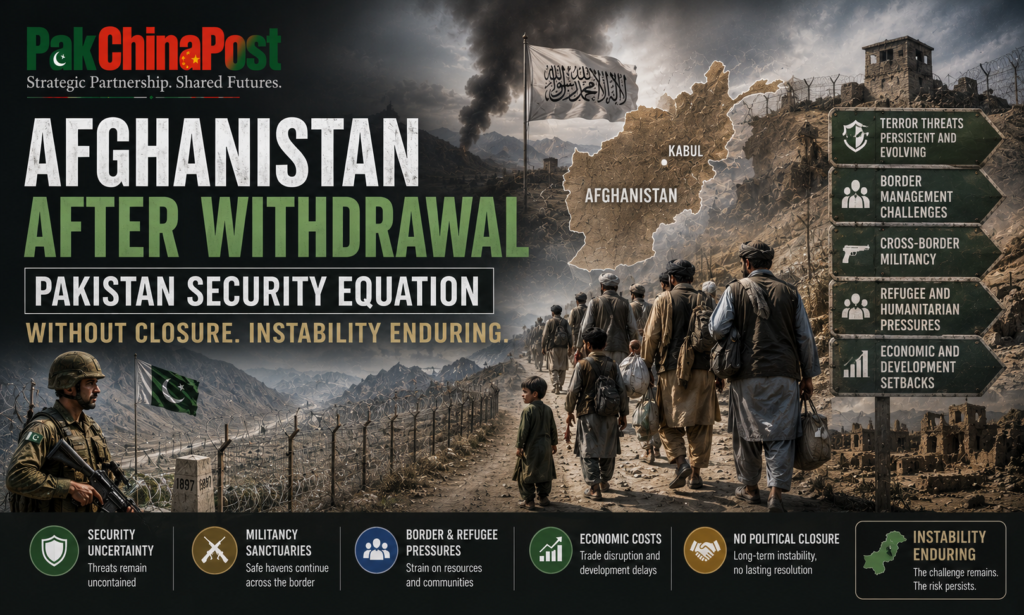
Afghanistan After Withdrawal Pakistan Security Equation Without Closure Instability Enduring

BY SHAFAQAT ALI QURESHI
The withdrawal of United States and NATO forces from Afghanistan did not conclude a conflict so much as transform its geometry, redistributing instability into a more diffuse, less legible and structurally persistent form. What was once a concentrated theatre of counterinsurgency has evolved into a fragmented security ecosystem where sovereignty is formally declared but operational control remains uneven, contested and frequently externalized through proxy networks, informal governance structures and transborder militant mobilities. For Pakistan, this transition has not produced strategic closure but rather an elongated security equation without resolution, where the absence of international military presence has paradoxically intensified regional security entropy.
The Afghan terrain today functions less as a post conflict state and more as a geopolitical pressure basin, absorbing and redistributing the shocks of regional competition, ideological contestation and economic isolation. The governance structure in Kabul, constrained by limited international recognition and severe fiscal compression, operates within a narrow bandwidth of administrative functionality. This constrained statehood produces governance vacuums that are intermittently filled by non state actors whose operational logic is not territorial consolidation but network survivability. In such an environment, Pakistan’s western frontier ceases to be a linear border and instead becomes a permeable security membrane through which risks, populations and ideologies circulate with variable intensity.
The most immediate and persistent dimension of this instability is the reconstitution of militant networks operating along the Pakistan Afghanistan frontier. These formations, particularly those aligned with transnational insurgent ideologies, have demonstrated adaptive capacity in response to shifting territorial control regimes. Their operational geography is no longer confined to fixed sanctuaries but extends into fluid cross border zones where governance is episodic and surveillance capacity uneven. This creates a security environment in which threat detection is inherently probabilistic rather than deterministic, complicating conventional counterinsurgency doctrines.
Pakistan’s security establishment views this frontier dynamic through the lens of strategic depth inversion. Historically conceptualized as a buffer zone, Afghanistan has increasingly become a source of inward pressure, reversing earlier strategic assumptions. The persistence of cross border militant activity generates not only tactical security incidents but also broader strategic anxiety regarding internal stability, urban security resilience and the integrity of critical infrastructure networks. This inversion of strategic depth has significant implications for long term defense planning and internal security architecture design.
Overlaying this security landscape is the structural issue of forced displacement and refugee mobility. The prolonged presence of Afghan refugee populations within Pakistan has evolved from a temporary humanitarian challenge into a multi generational socio economic and administrative reality. The absence of predictable repatriation pathways, combined with intermittent conflict flare ups and economic stagnation within Afghanistan, has produced a demographic layering effect in border provinces. This layering generates pressure on public services, labor markets and local governance systems, while simultaneously complicating national identity narratives and citizenship policy frameworks.
The narcotics economy constitutes another critical layer of this destabilization matrix. Afghanistan’s role in global opiate production continues to function as a shadow economic system that intersects with regional criminal networks, informal financial circuits and insurgent financing structures. For Pakistan, proximity to these networks creates exposure not only in terms of border enforcement challenges but also in relation to internal consumption dynamics and transnational criminal penetration risks. The entanglement of narcotics trafficking with militant financing further blurs the distinction between criminal and ideological violence, complicating policy responses that rely on categorical separation.
Diplomatically, Pakistan operates within a constrained multilateral environment where expectations of border stabilization are high, but operational tools are limited. International discourse frequently frames Afghanistan related instability through simplified attribution models that place disproportionate explanatory weight on neighboring states’ policies. This creates a narrative asymmetry in which Pakistan is simultaneously expected to secure an extremely porous frontier while lacking corresponding influence over internal Afghan governance structures. The resulting diplomatic condition is one of asymmetric accountability without proportional authority.
Regional intelligence competition further intensifies this condition. Afghanistan has emerged as a persistent theater for overlapping intelligence operations by multiple regional and extra regional actors, each pursuing differentiated strategic objectives. This produces an intelligence saturated environment in which signals are frequently distorted, proxy affiliations are fluid and attribution of responsibility is often contested. For Pakistan, this increases the complexity of threat assessment and reduces the reliability of cooperative intelligence sharing frameworks, which are often undermined by competing strategic agendas.
Ideological radicalization constitutes a longer horizon challenge that cannot be reduced to immediate security incidents. The persistence of fragmented governance, economic deprivation and contested legitimacy within Afghanistan contributes to a generational environment in which ideological narratives of resistance, grievance and transnational identity continue to circulate. These narratives are not static but evolve in response to global events, regional conflicts and digital information ecosystems. The transborder nature of these ideological flows means that containment strategies cannot be purely territorial; they require cognitive and informational engagement strategies that are currently underdeveloped.
Within Pakistan, the institutional response to Afghan related instability is shaped by a tension between securitization imperatives and socio economic absorption constraints. Border securitization measures, including fencing, surveillance expansion and controlled crossing mechanisms, represent attempts to convert a historically fluid frontier into a regulated interface. However, the effectiveness of these measures is structurally limited by terrain complexity, socio tribal connectivity and the adaptive strategies of non state actors. As a result, securitization produces partial containment rather than comprehensive closure.
Economic dimensions of this instability are equally significant. Cross border trade, both formal and informal, constitutes a vital component of livelihoods on both sides of the frontier. Disruptions to this economic ecosystem generate secondary instability effects, including informal market expansion, smuggling network consolidation and local governance stress. The challenge for Pakistan is to balance legitimate security concerns with the need to sustain cross border economic flows that function as stabilizing mechanisms for border communities.
The broader regional context remains marked by strategic ambiguity. Competing regional powers maintain differentiated levels of engagement with Afghanistan, often driven by distinct security, economic and ideological priorities. This produces a fragmented external support environment in which stabilization efforts are episodic, conditional and frequently uncoordinated. For Pakistan, this means that burden sharing in Afghan stabilization is uneven, while expectations of unilateral mitigation of spillover effects remain disproportionately high.
Establishment level concerns within Pakistan are increasingly focused on the long term sustainability of this security equilibrium. The central anxiety is not episodic violence but structural normalization of instability, where irregular conflict dynamics become embedded into the regional operating environment. In such a scenario, the distinction between peace and conflict becomes analytically blurred, replaced by a continuum of variable intensity insecurity. This represents a fundamental challenge to traditional security doctrine, which relies on clearer categorizations of threat environments.
Policy responses emerging from this analysis converge on several strategic imperatives. The first is the necessity of developing integrated borderland governance frameworks that combine security enforcement with socio economic development interventions. Purely kinetic approaches are insufficient in environments characterized by hybrid threat ecosystems. The second is the need for enhanced regional intelligence coordination mechanisms that reduce informational asymmetries and improve attribution accuracy in cross border incidents. The third is the importance of structured engagement with Afghan governance structures, regardless of formal recognition constraints, to establish functional communication channels on security and humanitarian issues.
A fourth imperative lies in addressing the refugee governance challenge through long term policy frameworks that move beyond ad hoc crisis management. This requires integrating humanitarian considerations with national security planning in a coherent institutional architecture. The fifth imperative involves countering ideological radicalization through digital engagement strategies, educational interventions and community level resilience building, recognizing that ideological flows are increasingly transnational and digitally mediated.
Ultimately, Afghanistan’s post withdrawal trajectory has not produced regional stabilization but rather a reconfiguration of instability into more dispersed and less containable forms. For Pakistan, this represents an enduring security equation without definitive closure. The challenge is not to eliminate instability, which is structurally embedded, but to manage its intensity, diffusion and impact in a manner that preserves internal cohesion and external strategic flexibility. In this sense, Afghanistan is not a neighboring crisis to be resolved but a persistent regional condition to be continuously managed within an evolving geopolitical landscape.
A Public Service Message