
Pakistan Between Washington Beijing Cold Peace Strategic Compression

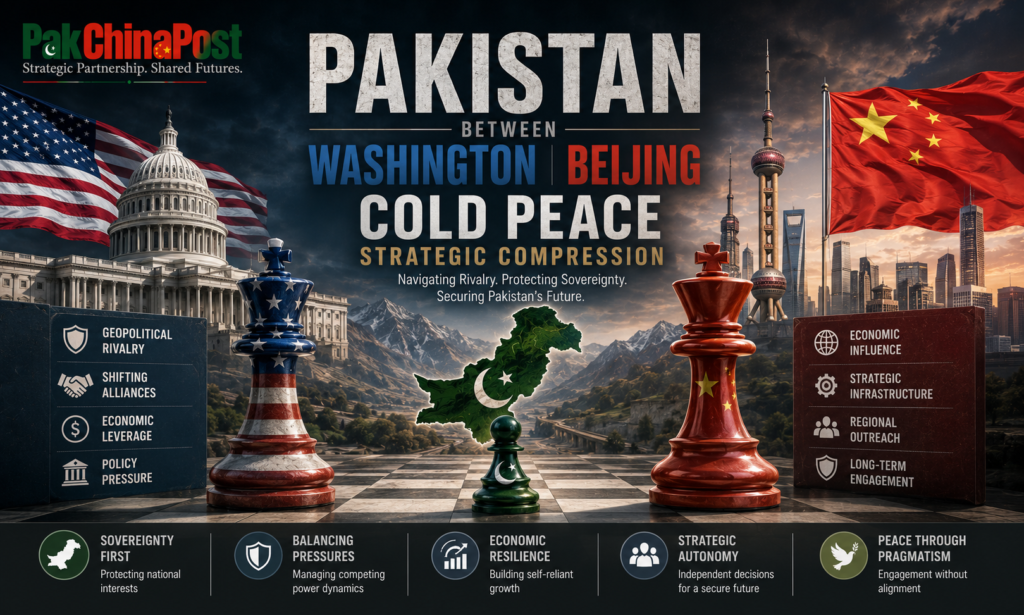
The contemporary international system is no longer adequately described by Cold War binaries, nor by the euphemistic language of post bipolar interdependence. It has instead settled into a more ambiguous and structurally unstable condition often best described as a cold peace, in which overt ideological confrontation between Washington and Beijing is replaced by calibrated competition across technology stacks, financial architectures, supply chain security regimes and selective military posturing. Within this reconfigured global geometry, Pakistan occupies a uniquely overdetermined position, simultaneously indispensable and constrained, courted and disciplined, strategically leveraged and structurally vulnerable.
The Pakistani state is situated at the intersection of two asymmetrical gravitational fields. On one side lies the United States, whose engagement is increasingly mediated through financial governance instruments, counterterrorism conditionalities, and Indo Pacific strategic alignment narratives that implicitly redefine Pakistan as a peripheral variable within a larger containment architecture directed at China. On the other side stands China, whose engagement is materialized through long horizon infrastructural embedding, digital corridor expansion, energy interdependence and strategic logistics integration under the broader logic of continental connectivity. Neither axis offers unconditional alignment, and both impose constraints that are increasingly incompatible when viewed through the lens of sovereign policy autonomy.
This dual dependency structure has transformed Pakistan’s foreign policy from a domain of strategic choice into a condition of managed equilibrium under external pressure. The recalibration of United States China relations into a domain of selective decoupling rather than comprehensive rupture has intensified this condition. Technology transfer restrictions, semiconductor export controls, artificial intelligence governance regimes and defense industrial segmentation have all contributed to a world in which Pakistan is compelled to navigate fragmented supply chains and politically charged infrastructure ecosystems. In this environment, neutrality is no longer passive positioning but an active, resource intensive and continuously contested state practice.
Within this framework, Pakistan’s security establishment operates as both stabilizer and signal transmitter. Military cooperation with the United States continues to exist within narrowly defined counterterrorism and intelligence sharing parameters, yet it is increasingly transactional, episodic and contingent on broader geopolitical alignment signals. Simultaneously, defense cooperation with China has evolved beyond conventional procurement into integrated systems alignment, particularly in air defense, naval modernization and satellite enabled surveillance capacities. This dual track engagement creates a structural tension in which strategic trust on one axis is frequently interpreted as strategic divergence on the other.
The International Monetary Fund functions within this ecosystem not merely as a financial institution but as an implicit geopolitical stabilizer whose conditionalities intersect with broader strategic expectations of fiscal transparency, debt restructuring discipline and macroeconomic predictability. The cyclical nature of Pakistan’s engagement with multilateral lenders produces a form of economic governance that is deeply intertwined with external strategic perceptions of state stability. In parallel, Chinese financial exposure through sovereign lending and infrastructure financing creates a different but equally significant form of leverage, embedded in long term repayment structures and project based dependency.
The convergence of these two financial architectures produces what can be described as a constrained sovereignty corridor, in which policy space exists but is continuously narrowed by external validation requirements. Fiscal policy, energy procurement strategy, currency stabilization efforts and trade diversification attempts are all subject to interpretive scrutiny within competing geopolitical frameworks. The result is not direct control but calibrated influence exercised through multiple overlapping institutional channels.
At the diplomatic level, Pakistan’s signalling behavior has evolved into a form of strategic ambiguity management. Official narratives emphasize multipolar engagement, diversified partnerships and regional connectivity, yet operational realities reflect a constant process of balancing reassurance to Washington with continuity of alignment with Beijing. This balancing act is increasingly difficult to sustain as the technological decoupling between the two major powers accelerates. Semiconductor ecosystems, fifth generation communication infrastructure, cloud computing governance and artificial intelligence standard setting are becoming politically segmented domains, forcing states like Pakistan to make implicit compatibility choices even when explicit alignment is avoided.
The internal dimension of this external pressure is equally significant. Institutional cohesion within Pakistan’s policy apparatus is tested by divergent expectations across economic, military and diplomatic bureaucracies. The establishment perspective, broadly understood as the strategic continuity framework that underpins state decision making, is increasingly preoccupied with the risks of over dependence on any single external actor. The fear is not immediate rupture but gradual strategic suffocation, in which policy flexibility is eroded through incremental commitments that become structurally irreversible.
This concern is particularly acute in relation to infrastructure dependency. Large scale connectivity projects, energy corridors and digital backbone investments create sunk cost environments in which future policy recalibration becomes economically and politically costly. At the same time, disengagement from such projects is not feasible without generating immediate macroeconomic shocks. This paradox defines the contemporary Pakistani condition: embeddedness without full control, participation without equal authorship, integration without strategic insulation.
The regional environment further complicates this equation. The Indo Pacific strategic architecture, driven largely by United States led alliance networks, positions Pakistan indirectly within a broader maritime and technological containment discourse. Even when not explicitly named, Pakistan is structurally implicated through its geographic adjacency to critical transit routes, its nuclear status and its historical security relationships. Meanwhile, China’s western development corridors and maritime diversification strategies increasingly rely on Pakistan as a logistical and geopolitical bridge. This dual insertion into competing strategic geographies produces a condition of permanent strategic visibility.
Information ecosystems intensify these dynamics. Narrative construction has become an instrument of geopolitical competition, where perception management precedes and sometimes substitutes for material policy shifts. Pakistan is frequently represented in external discourse through simplified binaries of stability and fragility, alignment and deviation, reliability and risk. These representations feed back into policy formulations in external capitals, influencing investment flows, diplomatic engagement intensity and security cooperation thresholds.
Within this environment, several hidden risks emerge that are not always captured in conventional policy analysis. The first is the risk of incremental strategic entrapment, in which successive short term decisions accumulate into long term structural dependence on incompatible external systems. The second is the risk of narrative compression, where Pakistan’s complex strategic reality is reduced into externally consumable archetypes that constrain diplomatic flexibility. The third is the risk of financial synchronisation failure, where competing external funding expectations generate macroeconomic volatility. The fourth is the risk of technological bifurcation, where incompatible digital ecosystems fragment national capacity for innovation and integration.
The military dimension remains central but increasingly complex. Defense modernization, procurement diversification and intelligence cooperation are no longer purely bilateral matters but are embedded within broader geopolitical signalling systems. The perception of alignment in one domain can trigger recalibration in another, creating a constant need for calibrated messaging across multiple strategic audiences. Counterterrorism cooperation, border security management and regional stability operations are therefore not isolated security tasks but components of a larger diplomatic architecture.
Energy security represents another critical axis of vulnerability and leverage. Pakistan’s dependence on imported energy sources intersects with Gulf market dynamics, Chinese investment frameworks and Western financial oversight mechanisms. Energy decisions are therefore simultaneously economic and geopolitical, influencing external perceptions of alignment and reliability. The transition toward diversified energy portfolios is constrained not only by financial limitations but also by strategic expectations embedded within existing partnerships.
In this context, calibrated neutrality emerges not as passive non alignment but as an active doctrine requiring institutional sophistication. It demands the capacity to engage multiple external systems without full absorption into any single one. This requires diplomatic agility, economic resilience and technological adaptability. It also requires a rethinking of strategic communication, in which narrative clarity and ambiguity are carefully balanced to preserve operational flexibility.
Policy recommendations flowing from this analysis converge on several strategic imperatives. The first is the necessity of deepening institutional coherence across economic, security and foreign policy domains to prevent fragmented external engagement. The second is the urgent need for technological diversification to avoid systemic dependency on single ecosystem architectures. The third is the strengthening of financial resilience mechanisms that reduce cyclical exposure to external conditionalities. The fourth is the development of a proactive narrative strategy that redefines Pakistan not as a passive object of geopolitical competition but as an active architect of regional connectivity.
Establishment level concerns, often understated in public discourse, revolve around the sustainability of strategic autonomy under conditions of accelerating external polarization. The fear is not immediate crisis but gradual erosion of decision-making elasticity. In such a scenario, sovereignty becomes formally intact but substantively constrained. Avoiding this outcome requires continuous recalibration of external engagements, disciplined prioritization of national interests and institutional resistance to overextension.
Ultimately, Pakistan’s position within the emerging cold peace is neither peripheral nor central but structurally intermediate. It is this intermediate status that produces both opportunity and vulnerability. The challenge is not to escape this position, which is geopolitically fixed, but to manage it with sufficient sophistication to prevent it from becoming structurally determinative. In a world where alignment is increasingly fragmented and neutrality increasingly costly, strategic survival depends on the ability to remain simultaneously connected and insulated, engaged and autonomous, visible and unabsorbed.
A Public Service Message