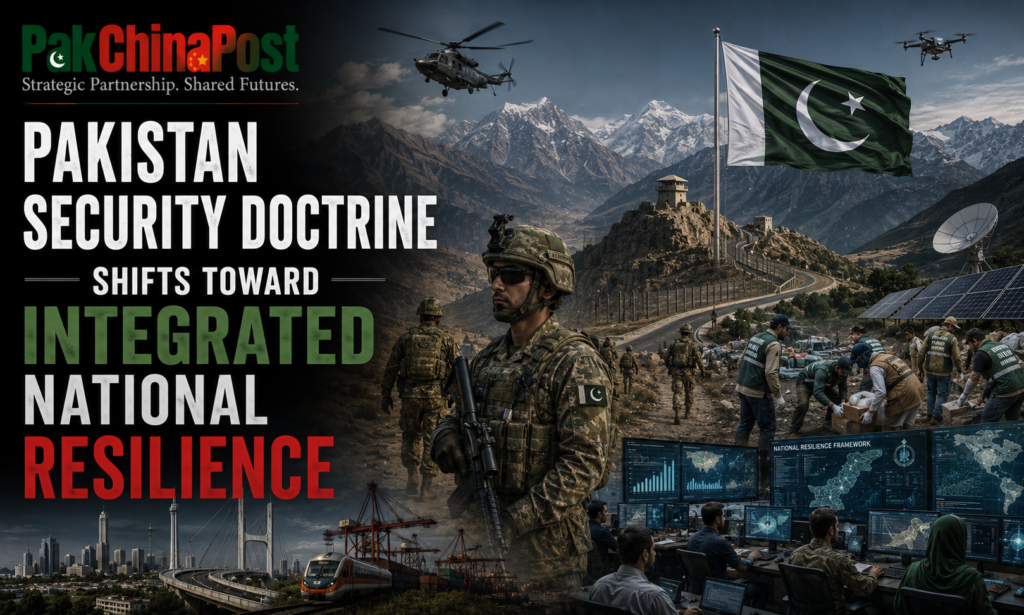
Pakistan Security Doctrine Shifts Toward Integrated National Resilience

Pakistan’s prevailing national security architecture, historically constructed upon the imperatives of territorial defence, strategic deterrence, and conventional force readiness, is increasingly confronted by a paradox of relevance. The operational grammar of security, once defined by borders, military balance, and external threat matrices, is now being reshaped by internal volatility, economic fragility, climatic disruption, demographic acceleration, and informational disorder. The resulting condition is not merely an expansion of the threat spectrum but a fundamental transformation in the ontology of security itself, where survival is determined less by battlefield superiority and more by systemic resilience.
Within this evolving environment, Pakistan’s doctrinal inertia appears increasingly misaligned with the structural realities of the twenty first century strategic landscape. The persistence of a state-centric, kinetically oriented security paradigm has created an analytical lag between threat perception and threat reality. While external deterrence remains a necessary pillar, it is no longer sufficient to define the full spectrum of existential risk confronting the state. Internal instability, fiscal contraction, institutional fragmentation, and socio-political polarisation have emerged as primary vectors of strategic vulnerability, gradually eclipsing conventional military considerations in their long-term impact.
The global security environment offers instructive contrasts. Several middle and high income states have begun recalibrating their national security frameworks toward what may be described as integrated resilience doctrines. These models incorporate economic sovereignty, cyber defence architectures, food and water security systems, climate adaptation strategies, and cognitive domain protection under a unified strategic umbrella. Security, in this redefined paradigm, is not an isolated military function but a distributed national capacity embedded across institutions, markets, and governance ecosystems. The strategic implication is clear: states that fail to internalise this multidimensional threat architecture risk gradual strategic dilution, even in the absence of direct military confrontation.
In Pakistan’s case, the structural challenge is compounded by institutional segmentation. Civil and military domains, while individually capable within their respective spheres, operate within partially disconnected policy ecosystems. This fragmentation limits the development of a unified national risk perception model. Economic planning, climate governance, digital regulation, and internal security management often evolve in parallel rather than converging into a coherent strategic synthesis. The absence of a centralised risk integration mechanism results in reactive governance cycles, where crises are managed episodically rather than anticipated systemically.
Establishment concerns in this context revolve around the sustainability of strategic coherence under conditions of internal stress accumulation. Inflationary pressures, energy insecurity, water scarcity, and population growth are not isolated policy challenges but interconnected stress multipliers that directly affect national stability. When economic resilience weakens, strategic autonomy correspondingly contracts. When institutional trust erodes, policy execution becomes inconsistent. When digital ecosystems remain unregulated or fragmented, informational vulnerabilities expand, creating cognitive asymmetries that adversarial actors can exploit without kinetic engagement.
The digital domain, in particular, represents an under-acknowledged frontier of national security vulnerability. Information disorder, algorithmic manipulation, and narrative fragmentation have introduced a new category of strategic risk that operates beneath conventional detection thresholds. In such an environment, perception itself becomes a contested domain, where legitimacy, cohesion, and institutional credibility can be eroded without physical confrontation. Pakistan’s current institutional configuration lacks a fully integrated mechanism to monitor, interpret, and respond to such hybrid informational pressures at scale.
Climate-induced stress further intensifies this multidimensional vulnerability matrix. Water scarcity in agricultural zones, heat stress in urban centres, and increasing frequency of extreme weather events are not merely environmental concerns but macro-strategic variables that directly influence internal stability, migration patterns, and economic productivity. The failure to integrate climate resilience into national security planning represents a structural gap that will increasingly define long-term strategic outcomes.
Demographic expansion adds another layer of complexity. A rapidly growing youth population, if insufficiently integrated into productive economic systems, creates both opportunity and instability simultaneously. Without corresponding expansion in employment generation, skill development, and technological integration, demographic energy risks converting into socio-political pressure. This dynamic is already visible in patterns of urban stress, informal economic expansion, and rising expectations from the state that exceed institutional delivery capacity.
The proposed transition toward an integrated national resilience doctrine requires a fundamental reordering of strategic priorities. Security must be reconceptualised as a function of systemic stability rather than solely territorial defence. This implies the institutional convergence of previously siloed domains under a unified strategic framework. Economic policy, climate adaptation, digital governance, internal security, and foreign policy must be aligned through a centralised risk intelligence architecture capable of continuous horizon scanning and scenario modelling.
A National Strategic Foresight and Risk Convergence Authority, positioned at the apex of policy coordination, could serve as the institutional nucleus of this transformation. Such an entity would not replace existing ministries or security institutions but would synthesise their outputs into a coherent national risk map. Its mandate would include early warning analysis, cross-sectoral vulnerability assessment, and long-term strategic forecasting, enabling the state to shift from reactive crisis management to anticipatory governance.
Establishment stakeholders are likely to view such restructuring through the lens of institutional balance and command coherence. However, the absence of integration carries its own systemic risk. Fragmentation at the level of perception leads to fragmentation at the level of response. In a complex threat environment, delayed coordination can be strategically equivalent to operational failure. The cost of maintaining legacy structures may therefore exceed the cost of controlled reform.
Comparative international experience underscores the necessity of adaptation. States that have successfully navigated similar transitions have done so by embedding resilience thinking into their national security frameworks. This includes integration of economic security councils, climate risk units, and cyber command structures into unified strategic planning systems. The underlying principle is convergence rather than compartmentalisation, where multiple domains of vulnerability are treated as interconnected components of a single strategic ecosystem.
Pakistan’s geopolitical positioning further amplifies the urgency of such transformation. Situated at the intersection of multiple regional fault lines, the state is exposed simultaneously to economic volatility, security pressures, and environmental stress. External partnerships and strategic alignments, while significant, cannot fully compensate for internal structural weaknesses. Indeed, external leverage is maximised only when internal coherence is strong. Without domestic resilience, strategic partnerships risk becoming asymmetrical rather than mutually reinforcing.
The economic dimension remains central to this recalibration. Fiscal instability, low productivity growth, and external dependency constrain strategic autonomy. Economic resilience is therefore not merely a developmental objective but a core security requirement. The integration of economic planning into national security frameworks is essential to ensure that fiscal policy, trade strategy, and industrial development are aligned with long-term strategic objectives rather than short-term stabilisation cycles.
Institutional reform constitutes the most sensitive dimension of this transition. Bureaucratic inertia, procedural fragmentation, and politicisation of administrative processes have historically constrained policy continuity. Any attempt to restructure the security doctrine must therefore include mechanisms for institutional accountability, merit-based governance, and performance-driven evaluation systems. Without such reforms, even well-designed frameworks risk implementation failure.
The strategic horizon suggests that the nature of conflict is undergoing irreversible transformation. Conventional military confrontation remains possible but increasingly less decisive. The more persistent challenges will emerge from economic coercion, informational disruption, climate instability, and internal fragmentation. In such a context, resilience becomes the primary determinant of sovereignty.
The recalibration of Pakistan’s national security doctrine toward an integrated resilience model is therefore not a policy preference but a structural necessity. The longer this transition is delayed, the greater the accumulation of latent vulnerabilities across multiple domains. Strategic foresight demands recognition that the future of security lies not in the expansion of conventional capabilities alone, but in the integration of systemic capacities across the entire state architecture.
The challenge is profound, but so is the opportunity. A successful transition would not only stabilise internal dynamics but also enhance Pakistan’s strategic credibility in an increasingly complex regional and global environment. The alternative is a gradual erosion of coherence, where fragmented responses to interconnected threats undermine long-term national stability.
In this unfolding strategic landscape, resilience is no longer an abstract policy concept. It is the defining condition of state survival.
A Public Service Message