
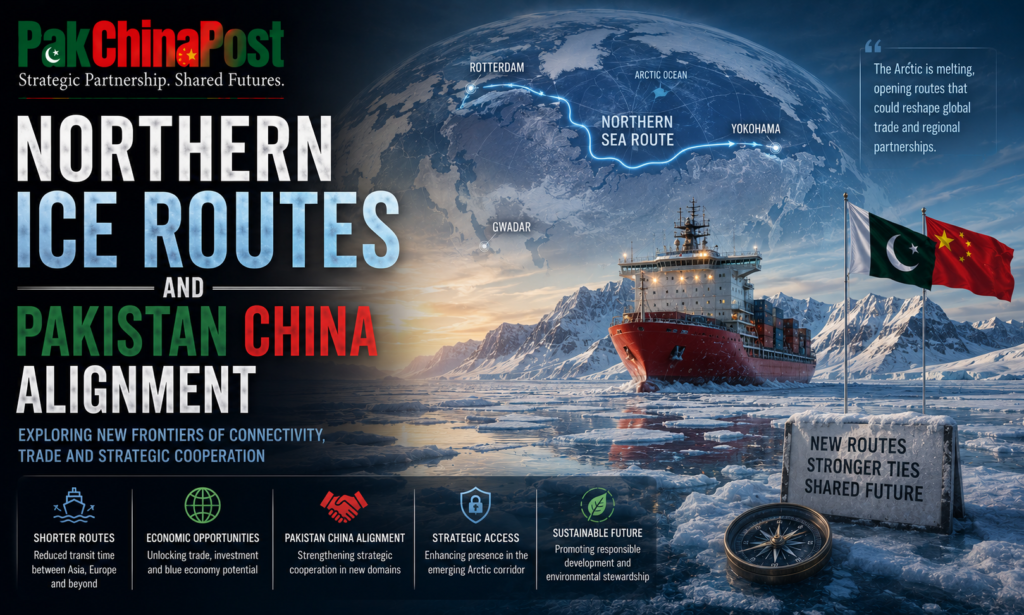
Northern Ice Routes and Pakistan China Alignment

BY SHAFQAT ALI QURESHI
The accelerating transformation of the Arctic from a peripheral frozen expanse into a functional theatre of maritime mobility, resource extraction, and scientific presence has introduced a new layer of strategic calculation for mid-tier states seeking relevance beyond their immediate geography. The melting of ice sheets is not merely an environmental phenomenon but a structural reordering of navigational economics and resource accessibility, compressing distances between East Asia, Europe, and North America through emergent shipping corridors that may redefine global logistics architecture over the coming decades. Within this evolving context, China has steadily expanded its Arctic footprint through scientific expeditions, polar research stations, shipping trials along the Northern Sea Route, and engagement with Arctic governance platforms, positioning itself as a near-Arctic stakeholder. Pakistan, though geographically distant, is increasingly confronted with the question of whether and how it can interface with this northern transformation through its strategic partnership with China, particularly in domains where science diplomacy, logistics complementarity, and institutional participation intersect.
For Pakistan, the Arctic is not a theater of direct territorial or security interest; rather, it is a derivative space where alignment opportunities emerge through its broader relationship with China and its aspiration to diversify scientific and economic partnerships beyond its immediate regional constraints. The key proposition is not Pakistan’s independent Arctic engagement, which would be structurally limited, but its calibrated participation within China-led or China-linked Arctic initiatives that could offer incremental scientific capacity building, maritime learning, and selective logistical integration. This requires a careful disentangling of symbolic alignment from operational feasibility, ensuring that Pakistan’s engagement does not exceed its institutional readiness or fiscal bandwidth.
China’s Arctic engagement has evolved through a dual-track approach combining scientific legitimacy and infrastructural foresight. Its designation as a “near-Arctic state” reflects an attempt to embed itself within governance discussions dominated by Arctic littoral states, while simultaneously investing in polar research vessels, ice-class shipping capabilities, and data collection systems that support long-term navigation and resource assessment. The Polar Silk Road concept, though often rhetorically amplified, represents a practical ambition to integrate Arctic maritime routes into broader Eurasian connectivity planning, potentially shortening shipping times between Chinese ports and European markets by significant margins under favorable ice conditions. Within this framework, China’s emphasis on scientific diplomacy functions as both an entry mechanism and a legitimacy-building exercise, allowing it to participate in Arctic Council-adjacent scientific working groups and bilateral research partnerships with Nordic countries and Russia.
Pakistan’s potential alignment with this architecture must be interpreted through three distinct but interlinked lenses: scientific participation, logistical adjacency, and governance familiarity. On the scientific front, Pakistan possesses limited but relevant capacity within its maritime and meteorological institutions that could be selectively integrated into collaborative research programs focusing on climate modeling, cryosphere studies, and monsoon-Arctic teleconnection research. The scientific value proposition lies not in Pakistan conducting independent Arctic expeditions but in contributing data analysis, computational modeling, and atmospheric correlation studies that link Arctic warming patterns with South Asian climate variability. Such an approach would allow Pakistan to position itself as a downstream beneficiary and analytical contributor within global climate science networks anchored in Chinese-led or multilateral Arctic research consortia.
However, this pathway is constrained by structural deficiencies in Pakistan’s research infrastructure, including underfunded oceanographic institutions, limited polar research training, and weak integration between climate science and policy planning. Without addressing these foundational gaps, any Arctic-related scientific diplomacy risks remaining symbolic rather than substantive. Engagement with China in this domain would therefore require capacity embedding programs, joint training initiatives, and the establishment of specialized climate research units capable of interfacing with international datasets and Arctic observation platforms. This is not merely an academic exercise but a prerequisite for ensuring that Pakistan’s participation is recognized within technical rather than purely diplomatic registers.
The logistical dimension of Arctic engagement presents a more indirect but potentially significant opportunity. As China continues to explore seasonal viability of Northern Sea Route navigation, particularly during late summer and early autumn windows, questions arise regarding the integration of Arctic shipping corridors with existing Eurasian supply chains that already involve Pakistan through the China-Pakistan Economic Corridor framework. While Pakistan does not directly interface with Arctic maritime routes, its ports, particularly Gwadar and Karachi, form part of China’s broader maritime diversification strategy. In a long-term scenario, Arctic shipping routes could complement rather than replace southern maritime pathways, creating a multi-vector logistics system in which cargo flows are dynamically allocated based on seasonal efficiency, geopolitical stability, and insurance considerations.
In such a configuration, Pakistan’s role would not be that of an Arctic participant but a southern relay node within a distributed logistics network extending from East Asia through the Indian Ocean to Europe and potentially intersecting with Arctic-bound flows at transshipment or re-export stages. This conceptualization, however, remains speculative and dependent on multiple variables, including the commercial viability of Arctic routes, regulatory acceptance by Arctic states, and insurance risk assessments associated with polar navigation. Pakistan’s immediate policy relevance therefore lies not in infrastructural expansion toward the Arctic but in enhancing interoperability standards within its existing port and customs systems to accommodate future diversification of China-linked maritime trade flows.
The governance dimension of Arctic affairs introduces a more complex diplomatic calculus. The Arctic Council remains the principal forum for Arctic governance, though its functionality has been affected by geopolitical tensions among member states. China’s engagement with Arctic governance structures has been carefully calibrated to avoid direct confrontation while maximizing observer influence. Pakistan, lacking geographical proximity or historical engagement, would face significant barriers to formal participation in Arctic governance institutions. Nevertheless, indirect participation through scientific working groups, academic consortia, and climate policy forums linked to Arctic studies remains a plausible avenue.
This would require Pakistan to adopt a “proxy engagement model,” whereby it participates in Arctic-related governance discussions through thematic entry points such as climate resilience, maritime safety, and polar environmental protection rather than territorial claims or resource negotiations. China’s existing networks in Arctic governance could serve as an entry conduit, but this would necessitate Pakistan maintaining diplomatic neutrality and avoiding alignment perceptions that could complicate its relations with other global actors engaged in Arctic affairs. The challenge lies in ensuring that participation is perceived as knowledge-based rather than geopolitical signaling.
A further constraint arises from Pakistan’s institutional bandwidth. Arctic engagement, even in indirect form, requires sustained investment in specialized expertise, including polar law, maritime climatology, and international environmental governance. At present, Pakistan’s foreign policy establishment operates under significant resource constraints, with priority typically allocated to immediate regional concerns. Integrating Arctic considerations into policy planning would require either the establishment of a dedicated polar affairs unit or the embedding of Arctic-related expertise within existing climate and maritime divisions. Without such institutional anchoring, engagement risks remaining episodic and personality-driven rather than structurally embedded.
From China’s perspective, Pakistan’s value in Arctic-related cooperation is not operational but strategic-symbolic and analytical. Pakistan offers a large developing-country perspective that can contribute to framing Arctic climate discussions within global South narratives, particularly in linking polar warming to downstream agricultural vulnerability in monsoon-dependent economies. This narrative linkage is increasingly relevant in multilateral climate negotiations, where the interdependence of global climate systems is gaining recognition. Pakistan could thus function as a bridging voice between Arctic science outputs and South Asian climate policy discourse, provided it develops the analytical capacity to substantiate such linkages.
The scientific diplomacy component of this engagement is particularly significant. Joint research initiatives between Pakistani institutions and Chinese polar research centers could be structured around satellite data analysis, atmospheric circulation modeling, and climate impact forecasting. Such collaboration would allow Pakistan to indirectly participate in Arctic observation without requiring physical deployment in polar regions. China’s expanding satellite infrastructure and polar data collection systems provide a potential platform for such cooperation, enabling data-sharing agreements that could enhance Pakistan’s climate modeling capabilities.
Yet, this trajectory is not without risks. Over-association with Arctic strategic narratives could expose Pakistan to perceptions of geopolitical overextension, particularly if Arctic competition intensifies among major powers. It is therefore essential that Pakistan’s engagement remains firmly anchored in scientific and developmental framing rather than strategic competition discourse. Any deviation into geopolitical signaling would undermine the credibility of its participation and potentially complicate its broader diplomatic posture.
In policy terms, Pakistan’s optimal approach can be characterized as calibrated peripheral engagement, defined by three operational principles. First, minimal physical footprint, ensuring that no resource-intensive Arctic infrastructure commitments are undertaken. Second, maximal scientific integration, focusing on data, modeling, and research collaboration rather than territorial or logistical claims. Third, governance neutrality, maintaining participation in Arctic-related forums strictly within climate and scientific domains without aligning with competitive narratives among Arctic stakeholders.
The implementation of such an approach would require institutional coordination between Pakistan’s foreign ministry, climate authorities, maritime agencies, and academic institutions. It would also necessitate sustained engagement with Chinese scientific and policy institutions to ensure alignment with ongoing Arctic research initiatives. However, this alignment must be carefully managed to avoid dependency dynamics that could limit Pakistan’s analytical autonomy.
Ultimately, the Arctic represents for Pakistan not a zone of direct expansion but a secondary interface of global system transformation. Its relevance emerges through China’s expanding presence, global climate interdependencies, and the evolving structure of maritime trade routes. The challenge for Pakistan is not to position itself as an Arctic actor but to ensure that it is not excluded from the knowledge systems and logistical recalibrations that Arctic change is likely to generate. In this sense, Arctic engagement becomes less about geography and more about epistemic participation in a rapidly reorganizing global environmental and economic order.
The strategic question is therefore not whether Pakistan can enter the Arctic space, but whether it can embed itself within the informational, scientific, and logistical architectures that Arctic transformation is already producing. Through selective alignment with China’s scientific diplomacy and cautious engagement with emerging governance frameworks, Pakistan can secure a marginal but meaningful presence in a domain that will increasingly influence global climate stability, maritime economics, and resource distribution over the coming decades.
A Public Service Message