
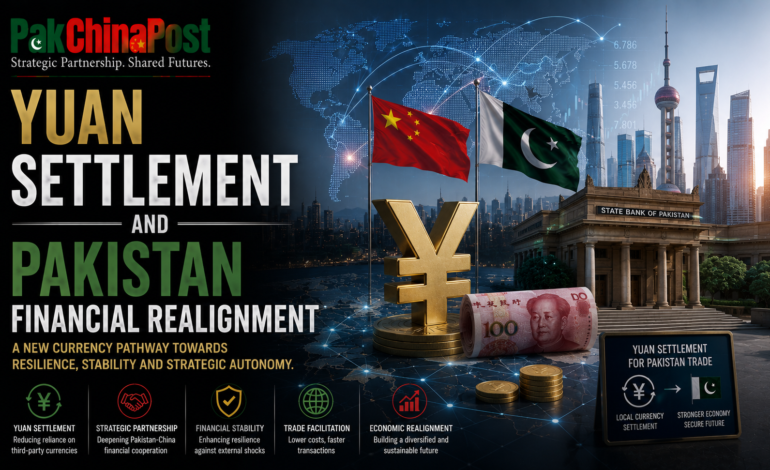
Yuan Settlement and Pakistan Financial Realignment


The gradual reconfiguration of Pakistan’s external payment architecture has placed renewed attention on the feasibility of expanding Chinese yuan denominated trade settlement as an operational alternative to the US dollar. With persistent pressure on foreign exchange reserves, recurring balance of payments constraints, and elevated transaction costs associated with dollar clearing systems, policymakers are increasingly confronted with a structural question: whether a deeper yuan based settlement framework can transition from a bilateral facilitation mechanism into a functional pillar of Pakistan’s external trade ecosystem. This is not merely a technical banking adjustment but a recalibration of financial sovereignty, liquidity management, and external account vulnerability in an environment where currency exposure directly shapes macroeconomic stability.
At present, Pakistan’s trade settlement architecture remains overwhelmingly dollar centric, with limited but expanding experimentation in yuan denominated transactions primarily through Chinese commercial banks operating under correspondent arrangements. These mechanisms, while symbolically significant, remain operationally constrained. The absence of deep domestic liquidity in yuan, limited hedging instruments, and partial banking interoperability restrict the scalability of such arrangements. The structural question is therefore not whether yuan settlement is possible, but whether Pakistan’s financial ecosystem is sufficiently prepared to absorb the systemic implications of partial currency substitution without amplifying existing vulnerabilities.
The most immediate consideration is banking readiness. Pakistan’s commercial banking sector operates within a regulatory framework that is still heavily optimized for dollar clearing systems, SWIFT based messaging, and conventional foreign exchange settlement cycles. Transitioning toward yuan denominated trade settlement requires not only correspondent banking expansion with Chinese financial institutions but also internal capacity building in currency risk management, yuan liquidity provisioning, and settlement reconciliation systems. At present, only a limited number of banks maintain active yuan clearing capabilities, and even these are largely dependent on external liquidity injections rather than domestically generated currency pools. Without a deepened interbank yuan market, settlement remains episodic rather than systemic.
A second dimension concerns foreign exchange implications. The introduction of yuan settlement alters the composition of external liabilities and asset exposures on Pakistan’s balance sheet. While it may reduce immediate pressure on dollar reserves for bilateral trade with China, it simultaneously introduces a new layer of currency concentration risk. If imports from China expand in yuan terms without corresponding export earnings denominated in the same currency, Pakistan may accumulate a structural yuan deficit. This would necessitate either reserve diversification into yuan assets or continued reliance on dollar conversions to bridge settlement gaps, thereby limiting the intended de-dollarization effect. Currency substitution without corresponding export diversification can therefore shift rather than resolve external vulnerability.
Reserve management considerations are equally consequential. Pakistan’s foreign exchange reserves are traditionally held in a mix of dollar dominated assets, with limited exposure to alternative reserve currencies. Expanding yuan based settlement would require a parallel evolution in reserve composition, potentially including holdings in Chinese sovereign instruments or yuan denominated liquidity buffers. This introduces both opportunity and constraint: while it may provide access to Chinese financial support mechanisms, it also increases exposure to the monetary policy dynamics of a single external jurisdiction. The tradeoff between liquidity diversification and concentration risk becomes a central policy dilemma.
The structural viability of yuan settlement also depends on trade asymmetry dynamics. Pakistan’s trade with China is heavily import weighted, with machinery, electronics, industrial inputs, and energy related goods constituting a significant proportion of imports. Export flows in the opposite direction remain comparatively narrow and concentrated in low value added categories. This asymmetry means that yuan settlement, if expanded, could intensify structural trade imbalance unless accompanied by export scaling into Chinese markets. Without export deepening, yuan settlement risks becoming a one directional liquidity drain mechanism rather than a balanced bilateral clearing system.
Beyond technical banking considerations, there is a broader institutional dimension relating to financial system interoperability. The global financial architecture remains largely dollar anchored, with deep integration into Western clearing systems. While yuan internationalization has progressed steadily through bilateral swap agreements, offshore clearing centers, and regional trade facilitation mechanisms, it has not yet achieved full fungibility comparable to the dollar. Pakistan’s incremental shift toward yuan settlement therefore operates within a hybrid system where dual currency exposure must be carefully managed to avoid arbitrage inefficiencies and settlement mismatches.
Geopolitically, the expansion of yuan based settlement introduces a recalibrated positioning within global financial networks. It does not imply exclusion from dollar based systems, but rather diversification of settlement pathways. This diversification can enhance resilience against external liquidity shocks, particularly in periods of tightening global financial conditions. However, it also requires careful calibration to avoid overexposure to bilateral financial dependencies. The objective, from a policy perspective, is not substitution but managed pluralism in currency settlement architecture.
The operationalization of yuan settlement at scale would require several foundational reforms. First, the establishment of a deep offshore yuan liquidity pool within Pakistan’s banking system is essential. This would necessitate structured swap arrangements with Chinese financial institutions, enabling domestic banks to access yuan liquidity without continuous conversion through third currencies. Second, the development of yuan hedging instruments, including forward contracts and currency futures, would be critical to mitigate exchange rate volatility risks for importers and exporters. Without hedging infrastructure, commercial actors remain exposed to unpredictable currency fluctuations, limiting adoption.
Third, integration of payment systems must be enhanced beyond correspondent banking relationships. Direct settlement channels between Pakistani banks and Chinese payment infrastructure would reduce transaction latency and costs, improving efficiency for high volume trade flows. Fourth, regulatory frameworks must evolve to recognize yuan denominated accounting, taxation, and reporting standards, ensuring that currency diversification does not create compliance fragmentation within domestic financial governance systems.
Fifth, export policy alignment is indispensable. If yuan settlement is to function as more than a liquidity management tool, Pakistan must expand its export base into Chinese markets in sectors where comparative advantage can be realistically developed. This requires targeted industrial policy interventions, particularly in agro processing, light engineering, and niche textile segments that can integrate into Chinese consumption and industrial supply chains. Without export scaling, currency settlement diversification risks remaining structurally imbalanced.
The broader macroeconomic implication of yuan settlement expansion is its potential to partially insulate Pakistan from short term dollar liquidity shocks. In periods of external pressure, reduced reliance on dollar denominated trade settlement could provide temporary stabilization of import financing. However, this must be balanced against the risk of creating parallel currency exposure cycles that complicate external debt management and reserve allocation strategies. Currency diversification is not inherently stabilizing unless accompanied by disciplined macroeconomic coordination.
It is also necessary to acknowledge that yuan internationalization itself remains an evolving process. While China has expanded bilateral currency swap arrangements and promoted yuan invoicing in energy and commodity trade, capital account convertibility remains selectively managed. This means that yuan liquidity, while increasingly available for trade settlement, does not yet function as a fully globalized store of value. Pakistan’s engagement with yuan settlement must therefore remain calibrated to the structural limits of its international usability.
From a policy architecture perspective, the question is not whether Pakistan should adopt yuan settlement, but how it should structure a phased, risk-managed transition. An abrupt shift would introduce financial volatility, while passive reliance on dollar dominance perpetuates existing vulnerabilities. A calibrated hybrid model, where yuan settlement is expanded in specific trade corridors while maintaining dollar flexibility for broader external obligations, appears to be the most viable pathway.
Ultimately, the emergence of yuan-based settlement in Pakistan is less a currency substitution narrative and more an exercise in financial system diversification. Its success will depend not on political alignment or bilateral enthusiasm, but on the robustness of domestic financial institutions, the depth of liquidity management frameworks, and the coherence of macroeconomic policy coordination. Without these foundational elements, currency diversification risks becoming symbolic rather than structural.
The strategic objective for policymakers should therefore be the construction of a resilient, multi layered settlement ecosystem capable of absorbing external shocks, optimizing transaction efficiency, and reducing overdependence on any single currency architecture. In this sense, yuan settlement is not an endpoint but a transitional instrument within a broader reengineering of Pakistan’s external financial interface.
A Public Service Message


