
Pakistan China Regulatory Stability Shapes Enduring Strategic Investment Confidence

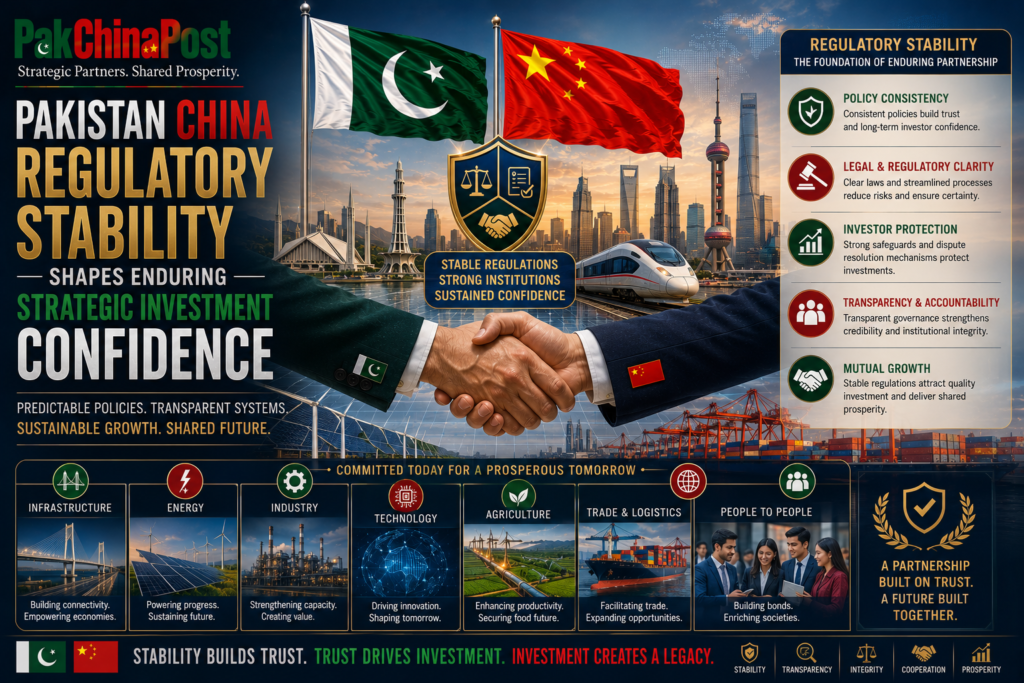
Pakistan and China increasingly recognise that the next phase of their economic partnership will be determined less by the announcement of ambitious investment packages than by the credibility of institutions responsible for implementing them. Across global capital markets, strategic investors no longer assess opportunities solely through the traditional metrics of tax concessions, subsidised industrial zones or preferential financing. Instead, they evaluate whether governments can sustain regulatory continuity, honour contractual obligations, resolve commercial disputes efficiently, maintain administrative consistency and demonstrate institutional discipline over extended political cycles. The strategic competition for investment has therefore evolved into a competition for governance credibility, making regulatory predictability one of the most valuable national assets in contemporary economic statecraft.
For Pakistan and China, this transition carries particular significance. Bilateral cooperation has already progressed beyond infrastructure development into manufacturing, technology, industrial relocation, digital connectivity, agricultural modernisation and emerging innovation ecosystems. These sectors involve investment horizons extending over decades rather than electoral terms. Consequently, investors increasingly seek assurances that regulatory environments will remain stable regardless of changes in political leadership, bureaucratic restructuring or evolving domestic priorities. Capital can accommodate commercial risk; it is institutional uncertainty that often proves more damaging to long-term investment decisions.
The international investment environment has become considerably more complex following geopolitical fragmentation, supply chain diversification, technological competition and heightened economic security considerations. Governments now compete not only through financial incentives but also through the reliability of governance systems capable of managing increasingly sophisticated investment ecosystems. Multinational corporations, sovereign investment funds and strategic industrial partners consistently identify regulatory certainty as a decisive factor when allocating capital across competing jurisdictions. Predictable governance reduces transaction costs, strengthens financial planning, enhances operational efficiency and lowers the perceived political risks embedded within long-term projects.
Pakistan’s partnership with China provides an opportunity to embed these governance principles within an expanding framework of economic cooperation. The evolution of bilateral initiatives increasingly requires sophisticated regulatory institutions capable of coordinating multiple ministries, provincial authorities, judicial bodies, financial regulators and specialised implementation agencies. Infrastructure construction represented only the first phase of cooperation. Industrial development, advanced manufacturing, digital services, artificial intelligence, renewable energy, biotechnology and financial integration demand significantly higher standards of administrative professionalism and legal consistency.
The experience of international investment demonstrates that generous fiscal incentives rarely compensate for inconsistent regulatory administration. Investors frequently accept higher operational costs when governance systems provide certainty regarding licensing procedures, taxation frameworks, environmental compliance, customs administration and dispute resolution mechanisms. Conversely, jurisdictions offering attractive financial incentives often struggle to attract sustainable investment if regulatory frameworks change unpredictably or administrative decisions vary across institutions.
Administrative consistency begins with the principle that government decisions should be based upon transparent legal frameworks rather than discretionary interpretations. Investors seek confidence that identical regulatory circumstances will produce comparable administrative outcomes regardless of individual office holders or changing institutional preferences. Such consistency encourages long-term planning, facilitates corporate governance and reduces unnecessary compliance costs. It also strengthens public confidence by demonstrating that regulatory institutions operate according to established legal principles rather than subjective administrative discretion.
Judicial efficiency represents another indispensable pillar of investment confidence. Commercial disputes are inevitable within complex economic systems. What distinguishes mature investment environments is not the absence of disputes but the existence of credible mechanisms capable of resolving disagreements fairly, efficiently and transparently. Delayed commercial litigation, inconsistent judicial interpretation and prolonged contract enforcement substantially increase investment risk premiums, raising financing costs while discouraging capital-intensive projects requiring predictable legal protection.
Pakistan’s judicial reforms therefore possess strategic economic implications extending beyond legal administration. Efficient commercial courts, specialised arbitration mechanisms, digital case management systems and technically qualified judicial expertise contribute directly to national economic competitiveness. Investors evaluate not merely the legal provisions contained within legislation but the practical effectiveness with which judicial institutions enforce contractual rights and commercial obligations.
China’s own economic transformation illustrates the importance of institutional evolution accompanying rapid industrial development. While governance structures differ across national systems, sustained economic expansion has consistently required progressively stronger administrative coordination, regulatory adaptation and institutional capacity. As bilateral economic cooperation expands into increasingly sophisticated sectors, governance cooperation may become as strategically valuable as financial cooperation itself.
Contract enforcement constitutes the operational foundation of market confidence. Every investment decision ultimately depends upon confidence that negotiated agreements will be implemented according to mutually accepted legal standards. Effective contract enforcement extends beyond courtroom litigation to encompass administrative compliance, regulatory coordination, licensing consistency and bureaucratic accountability. Investors require assurance that approved projects will not encounter arbitrary procedural obstacles after significant financial commitments have already been undertaken.
Institutional credibility develops gradually through consistent performance rather than legislative announcements alone. Governments frequently introduce ambitious reform agendas accompanied by comprehensive policy frameworks. However, international investors increasingly distinguish between policy declarations and implementation capability. Credibility emerges when institutions repeatedly demonstrate professional competence, regulatory consistency and administrative integrity over extended periods. Trust accumulated through reliable institutional performance eventually becomes a strategic economic asset attracting additional investment through reduced perceived risk.
Pakistan possesses considerable opportunities to strengthen institutional credibility through administrative modernisation rather than wholesale institutional reconstruction. Digital governance platforms, integrated regulatory databases, transparent licensing procedures, standardised administrative timelines and measurable institutional performance indicators can substantially improve investor confidence without requiring extensive legislative transformation. Predictability frequently depends more upon administrative discipline than institutional complexity.
Bureaucratic professionalism similarly deserves greater recognition within strategic economic policymaking. Professional civil services provide continuity across political transitions while preserving institutional memory essential for long-term economic projects. Investors interacting with technically competent, politically neutral and administratively efficient public officials experience greater confidence regarding project implementation and regulatory compliance. Conversely, frequent administrative turnover, inconsistent decision-making and limited technical capacity generate uncertainty irrespective of favourable investment policies.
The Pakistan China economic partnership increasingly requires specialised bureaucratic expertise spanning international finance, industrial policy, environmental regulation, digital governance, intellectual property, infrastructure management, advanced manufacturing and cross-border commercial law. Building such administrative capacity should therefore be regarded as strategic investment infrastructure comparable to physical transport networks or industrial facilities.
Regulatory continuity across successive administrations represents one of the greatest challenges confronting emerging investment destinations. Democratic political transitions naturally produce evolving policy priorities reflecting changing electoral mandates. However, successful investment destinations distinguish between legitimate policy evolution and disruptive regulatory volatility. Long-term strategic projects require governance mechanisms preserving fundamental contractual commitments while allowing governments sufficient flexibility to pursue evolving development objectives.
Institutionalising bipartisan consensus regarding core economic priorities offers one potential mechanism for balancing democratic accountability with regulatory stability. National investment frameworks, strategic infrastructure policies and internationally negotiated commercial agreements benefit from broad political support extending beyond individual administrations. Such consensus reduces investor concerns regarding abrupt policy reversals following electoral transitions while strengthening national strategic coherence.
Independent regulatory institutions also contribute significantly to investment predictability. Regulatory authorities operating under clearly defined legal mandates, professional appointment procedures and transparent decision-making processes can provide greater continuity than institutions subject to frequent political intervention. Independence should nevertheless remain balanced with democratic accountability through parliamentary oversight, judicial review and public transparency mechanisms ensuring regulatory legitimacy.
Federal and provincial coordination presents another critical dimension of investment governance within Pakistan. Investors frequently encounter differing administrative interpretations across multiple governmental levels, generating procedural uncertainty despite supportive national policies. Establishing integrated regulatory coordination mechanisms capable of harmonising implementation across federal and provincial institutions would substantially strengthen investment confidence while reducing bureaucratic fragmentation.
Digital governance technologies provide unprecedented opportunities for enhancing regulatory predictability. Electronic licensing systems, integrated compliance platforms, digital contract management, automated regulatory notifications and transparent administrative tracking significantly reduce opportunities for inconsistency while improving institutional accountability. Technology cannot substitute for governance, but it can substantially strengthen administrative transparency and procedural consistency.
Data driven governance similarly enables governments to evaluate regulatory performance objectively. Measuring administrative timelines, dispute resolution efficiency, licensing consistency, investor satisfaction and institutional responsiveness provides evidence-based foundations for continuous governance improvement. Performance indicators also strengthen accountability by allowing policymakers to identify administrative bottlenecks before they undermine broader investment objectives.
Strategic communication represents an often overlooked component of regulatory predictability. Investors respond not only to substantive regulatory changes but also to uncertainty regarding future policy direction. Governments capable of communicating policy intentions clearly, consulting stakeholders systematically and providing reasonable implementation timelines minimise uncertainty even when legitimate regulatory adjustments become necessary. Predictable communication reduces speculation while enhancing investor confidence in institutional decision-making processes.
International experience increasingly demonstrates that successful investment destinations institutionalise consultation rather than relying upon ad hoc policy engagement. Regular dialogue among government agencies, domestic businesses, international investors, financial institutions and academic experts strengthens regulatory quality while identifying implementation challenges before they become systemic obstacles. Such consultation mechanisms improve policy design without compromising governmental decision-making authority.
Pakistan and China could further strengthen bilateral investment governance through enhanced institutional cooperation extending beyond commercial negotiations. Joint regulatory dialogues, administrative training programmes, judicial exchanges, digital governance collaboration and regulatory harmonisation initiatives would strengthen implementation capacity while improving mutual understanding of evolving investment requirements. Institutional cooperation complements financial cooperation by addressing governance challenges influencing long-term project sustainability.
Commercial arbitration deserves particular attention as cross-border investment expands into increasingly sophisticated sectors. Efficient arbitration mechanisms reduce litigation costs, accelerate dispute resolution and preserve commercial relationships essential for long-term strategic partnerships. Establishing internationally respected arbitration institutions supported by technically qualified professionals would enhance Pakistan’s attractiveness as a regional investment destination while strengthening bilateral commercial confidence.
Legal certainty regarding property rights, intellectual property protection, competition policy and corporate governance increasingly influences investment decisions involving technology-intensive industries. Future Pakistan China cooperation will likely expand into sectors where intangible assets possess greater economic value than physical infrastructure. Governance systems must therefore evolve alongside economic transformation, ensuring legal frameworks adequately protect innovation while encouraging collaborative technological development.
Public sector integrity remains inseparable from investment confidence. Transparent procurement systems, objective regulatory enforcement, professional recruitment practices and effective accountability mechanisms reduce governance risks while strengthening institutional legitimacy. Integrity should be understood not merely as an ethical objective but as an economic competitiveness strategy directly influencing investor perceptions of regulatory reliability.
Macroeconomic stability complements regulatory predictability by reinforcing broader governance credibility. Stable monetary policy, responsible fiscal management, sustainable debt frameworks and transparent financial regulation create supportive conditions enabling regulatory reforms to achieve maximum effectiveness. Investors evaluate governance holistically, recognising that institutional reliability extends across economic management rather than isolated regulatory agencies.
Global competition for strategic investment continues intensifying as countries pursue industrial upgrading, technological innovation and supply chain diversification. Pakistan’s comparative advantage increasingly depends upon demonstrating governance maturity capable of supporting sophisticated international partnerships rather than competing exclusively through labour costs or fiscal incentives. Regulatory predictability therefore constitutes an essential component of national economic security alongside physical infrastructure, human capital and financial stability.
The emergence of environmental, social and governance standards further reinforces the importance of institutional credibility. International investors increasingly incorporate governance quality into financing decisions, recognising that predictable regulatory environments reduce operational uncertainty while supporting sustainable commercial performance. Pakistan’s governance reforms therefore align with broader international investment trends emphasising transparency, accountability and institutional effectiveness.
Strategic investment increasingly reflects geopolitical considerations alongside commercial calculations. Governments and corporations alike assess whether prospective investment destinations possess institutional resilience capable of managing external economic pressures, technological competition and evolving international regulatory standards. Governance credibility enhances strategic autonomy by reducing vulnerability to external economic disruptions while strengthening national negotiating capacity.
For Pakistan, the next phase of economic transformation will depend less upon announcing additional investment initiatives than upon strengthening institutions responsible for implementing existing commitments consistently and professionally. Governance reforms should therefore prioritise implementation capacity, regulatory coordination and administrative predictability rather than legislative proliferation. Investors generally prefer stable regulatory frameworks administered efficiently over continuously changing legal regimes promising incremental improvements.
Policy continuity should be embedded through legally protected national economic strategies extending beyond electoral cycles. Parliament, executive institutions, provincial governments and regulatory agencies should collectively establish mechanisms preserving strategic investment commitments while allowing appropriate democratic adaptation where necessary. Such institutional arrangements would reassure investors that fundamental economic policies remain resilient despite normal political transitions.
The establishment should view regulatory predictability as an element of comprehensive national resilience rather than merely an administrative objective. Economic security increasingly depends upon governance systems capable of sustaining investor confidence under varying domestic and international circumstances. Coordinated institutional planning involving economic ministries, financial regulators, judicial authorities, provincial administrations and strategic planning institutions would strengthen national implementation capacity while supporting broader development objectives.
A National Regulatory Coordination Council could institutionalise cross-government policy harmonisation by reviewing proposed regulatory changes affecting strategic investment before implementation. Complementing this mechanism with mandatory regulatory impact assessments, digital compliance monitoring, standardised administrative procedures, specialised commercial courts, strengthened arbitration institutions, integrated federal provincial coordination frameworks, periodic investor consultations and performance based bureaucratic evaluation would create an interconnected governance architecture supporting long-term investment confidence.
Pakistan and China possess an opportunity to demonstrate that enduring strategic partnerships require not only financial resources and political commitment but also governance systems capable of delivering predictable outcomes across generations of policymakers. Infrastructure may attract initial investment, yet institutions ultimately determine whether investment remains, expands and contributes sustainably to national prosperity. In an increasingly competitive global economy, regulatory predictability has become the hidden currency of strategic credibility, transforming administrative professionalism into a decisive instrument of national power, economic resilience and enduring international confidence.
A Public Service Message