

Silent Logistics and the Militarisation of Commercial Infrastructure Across the Indo Pacific

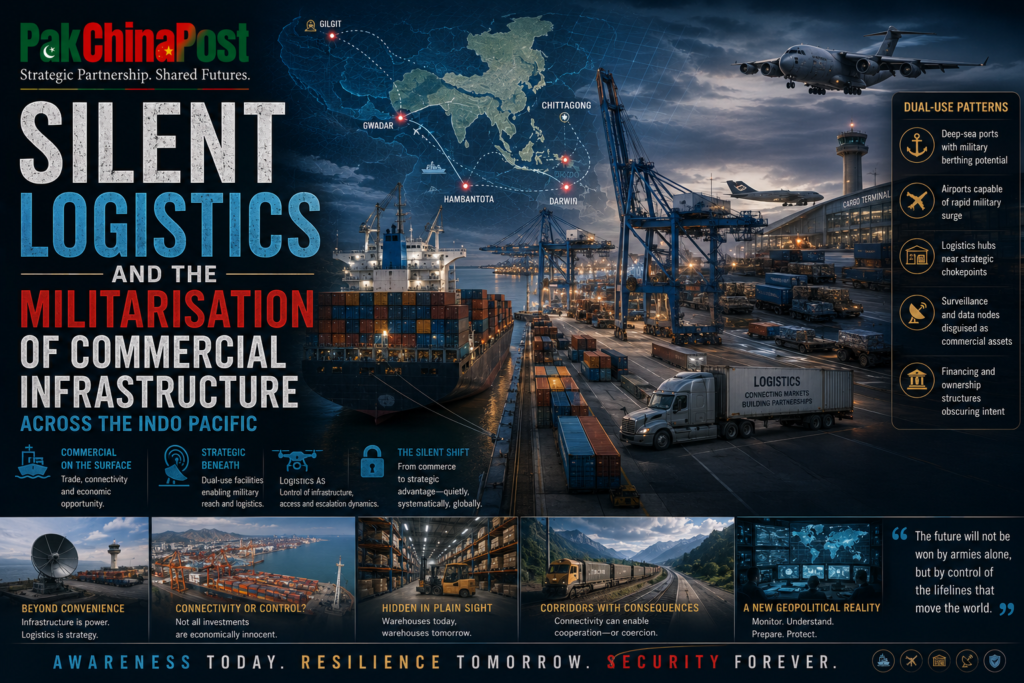
The geography of strategic competition across the Indo Pacific is no longer defined solely by aircraft carriers, missile systems or naval deployments. Increasingly, the decisive arena lies within commercial infrastructure that once appeared politically neutral. Ports, logistics corridors, container terminals, undersea communication cables, industrial warehouses, digital customs systems, autonomous shipping technologies and maritime supply chains have gradually evolved into strategic assets capable of shaping national resilience during periods of geopolitical uncertainty. The international discourse surrounding maritime infrastructure has therefore undergone a profound transformation. What was once discussed primarily in terms of trade facilitation, investment returns and commercial efficiency is now examined through the language of strategic preparedness, economic security and technological sovereignty.
This transformation reflects a broader evolution in international politics. Economic connectivity and national security have become deeply interconnected. Global supply chains are increasingly viewed as strategic ecosystems whose disruption could influence economic performance, military readiness and political stability simultaneously. Rather than separating commerce from security, policymakers increasingly recognise that commercial infrastructure forms part of a nation’s comprehensive strategic capacity.
Commercial ports illustrate this transition most clearly. Modern ports are no longer simple gateways for imports and exports. They are integrated logistical platforms combining artificial intelligence, automated cargo management, satellite navigation, digital customs processing, cyber infrastructure and multimodal transportation networks. During periods of stability these systems maximise commercial productivity. During crises they can facilitate humanitarian assistance, emergency mobilisation, industrial continuity and strategic logistics. Consequently, investments in maritime infrastructure are now evaluated not merely by throughput statistics but by their resilience under geopolitical stress.
This evolution has encouraged governments across the Indo Pacific to reconsider maritime governance through the lens of national preparedness. Strategic planning increasingly incorporates redundancy, cyber resilience, diversified shipping routes and secure logistics architecture. Maritime policy has therefore become a multidisciplinary enterprise combining defence planning, industrial policy, digital governance and economic diplomacy.
Undersea communication systems represent another dimension of this emerging strategic landscape. More than ninety percent of global digital communications depend upon submarine cable networks carrying financial transactions, government communications, commercial data and cloud computing services. These cables constitute the invisible infrastructure supporting modern economic activity. Their security has consequently become an essential component of national resilience. Concerns regarding accidental damage, cyber vulnerabilities and strategic interference have prompted many governments to develop enhanced monitoring capabilities and cooperative mechanisms for protecting critical digital infrastructure.
Industrial logistics platforms have undergone a similar strategic reassessment. Warehousing systems, distribution centres, railway connectivity, inland transport corridors and energy storage facilities increasingly determine whether economies can maintain continuity during external shocks. Rather than measuring logistics solely through commercial efficiency, governments increasingly evaluate supply chains according to redundancy, adaptability and resilience. Strategic stockpiles, diversified sourcing and integrated transport planning now receive greater policy attention than traditional cost optimisation models.
Autonomous maritime technologies are accelerating these changes. Artificial intelligence supported navigation, autonomous surface vessels, unmanned underwater systems, predictive maintenance software and digital fleet management promise substantial commercial benefits while simultaneously expanding strategic applications. Automation increases operational efficiency but also introduces cybersecurity considerations requiring comprehensive governance frameworks. Maritime digitalisation therefore requires robust institutional safeguards capable of maintaining operational continuity while protecting sensitive infrastructure from cyber threats.
Supply chain security has similarly emerged as a defining feature of strategic competition. Recent disruptions caused by pandemics, regional conflicts and environmental events demonstrated the vulnerability of highly concentrated production networks. Governments increasingly seek geographically diversified manufacturing, alternative transportation corridors and resilient procurement systems capable of reducing exposure to unexpected disruptions. This approach does not necessarily imply economic decoupling but rather strategic diversification intended to strengthen national resilience.
Against this evolving background, Pakistan and China possess significant opportunities to strengthen maritime cooperation through practical institutional development rather than geopolitical symbolism. Their maritime partnership should increasingly emphasise governance capacity, commercial transparency, technological innovation and logistical resilience capable of serving both national development objectives and regional economic connectivity.
Pakistan’s strategic location provides natural advantages linking South Asia, Central Asia, the Middle East and the western Indian Ocean. Maritime infrastructure associated with this geography can contribute substantially to regional commerce if supported by efficient governance, predictable regulation and sustained institutional capacity. Future maritime planning should therefore prioritise administrative modernisation alongside physical infrastructure development. Efficient customs systems, integrated digital documentation, transparent procurement procedures and coordinated port management can significantly enhance commercial competitiveness while simultaneously strengthening strategic preparedness.
China’s experience in large scale infrastructure development, logistics modernisation and maritime industrial planning offers valuable opportunities for technical cooperation. Joint initiatives focusing upon port automation, smart logistics systems, maritime digital platforms, environmental sustainability and workforce development could generate long term economic benefits while enhancing institutional interoperability. Such cooperation would be most effective when based upon internationally recognised commercial standards, transparent contractual arrangements and predictable regulatory frameworks.
Naval logistics integration represents another important area requiring careful development. Effective maritime resilience depends upon close coordination between civilian infrastructure and emergency response capabilities while maintaining clear legal distinctions between commercial and military activities. Joint planning concerning disaster relief, humanitarian assistance, maritime search and rescue, emergency logistics and crisis management would strengthen preparedness without undermining the commercial orientation of maritime facilities. Institutional coordination mechanisms can improve operational efficiency while reinforcing confidence among international commercial stakeholders.
Commercial shipping security should similarly become a central component of bilateral maritime cooperation. Safe shipping lanes, effective port security, anti piracy cooperation, maritime information sharing and coordinated emergency response contribute directly to regional economic stability. These initiatives benefit not only participating countries but also the wider international trading community by reducing operational uncertainty and strengthening confidence in maritime transportation networks.
Technological interoperability represents another strategic priority. Digital customs platforms, cargo tracking systems, port management software, satellite navigation services and cybersecurity standards increasingly determine the efficiency of modern maritime operations. Joint investment in compatible technological systems can reduce transaction costs, improve operational coordination and strengthen resilience against cyber threats. However, interoperability should remain consistent with international commercial standards to facilitate broader regional integration rather than technological fragmentation.
The growing international debate surrounding infrastructure investment presents both challenges and opportunities. Infrastructure projects increasingly attract geopolitical interpretations extending beyond their immediate commercial functions. Competing narratives often portray major infrastructure investments either as engines of economic development or as instruments of strategic influence. These contrasting interpretations shape international perceptions, investment decisions and diplomatic engagement.
Such narratives reflect broader strategic competition rather than objective assessments alone. Infrastructure naturally possesses strategic significance because transportation networks, energy systems and communication platforms influence national resilience. However, strategic significance does not automatically imply coercive intent. Commercial infrastructure can simultaneously support economic development, regional connectivity and legitimate national preparedness without becoming an instrument of geopolitical confrontation.
Transparent institutional governance therefore becomes essential for shaping international perceptions. Clear regulatory frameworks, competitive procurement practices, financial accountability, environmental compliance and adherence to international commercial norms strengthen investor confidence while reducing external suspicion. Transparency does not eliminate geopolitical competition, but it provides credible evidence that infrastructure development serves broad economic objectives supported by responsible governance.
Independent regulatory institutions also contribute significantly to maritime credibility. Predictable legal frameworks governing investment, dispute resolution, customs administration and commercial operations reduce uncertainty for international shipping companies and logistics providers. Institutional consistency ultimately represents one of the strongest foundations for sustainable maritime competitiveness.
Environmental sustainability further enhances strategic credibility. Modern ports increasingly integrate renewable energy, emissions reduction technologies, digital energy management and climate adaptation measures into long term planning. Sustainable infrastructure reduces operational costs while strengthening resilience against climate related disruptions that increasingly affect maritime commerce. Joint Pakistan China initiatives focusing upon green shipping technologies, coastal resilience and environmentally responsible port development could reinforce both commercial competitiveness and international confidence.
Human capital development constitutes another indispensable element of maritime resilience. Advanced logistics systems require highly skilled professionals in engineering, cybersecurity, maritime law, artificial intelligence, port management and supply chain analytics. Educational partnerships, technical exchanges, specialised training programmes and collaborative research initiatives should therefore accompany physical infrastructure investment. Sustainable strategic capacity ultimately depends upon institutional knowledge as much as technological capability.
Regional cooperation should similarly remain central to future maritime governance. The Indo Pacific encompasses highly interconnected shipping routes supporting global commerce. Maritime security therefore cannot rely exclusively upon national capabilities. Cooperative mechanisms addressing navigation safety, environmental protection, emergency response, fisheries management and anti piracy operations contribute directly to regional stability. Constructive engagement with multiple regional partners strengthens resilience while reducing the likelihood of unnecessary strategic misunderstandings.
The future trajectory of maritime competition will likely depend less upon the number of naval platforms deployed than upon the resilience of underlying commercial ecosystems. Nations capable of maintaining secure logistics, reliable communications, adaptive supply chains and technologically sophisticated infrastructure will possess greater strategic flexibility during periods of uncertainty. Infrastructure resilience has therefore become an essential dimension of comprehensive national power.
For Pakistan and China, maritime cooperation should continue evolving towards institutional sophistication rather than symbolic infrastructure expansion alone. Greater emphasis upon governance quality, technological innovation, commercial transparency and regional cooperation can maximise the long term value of existing investments while strengthening resilience against emerging strategic challenges. Economic credibility and strategic preparedness need not represent competing objectives. Properly integrated governance frameworks allow both to reinforce each other.
Several practical policy priorities emerge from this evolving landscape. Pakistan and China should establish a permanent bilateral maritime resilience dialogue bringing together policymakers, port authorities, naval planners, logistics specialists and private sector stakeholders to coordinate long term infrastructure planning. They should jointly develop interoperable digital logistics platforms supported by internationally recognised cybersecurity standards and transparent data governance protocols. Investment in resilient undersea communication infrastructure, satellite supported maritime awareness and secure digital shipping systems should become a strategic priority. Comprehensive port governance reforms should strengthen transparency, regulatory consistency and commercial accountability while encouraging greater international participation. Joint research programmes focusing upon autonomous maritime technologies, green shipping innovation and resilient supply chain management should receive sustained institutional support. Maritime education partnerships should expand professional training across engineering, cybersecurity, logistics and maritime administration. Finally, broader regional cooperation on navigation safety, humanitarian assistance, disaster response and environmental protection should complement bilateral initiatives, reinforcing the perception of maritime infrastructure as a contributor to collective regional stability rather than geopolitical rivalry. The Indo Pacific’s maritime future will increasingly be determined not only by naval capability but by the quality, resilience and governance of commercial infrastructure that underpins modern economic life. Ports, logistics networks, communication systems and industrial supply chains have become strategic foundations of national resilience. Countries capable of integrating commercial efficiency with transparent governance, technological innovation and institutional preparedness will shape a maritime order that is economically competitive, strategically stable and resilient against the uncertainties of an increasingly contested international environment.
A Public Service Message


