

Space Power and the Future of Sino Pakistani Strategic Security

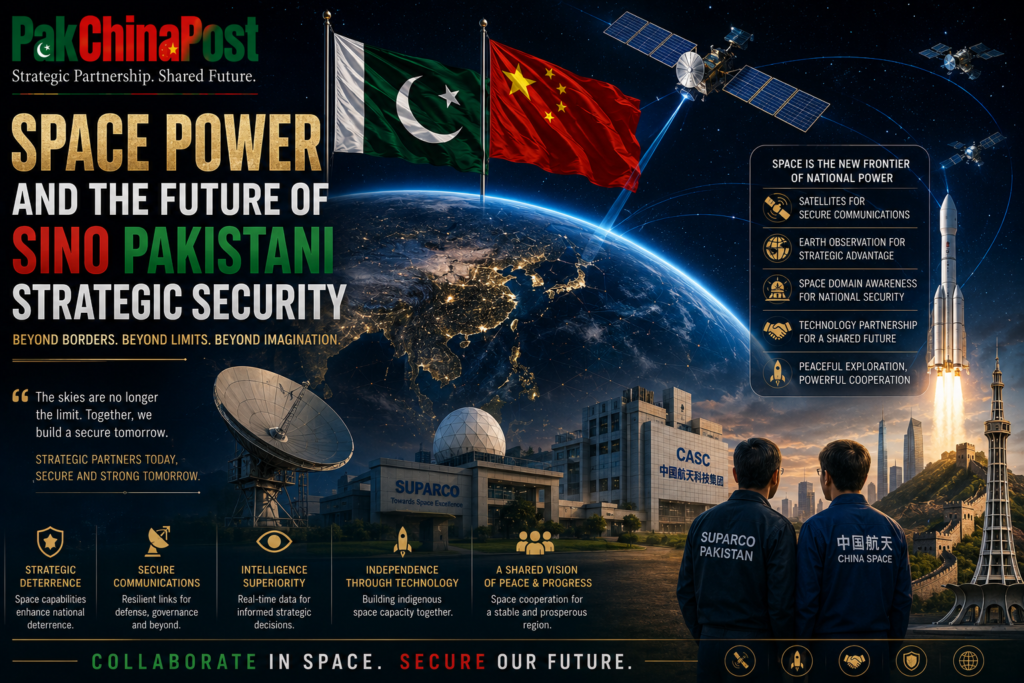
The strategic geography of the twenty first century is expanding beyond land, sea, air and cyberspace into an increasingly contested orbital environment. Space is no longer viewed merely as a scientific frontier or a platform for prestige missions. It has evolved into the invisible infrastructure upon which modern economic systems, military operations, digital governance, financial networks, disaster management, agricultural productivity and diplomatic influence increasingly depend. Satellites today guide commercial aviation, facilitate banking transactions, monitor environmental degradation, support telecommunications, provide weather forecasting and enable precision military operations. Consequently, national security calculations are undergoing a profound transformation. The ability to access, protect and utilise space based capabilities is emerging as one of the defining indicators of strategic autonomy.
This transition has altered the global understanding of power. Conventional military strength remains indispensable, yet its effectiveness increasingly depends upon space enabled intelligence, navigation, communication and surveillance systems. Military commanders rely on orbital assets to maintain situational awareness, coordinate operations across multiple theatres and support precision targeting. Civilian governments depend upon satellite derived information to monitor infrastructure, protect borders, forecast natural disasters and improve resource management. Commercial enterprises utilise earth observation data for logistics, insurance, mining, agriculture and urban planning. The distinction between civilian and military applications has therefore become increasingly blurred, making space one of the most significant dual use domains in international affairs.
Satellite constellations represent one of the most transformative developments within this evolving environment. Traditional space architecture relied upon relatively small numbers of expensive satellites positioned in predictable orbits. Contemporary strategies increasingly emphasise large constellations of interconnected satellites capable of providing persistent global coverage, redundancy and resilience. These distributed systems reduce vulnerability by ensuring that the loss of individual satellites does not significantly degrade operational capability. They also enable continuous communication, navigation and observation services that support both civilian governance and national defence.
Earth observation systems have similarly become indispensable instruments of strategic decision making. High resolution imagery allows governments to monitor infrastructure development, agricultural productivity, environmental degradation, maritime activities and border security with unprecedented accuracy. Remote sensing technologies provide early warning of floods, droughts, forest fires and other natural disasters while simultaneously supporting urban planning, mineral exploration and water resource management. During humanitarian crises, satellite imagery enables rapid damage assessment and efficient deployment of relief operations. In conflict situations, earth observation systems provide intelligence that shapes military planning while also supporting diplomatic verification and international transparency.
Navigation independence has emerged as another defining feature of strategic sovereignty. Global Positioning System dependence once appeared sufficient for most countries, yet geopolitical competition has encouraged major powers to develop independent navigation architectures capable of ensuring uninterrupted services during periods of political tension. Reliable positioning, navigation and timing systems underpin aviation, maritime commerce, telecommunications, financial transactions, emergency response and military operations. Strategic autonomy increasingly requires access to navigation capabilities that cannot be disrupted through external political or military pressure.
Space surveillance is becoming equally significant as orbital congestion intensifies. Thousands of operational satellites and increasing volumes of orbital debris complicate the management of space traffic. Governments require sophisticated surveillance capabilities to track satellites, monitor potential collisions and detect activities that may threaten national assets. Space situational awareness contributes directly to strategic stability by improving transparency, reducing miscalculation and enabling responsible management of increasingly crowded orbital environments.
Commercial launch capabilities have introduced another structural transformation. Private sector innovation has substantially reduced launch costs while increasing deployment frequency and operational flexibility. Commercial companies increasingly provide launch services, satellite manufacturing, imagery analysis, communication networks and orbital logistics. Governments therefore recognise that national resilience depends not only upon military institutions but also upon dynamic commercial ecosystems capable of sustaining indigenous space industries. Industrial competitiveness has become inseparable from strategic capability.
Military space technologies continue to evolve at remarkable speed. Secure satellite communications, missile early warning systems, electronic intelligence platforms and advanced reconnaissance satellites provide decisive operational advantages. Space based assets enhance command and control while improving force coordination across geographically dispersed theatres. Artificial intelligence increasingly processes satellite data in real time, enabling faster decision making and more accurate assessments. Future military effectiveness will therefore depend less upon the numerical size of conventional forces and more upon the quality, resilience and integration of space enabled information networks.
This evolution raises an important strategic question. Will future influence increasingly depend upon sovereign access to space based intelligence rather than conventional force structures? The evidence suggests that this transition is already underway. Conventional military platforms cannot operate effectively without reliable communication, navigation and intelligence support. Modern warfare relies upon continuous information superiority rather than simply numerical superiority. Governments possessing resilient satellite architectures enjoy greater operational awareness, faster decision cycles and improved strategic flexibility. Information has become the decisive resource that enables military power rather than replacing it.
However, sovereign access extends beyond ownership of satellites alone. It encompasses the entire institutional ecosystem supporting space operations. This includes launch facilities, manufacturing capability, ground control stations, skilled human resources, research institutions, regulatory frameworks, cybersecurity protection and international partnerships. Countries unable to sustain these interconnected components remain dependent upon external providers whose services may become uncertain during geopolitical crises. Strategic resilience therefore requires comprehensive national capacity rather than isolated technological achievements.
For Pakistan, the emergence of the space economy presents opportunities extending well beyond defence modernisation. Satellite technologies can substantially strengthen disaster preparedness by improving flood forecasting, glacier monitoring and earthquake assessment. Climate change has intensified environmental challenges across South Asia, making continuous earth observation increasingly valuable for national planning. Agricultural productivity can also benefit through satellite based monitoring of crop health, irrigation efficiency, soil moisture and pest outbreaks. Precision agriculture supports food security while improving resource allocation across rural communities.
Environmental observation represents another critical application. Satellite derived information enables monitoring of deforestation, desertification, coastal erosion, water quality and urban expansion. Such capabilities contribute directly to sustainable development while strengthening environmental governance. Digital mapping supported by high resolution imagery enhances infrastructure planning, transportation management and emergency response coordination. These applications demonstrate that investment in space capability simultaneously strengthens economic resilience, environmental sustainability and national security.
China possesses extensive experience across multiple dimensions of the space sector, including satellite manufacturing, launch services, navigation systems, lunar exploration and earth observation technologies. Its industrial ecosystem provides opportunities for long term technological cooperation that extend beyond traditional infrastructure development. Joint initiatives could strengthen Pakistan’s indigenous technical capacity while supporting regional scientific collaboration and economic development.
Satellite manufacturing offers one particularly promising avenue. Collaborative research institutions could facilitate technology transfer, workforce development and industrial localisation. Rather than relying exclusively upon imported systems, Pakistan could progressively expand domestic manufacturing capability through carefully structured partnerships. This approach would strengthen national resilience while encouraging the development of advanced engineering sectors.
Disaster monitoring provides another highly practical area for institutional cooperation. Joint satellite data centres could improve flood forecasting, glacier surveillance, drought assessment and emergency response planning. Shared analytical platforms supported by artificial intelligence could generate timely information for disaster management authorities while contributing to humanitarian cooperation throughout the wider region.
Precision agriculture represents an equally significant opportunity. Satellite imagery combined with climate modelling, machine learning and geographic information systems could optimise irrigation scheduling, fertiliser application and crop forecasting. Such technologies would improve agricultural productivity while reducing environmental pressures associated with inefficient resource utilisation. Food security increasingly depends upon accurate environmental intelligence rather than solely expanding cultivated land.
Environmental observation could similarly benefit from expanded collaboration. Joint monitoring programmes addressing air quality, water resources, biodiversity conservation and climate adaptation would support evidence based policymaking. Shared satellite datasets could strengthen regional environmental diplomacy while contributing to scientific research addressing common ecological challenges.
Digital mapping constitutes another strategic priority. High precision geographic information systems support infrastructure planning, transportation corridors, energy distribution networks and urban development. Enhanced mapping capabilities also contribute to border management, maritime domain awareness and critical infrastructure protection. Integrating satellite imagery with digital governance platforms would improve administrative efficiency while strengthening national resilience against natural and technological disruptions.
National security applications inevitably remain an important component of bilateral cooperation. Secure communications, maritime surveillance, border monitoring and strategic early warning all benefit from advanced satellite capability. Nevertheless, long term cooperation should emphasise defensive resilience, institutional capacity and technological innovation rather than encouraging destabilising military competition. Stability depends upon transparency, predictability and responsible capability development.
The diplomatic debate surrounding responsible space governance has therefore assumed increasing importance. Outer space remains a global commons where activities undertaken by one actor frequently affect many others. Growing orbital congestion, increasing satellite numbers and emerging counter space technologies have generated concerns regarding long term sustainability. Anti satellite weapons testing has produced hazardous debris that threatens civilian and commercial satellites regardless of nationality. Consequently, international discussions increasingly emphasise responsible behaviour, transparency measures and confidence building mechanisms.
Orbital governance must evolve alongside technological innovation. Existing legal frameworks established during earlier stages of space exploration provide valuable foundations but require practical adaptation to contemporary realities involving commercial actors, autonomous systems and large satellite constellations. Effective governance should encourage peaceful utilisation, equitable access, environmental sustainability and responsible operational conduct without unnecessarily restricting scientific advancement or commercial innovation.
Pakistan can contribute constructively to these diplomatic discussions by supporting multilateral initiatives promoting transparency, debris mitigation, information sharing and peaceful cooperation. Active participation within international space governance institutions enhances diplomatic credibility while protecting national interests. Constructive engagement also strengthens relationships with technologically advanced partners and contributes to global strategic stability.
A comprehensive national space resilience framework should therefore integrate technological capability with institutional coordination, economic development and diplomatic engagement. First, Pakistan should formulate a long term national space strategy aligning civilian development, scientific research, industrial policy and national security objectives within a unified institutional framework. Fragmented initiatives should be replaced by coordinated planning supported by sustained political commitment.
Second, indigenous research capacity should receive sustained investment through universities, specialised laboratories and innovation partnerships linking academia with industry. Human capital remains the foundation of technological sovereignty. Educational programmes addressing aerospace engineering, remote sensing, artificial intelligence and satellite systems should therefore expand significantly.
Third, public private partnerships should encourage domestic commercial participation in satellite applications, geospatial analytics, launch services and digital infrastructure. Commercial innovation strengthens resilience while reducing dependence upon government funding alone.
Fourth, cybersecurity must become an integral component of national space policy. Satellites, ground stations and communication networks increasingly face sophisticated digital threats. Protecting orbital infrastructure requires continuous investment in secure communications, resilient network architecture and specialised cyber expertise.
Fifth, Pakistan and China should institutionalise long term cooperation through permanent joint research centres, satellite data sharing arrangements, industrial partnerships and coordinated training programmes. Such collaboration should prioritise knowledge transfer, technological self reliance and mutually beneficial scientific development.
Finally, diplomatic engagement should reinforce responsible space governance by supporting confidence building measures, transparency initiatives and international cooperation addressing orbital sustainability. Strategic competition need not preclude collaborative management of shared challenges affecting the global space environment.
The future strategic landscape will increasingly reward nations capable of integrating technological innovation, institutional resilience and international cooperation into coherent national strategies. Space is becoming the invisible operating system of modern civilisation, influencing economic competitiveness, environmental sustainability, humanitarian preparedness and military effectiveness simultaneously. Sovereign access to space based intelligence will not eliminate the importance of conventional force structures, but it will increasingly determine how effectively those forces can operate within complex strategic environments.
For Pakistan and China, expanding cooperation across satellite manufacturing, environmental monitoring, digital mapping, disaster resilience and responsible space governance offers opportunities extending far beyond bilateral relations. Such collaboration can strengthen technological independence, support sustainable development and contribute to regional stability while preparing both countries for an era in which strategic influence will depend increasingly upon the ability to observe, interpret and responsibly utilise the orbital domain that now underpins national power.
A Public Service Message


