
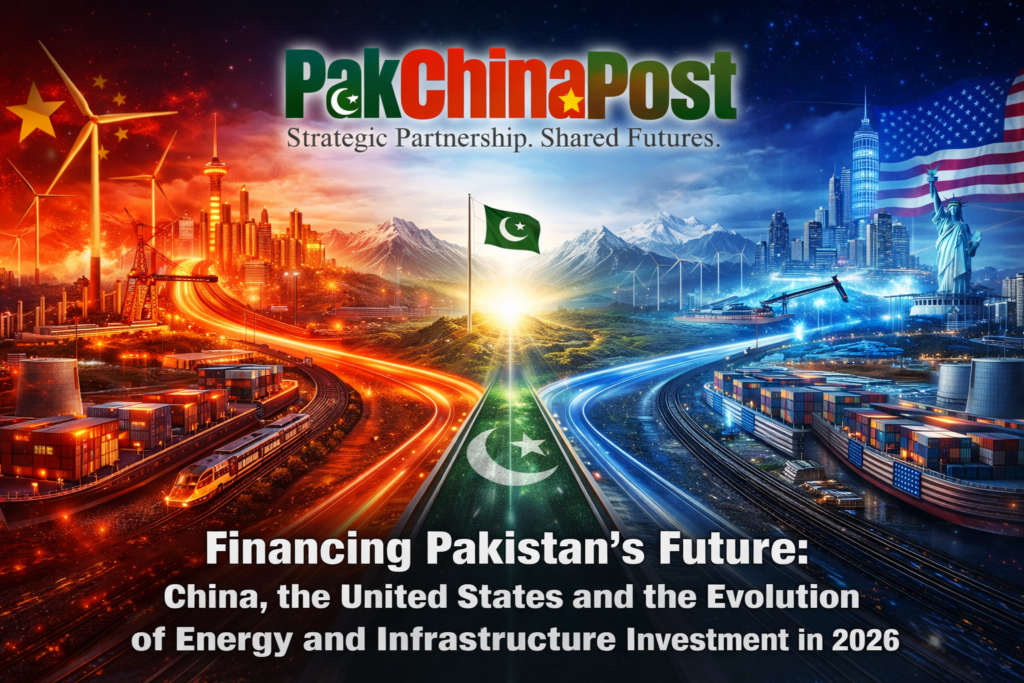
Financing Pakistan’s Future: China, the United States and the Evolution of Energy and Infrastructure Investment in 2026

In 2026 Pakistan’s economic landscape reflects a new chapter in the interplay of global capital, domestic imperatives and geopolitical interests. The country stands at a crossroads shaped by decades long engagement with Chinese financing under the banner of large scale infrastructure initiatives and a growing presence of United States linked investment that reflects a different economic logic. The evolving modalities of how energy and infrastructure financing arrives in Pakistan who bears risk which sectors are prioritized and what this means for the stability of external accounts economic autonomy and future growth is now one of the central debates in policy circles business forums and international economic diplomacy. What was once a narrative dominated by only one major external partner has become a more complex mosaic of finance that reveals both opportunity and constraint.
Over the past decade Chinese financing poured into Pakistan primarily through projects associated with the China Pakistan Economic Corridor. Many of these capital flows took the form of direct government to government loans aimed at building foundational infrastructure. Roads railways ports and energy plants emerged from this cooperation with the ambition of creating connectivity corridors and expanding installed capacity across the country. These funds often carried long tenor agreements with repayment structures that tied future fiscal outlays to project performance. In practice however a number of projects faced delays cost overruns and lower than expected utilization rates. While new capacity came online in power and transport the economic returns needed to service the debt and generate broad based growth were slower to materialize.
The story of Chinese investment in Pakistan cannot be separated from the underlying strategic narrative that shaped it. From Beijing’s perspective the Belt and Road framework was not only an economic proposition but also a geopolitical one. By linking the landlocked western provinces of China to the Arabian Sea through Pakistan the objective was to create alternative trade avenues reduce logistical friction and embed China more deeply into regional economic architecture. This strategic priority meant that financing decisions were made with a tolerance for slow payback and extensive risk sharing by Chinese state owned banks and financial institutions. The result was a significant expansion of infrastructure financed through external credit.
These credits often came with terms that blended concessional and commercial elements. Concessional in the sense that interest rates were lower than market levels and repayment periods were long. Commercial in the sense that they were still legally binding obligations that required hard currency for settlement. This combination created both space and pressure. On one hand Pakistan had access to capital that might not have been available from other international lenders on similar terms. On the other hand the requirement to ensure future repayment constrained fiscal flexibility especially when the expected economic payoffs lagged behind projections.
Compounding this challenge was the structure of investment within the energy sector. Many of the early projects financed through this engagement were based on traditional energy technologies that relied on imported inputs. Coal fired and fossil fuel powered plants increased installed capacity but also increased the need for sustained import of fuel. This reliance on imported energy inputs placed renewed pressure on the balance of payments and contributed to persistent current account deficits. The fiscal cost of servicing the debt combined with the economic cost of energy imports put the economy in a position where external financing became a continuous necessity rather than a one time stimulus.
It was in this context that new voices emerged in Pakistan urging diversification of financing partners and modalities. For many years the narrative around foreign investment in infrastructure had been dominated by a single model of state backed loans. The result was a concentration of risk within the sovereign balance sheet and limited integration of private capital markets. The global economic shift following the pandemic and the renewed focus by the United States on economic partnerships beyond traditional security cooperation opened new windows for engagement. US linked investment did not suddenly replace Chinese funds but it introduced an alternative logic that emphasized private sector participation risk sharing and sectoral focus on areas increasingly linked to global growth trajectories.
United States linked capital entered Pakistan’s financing landscape through a combination of private equity joint ventures and public private collaborations anchored in market access and technology transfer. Rather than financing large physical structures alone the new capital engaged areas such as renewable energy mineral processing digital infrastructure and supply chain integration. Investors and firms with interests in critical minerals saw Pakistan’s untapped reserves as part of a broader regional strategy to diversify sources of supply. Pakistan’s rich deposits of copper gold and other strategic resources became part of dialogues with United States based firms that sought to balance global supply chains and reduce exposure to concentrated production zones elsewhere.
The modality of this new investment differed markedly from the Chinese state led model. In many instances capital was structured through equity based participation that aligned returns with project performance rather than sovereign guarantees. This reduced direct pressure on the government’s balance sheet because it limited the use of direct sovereign borrowing. At the same time the involvement of private sector partners introduced new disciplines around project selection risk management and cost efficiency. Investors tied to global markets naturally oriented toward technologies and sectors with clear revenue pathways whether through energy exports domestic sales or value added processing for international markets.
One of the most visible areas where this new engagement took hold was renewable energy. Solar wind and storage technologies began attracting interest not only because they aligned with global climate commitments but also because they offered a pathway to reduce reliance on imported fuels. Investment in renewable energy infrastructure was increasingly coming from consortia of private capital combined with development finance institutions that brought both capital and technical expertise. These projects offered dual benefits. First they addressed energy deficits with solutions less dependent on imported inputs. Second they provided income streams that could be monetized domestically and internationally as part of regional energy markets.
This shift introduced an important question about risk exposure. Where Chinese financed projects placed much of the risk on the sovereign balance sheet the newer investment models placed risk on private partners while still enabling the public sector to benefit from increased capacity. The question thus became one of how to calibrate national interests with risk sharing in ways that did not compromise long term stability. Private capital comes with expectations of return and exit strategies. Governments in turn must balance these with social imperatives of accessibility affordability and equitable development.
The influence of the United States extended beyond direct capital flows into frameworks that encouraged transparency accountability and integration into global markets. Through engagement with US linked institutions Pakistan participated in knowledge exchanges regulatory reform dialogues and networking that helped align domestic systems with global practices. These soft determinants of investment climate played a role in attracting deeper capital into sectors that were previously considered high risk. Infrastructure financing became more than roads and bridges. It became a platform for systemic modernization connected to standards of governance essential for sustained external confidence.
One immediate effect of this evolution was a rebalancing of Pakistan’s external account stability. For decades the country struggled with persistent current account deficits driven by import reliance in energy and slow export diversification. The need to finance these deficits often led to repeated engagements with international creditors including the IMF and bilateral lenders. With the introduction of new investment flows into energy and value added sectors Pakistan began to see a gradual shift in its trade dynamics. Renewable energy reduced import needs for fossil fuels while mining and mineral processing created exportable products with higher value addition.
Another important development was the emergence of new corridors of economic activity that built on existing connectivity but extended into markets beyond the traditional. Investment in digital infrastructure connected Pakistan more deeply to regional and global information flows. This in turn enabled service exports that leveraged a young skilled workforce. These sectors did not depend on heavy state financing but rather on an ecosystem that brought together local entrepreneurs international capital and technology partners.
Yet this diversification also raised concerns about systemic risk that required careful management. Increased private sector participation through internationally linked capital exposed Pakistan to global market cycles. Private equity flows are responsive to shifts in investor sentiment. A global downturn or tighter financial conditions abroad could lead to rapid withdrawal of capital or postponement of new projects. Managing these exposures without resorting to protective isolation required robust domestic financial regulation and active engagement with international partners.
A further challenge lay in ensuring that new corridors of development translated into broad based economic benefits rather than concentrated enclaves of activity. Investment in renewable energy or mineral processing can generate significant returns but if local supply chains and workforce capacities remain weak the broader economy may not capture these gains. This tension between global integration and domestic empowerment became central to policy debates. It was clear that financing modalities that emphasized local value addition skills development and integration of small and medium sized enterprises into larger projects could produce more sustainable outcomes.
The role of governance also came to the fore. Investments tied to transparent procurement predictable regulatory frameworks and institutional accountability attracted deeper and more diversified capital. Investors consistently cited clarity of policy and stability of regulations as critical factors in long term engagement. Pakistan’s own efforts to streamline regulations reform taxation and strengthen legal protections for investors contributed to a more conducive climate. These reforms were not just technical adjustments but part of a broader shift toward aligning domestic frameworks with international expectations.
At the same time questions of sovereignty and economic autonomy remained central. Accepting capital on terms that align with national interests is a delicate balance. While Chinese financing offered scale it often limited Pakistan’s flexibility in prioritizing projects that may not have immediate or direct economic return but serve broader societal needs. United States linked investment offered aligned market incentives but came with expectations about governance commercial viability and return on equity that required careful negotiation. The challenge for Islamabad was to create an architecture of economic decision making that could incorporate diverse sources of capital without compromising strategic autonomy.
State owned enterprises also played a role in this evolving dynamic. Historically many infrastructure projects were implemented through entities that operated with varying degrees of efficiency and transparency. The newer era of investment placed increased pressure on these institutions to modernize adopt global standards and align with competitive practices. Where private sector participation increased accountability state entities often had to restructure operate on clearer financial terms and cultivate skills necessary to manage complex projects independently.
Another dimension of this evolution was regional economic integration. Investment in corridors and infrastructure that linked Pakistan to neighboring economies opened opportunities for cross border trade and cooperation. This regional logic transcended bilateral financing relationships and positioned Pakistan as a hub of connectivity within South and Central Asia. Such integration was not automatic. It required synchronized regulatory frameworks transport agreements and cooperative mechanisms for energy exchange. Investment in these corridors was thus as much about diplomacy and regional economic strategy as it was about isolated projects.
In examining the emerging picture one sees that the medium term implications on external account stability and economic autonomy are deeply interwoven with how Pakistan positions itself in global economic flows. Increased private capital participation reduced direct sovereign debt exposure. Renewable energy reduced import burdens. Value addition in mineral and digital sectors created export pathways beyond traditional products. Connectivity corridors expanded market reach for Pakistani goods and services. At the same time global capital flows remained sensitive to external shocks regulatory shifts and investor sentiment cycles. Pakistan’s policy framework had to remain adaptive resilient and tuned to evolving international norms.
The question of new economic corridors or projects that could become game changers naturally follows. Beyond the rewiring of traditional infrastructure one sees the potential of integrated energy grids that connect with regional partners service export platforms that leverage human capital and digital connectivity corridors that link multiple economies across Asia. These are not single high visibility projects but systemic transformations that reshape how economic value is created exchanged and retained domestically. Their success depends not solely on external capital but on domestic ability to absorb integrate and innovate.
Financially the shift toward diversified investment modalities represents a maturation of Pakistan’s economic engagement with the world. It reflects a transition from a model of reliance on a single source of large scale loans to a multi layered engagement that includes equity participation private capital and technological partnership. The risks are varied but they spread across multiple vectors reducing concentration in any single channel. The challenge lies in ensuring that this diversification does not fragment economic strategy or dilute national priorities.
Looking ahead the interplay between Chinese financed infrastructure and United States linked investment will continue to shape Pakistan’s trajectory. Each has unique strengths and limitations. Chinese financing delivers scale entrenches strategic connectivity and embeds Pakistan in broader regional initiatives. United States linked capital brings market discipline technology orientation and avenues for integration into global supply chains. The synthesis of these forms of engagement offers Pakistan the potential to build a more resilient and diversified economy.
In conclusion the evolving landscape of energy and infrastructure financing in Pakistan in 2026 reveals a shift from monolithic financing toward diversified investment modalities with different risk exposures sectoral focus areas and implications for external account stability and economic autonomy. The presence of Chinese and United States linked capital reflects both global strategic currents and domestic imperatives for modernization growth and competitiveness. The emerging corridors and projects that may define the next decade are those that integrate connectivity energy sustainability human capital and market access in a coherent economic vision. It will be Pakistan’s ability to navigate these opportunities with strategic clarity domestic reform and resilient policy frameworks that determines whether the promise of this new era of financing translates into broad based growth and sustained economic transformation.
A Public Service Message