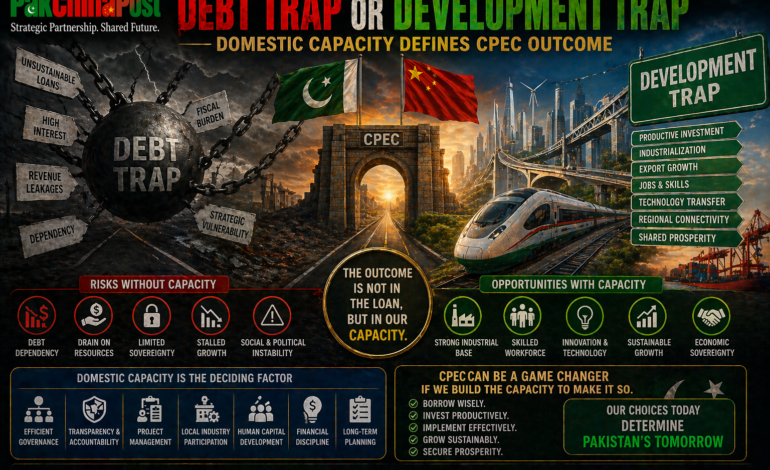
Debt Trap Or Development Trap Domestic Capacity Defines CPEC Outcome


The debate over whether Chinese financing under CPEC constitutes a “debt trap” has become one of the most politically charged narratives in contemporary geopolitical discourse on Pakistan’s economic trajectory. Yet this framing, while rhetorically powerful, obscures more than it reveals. It reduces a structurally complex development arrangement into a binary moral judgement, where China is cast as creditor strategist and Pakistan as passive victim. Such simplification may serve political narratives, but it fails to capture the deeper economic reality: Pakistan’s central constraint is not external indebtedness alone, but domestic institutional incapacity to transform capital inflows into sustained productivity growth.
At the core of CPEC lies a fundamental developmental assumption. Capital investment in infrastructure, energy, and logistics should reduce bottlenecks, lower transaction costs, and unlock industrial expansion. In theory, this should generate export capacity, fiscal space, and employment creation, thereby enabling debt servicing through growth rather than austerity. Yet in practice, this chain has been partially disrupted. The issue is not the absence of capital, but the inefficiency of conversion mechanisms that translate capital into productive economic outcomes.
Chinese financing, particularly in the early phases of CPEC, concentrated heavily on energy generation and transport infrastructure. These investments addressed genuine structural deficits in Pakistan’s economy, especially chronic energy shortages that constrained industrial output. However, the expected second-order effects, industrial diversification and export expansion, have been limited. The reason lies in the weak absorptive capacity of Pakistan’s economic institutions, which struggle to integrate infrastructure gains into broader industrial policy frameworks.
Energy projects financed under CPEC illustrate this contradiction clearly. While installed generation capacity has increased significantly, systemic inefficiencies in transmission, distribution, and pricing have prevented full utilization of this capacity. Circular debt in the power sector has accumulated due to tariff distortions, recovery inefficiencies, and subsidy misalignment. As a result, energy infrastructure that was intended to enable growth has, in some cases, contributed to fiscal strain. This is not a financing problem in isolation; it is a governance and regulatory problem embedded within domestic institutional structures.
The same pattern is visible in transport infrastructure. Improved highways and logistics corridors reduce travel time and transport costs, yet without corresponding industrial clustering and export-oriented production systems, these efficiencies remain underutilized. Infrastructure does not automatically generate industry; it enables it. The absence of coordinated industrial policy means that physical connectivity is not consistently translated into value chain integration.
Special Economic Zones were designed to address this gap by anchoring industrial activity within designated regions. However, their performance has been uneven. Delays in land acquisition, regulatory uncertainty, inconsistent taxation policies, and weak coordination between federal and provincial authorities have slowed operationalization. Investors, whether Chinese or otherwise, respond not only to incentives but to predictability. Where policy signals shift frequently, long-term commitments become difficult to justify.
The “debt trap” narrative often focuses on repayment obligations and sovereign guarantees associated with CPEC projects. While debt sustainability is a legitimate concern for any developing economy, Pakistan’s external debt composition is diversified across multiple creditors, including multilateral institutions, bilateral partners, and international capital markets. Chinese debt, though significant in specific sectors, does not exist in isolation. The broader issue is fiscal fragility, where narrow tax bases, low export revenues, and high import dependence constrain the state’s ability to service obligations regardless of creditor identity.
What distinguishes CPEC-related obligations is not their absolute size but their structural embedding in essential services such as energy and infrastructure. These are not speculative investments; they are foundational assets. This creates a different kind of pressure: not insolvency risk in the immediate sense, but fiscal rigidity, where repayment obligations reduce policy flexibility in other critical sectors such as health, education, and social protection.
However, attributing this rigidity solely to external financing misdiagnoses the problem. Pakistan’s fiscal structure is characterized by chronic under-taxation, narrow compliance, and heavy reliance on indirect taxation. This limits revenue elasticity and constrains the state’s ability to generate domestic resources for development financing. In such a context, external capital becomes not just supplementary but structural. The issue is therefore not dependency itself, but the absence of internal revenue modernization that would reduce reliance on external financing over time.
Another dimension often overlooked in the debt debate is project selection and implementation efficiency. In many cases, delays and cost overruns are not driven by creditor conditions but by domestic procedural inefficiencies. Lengthy approval cycles, overlapping institutional mandates, and frequent policy reversals increase transaction costs and reduce project efficiency. These inefficiencies are then translated into higher financial burdens, which are mistakenly attributed solely to external lending terms.
The productivity question is central. Debt becomes sustainable when it finances activities that generate returns exceeding repayment obligations. In Pakistan’s case, the productivity gap lies in the transition from infrastructure to industrial output. Without export growth, foreign exchange earnings remain constrained, limiting the economy’s ability to service external obligations. This is where the development trap thesis becomes more analytically relevant than the debt trap narrative.
A development trap occurs when capital inflows improve physical capacity without corresponding institutional transformation. Roads are built, power plants are installed, and ports are expanded, yet industrial ecosystems remain underdeveloped. In such a scenario, infrastructure exists in excess of economic integration. The result is underutilization of assets and limited multiplier effects on employment and exports.
The political economy dimension of this trap is equally important. Infrastructure-driven growth often strengthens existing distributional structures rather than transforming them. Benefits tend to concentrate in construction sectors, urban elites, and politically connected intermediaries, while broader productivity gains remain limited. This creates a form of growth without structural change, where GDP may expand in phases but economic complexity remains stagnant.
China’s role in this framework is often mischaracterized. Beijing’s financing strategy under CPEC has largely been project-based rather than macroeconomic conditionality-based. Unlike traditional IMF-style programs, Chinese capital is tied to specific infrastructure outputs rather than broad policy reforms. This limits external influence over domestic institutional restructuring. Consequently, responsibility for structural transformation remains primarily domestic.
This distinction is critical. External financing can enable development, but it cannot substitute for domestic institutional evolution. The ability to plan, implement, regulate, and integrate economic activity remains fundamentally a sovereign function. Where these functions are weak, external capital amplifies existing inefficiencies rather than resolving them.
The long-term sustainability of CPEC therefore depends less on debt renegotiation or financing restructuring and more on Pakistan’s ability to strengthen its institutional core. This includes tax reform, regulatory harmonization, industrial policy coherence, and governance decentralization. Without these reforms, even concessional financing will struggle to generate transformative outcomes.
In conclusion, the question is not whether Pakistan is trapped in debt, but whether it is trapped in a development model that cannot fully absorb and transform external capital into productive capacity. The distinction is not semantic; it is structural. Debt can be restructured. Development traps require systemic reform. Until Pakistan addresses its internal institutional bottlenecks, the risk is not insolvency, but stagnation within a cycle of under-realized potential, where infrastructure expands faster than economic transformation, and capital inflows outpace institutional evolution.
A Public Service Message