
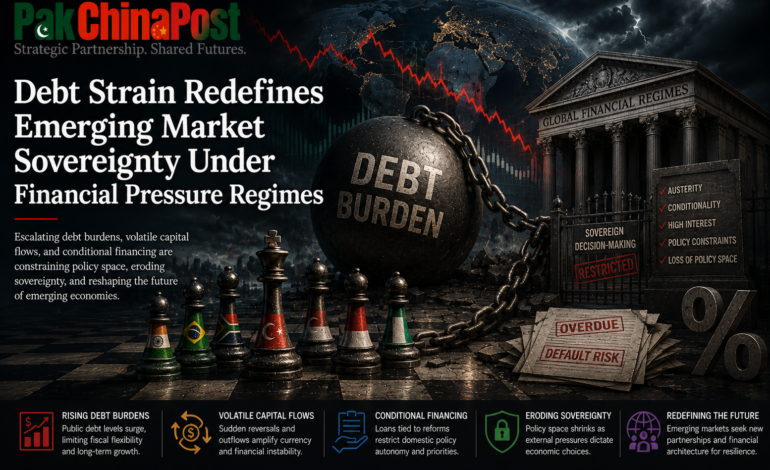
Debt Strain Redefines Emerging Market Sovereignty Under Financial Pressure Regimes

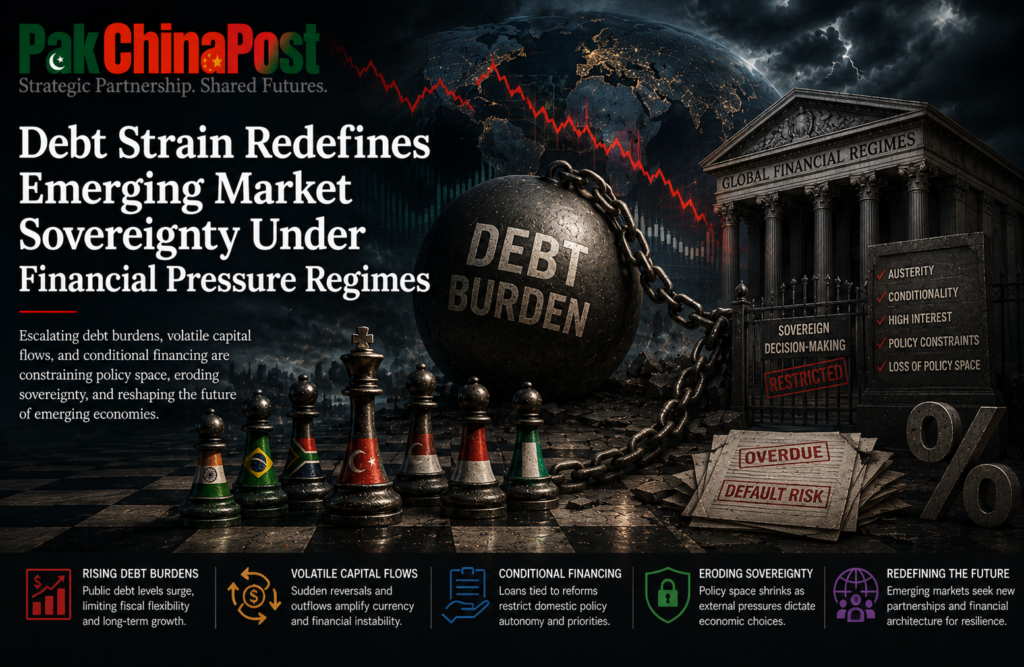
The contemporary global economy is increasingly being reshaped by an undercurrent of sovereign indebtedness that is neither episodic nor cyclical, but structurally embedded within the architecture of post pandemic financial normalisation, tightening global liquidity conditions, and the entrenched asymmetries of dollar denominated capital markets. Debt vulnerability in emerging economies has evolved into a systemic condition that extends beyond fiscal arithmetic, becoming a defining constraint on sovereignty, developmental autonomy, and macroeconomic stability. What is unfolding is not merely a debt crisis in isolated jurisdictions, but a slow moving transformation in which financial dependency is hardwired into the operating logic of the global order.
The expansion of sovereign debt across emerging markets over the past decade was initially justified by the imperatives of development financing, infrastructure expansion, and pandemic induced fiscal stabilisation. However, the structural environment that enabled cheap credit has now reversed. Global interest rates have risen sharply in response to inflationary pressures in advanced economies, particularly in the United States, triggering a repricing of risk across international capital markets. This shift has exposed the fragility of debt dependent economies whose repayment structures are heavily skewed toward external currency obligations. As refinancing costs escalate, fiscal space contracts, and the margin for developmental expenditure narrows with increasing speed.
At the core of this vulnerability lies a fundamental asymmetry in the global financial system. Emerging economies borrow predominantly in foreign currencies, while their revenue bases remain domestically anchored. This currency mismatch creates a structural exposure to exchange rate volatility. As domestic currencies depreciate, external debt servicing costs rise disproportionately, even in the absence of new borrowing. This dynamic transforms currency instability into a direct fiscal shock mechanism, forcing governments into difficult trade offs between debt servicing, import financing, and domestic welfare provisioning.
The consequences are visible across multiple economic dimensions. In many emerging markets, rising debt servicing obligations are now absorbing an increasingly large share of public revenues, crowding out critical investments in health, education, and infrastructure. Simultaneously, governments are compelled to compress imports in order to preserve foreign exchange reserves, leading to shortages of essential goods, industrial inputs, and energy supplies. This import compression feeds into domestic inflationary pressures, erodes real incomes, and amplifies social discontent. The result is a feedback loop in which debt stress translates into macroeconomic contraction, which in turn weakens growth prospects and further undermines debt sustainability.
Financial markets respond to these dynamics through heightened risk perception. Credit rating downgrades, rising sovereign spreads, and capital outflows become self reinforcing mechanisms that deepen instability. Once an economy enters this cycle, its access to affordable external financing becomes increasingly constrained, forcing reliance on short term, high cost borrowing instruments. This shift from long term concessional finance to short term speculative capital significantly increases rollover risk and amplifies vulnerability to sudden stops in capital inflows.
The geopolitical dimension of sovereign debt has also become increasingly pronounced. Debt restructuring processes are no longer purely technical negotiations but are embedded within broader strategic considerations involving major creditor states, multilateral institutions, and geopolitical alliances. Bilateral lending, particularly from non traditional creditors, has introduced new complexities into debt resolution frameworks, often leading to fragmented negotiations and delayed restructuring outcomes. This multiplicity of creditor interests complicates coordinated solutions and prolongs financial uncertainty for debtor nations.
Moreover, the architecture of global financial governance remains inadequately equipped to address the scale and complexity of contemporary debt distress. Existing restructuring mechanisms are slow, opaque, and often misaligned with developmental priorities. The absence of a comprehensive sovereign bankruptcy framework means that debt resolution tends to be reactive rather than preventive, frequently occurring only after macroeconomic conditions have significantly deteriorated. This delay increases the social and economic costs of adjustment and reduces the probability of a sustainable recovery.
Within this context, the role of multilateral institutions has become increasingly central yet contested. Institutions such as the International Monetary Fund continue to provide emergency liquidity support, but often under conditionalities that emphasise fiscal consolidation, subsidy reduction, and structural adjustment. While these measures aim to restore macroeconomic stability, they can also intensify short term economic contraction, particularly in politically fragile environments. The tension between stabilisation and growth remains unresolved, and in many cases, austerity driven adjustments have deepened rather than alleviated structural vulnerabilities.
For countries such as Pakistan and similarly positioned economies, the debt dilemma is particularly acute. Persistent current account deficits, narrow export bases, and high import dependence create a structural reliance on external financing. This dependence is compounded by cyclical currency depreciation and periodic capital outflows, which further destabilise debt dynamics. In such contexts, debt is not merely a financial instrument but a central determinant of economic policy space. Fiscal decisions become constrained by external repayment schedules, limiting the scope for autonomous development planning.
The broader systemic issue is that debt accumulation in emerging markets is increasingly decoupled from productive capacity expansion. In many cases, borrowed funds are used to finance consumption smoothing, import financing, or debt servicing itself rather than long term productive investment. This creates a situation in which debt stocks rise without corresponding increases in export capacity or revenue generation potential, thereby weakening future repayment capacity. The absence of strong export diversification further exacerbates this imbalance, locking economies into recurring cycles of external dependence.
Currency dynamics play a critical role in intensifying these pressures. In an environment of global monetary tightening, capital tends to flow toward safe haven assets, placing downward pressure on emerging market currencies. Depreciation, in turn, increases the local currency value of external debt, creating balance sheet stress for both public and private sectors. Central banks are often forced to intervene through interest rate hikes or foreign exchange interventions, both of which carry significant economic costs. High interest rates suppress domestic investment, while reserve depletion reduces external buffer capacity.
The interaction between sovereign debt and domestic political economy is equally significant. Fiscal constraints imposed by debt servicing obligations often translate into politically sensitive policy choices, including subsidy reductions, tax increases, and public sector expenditure cuts. These measures can generate social resistance and political instability, particularly in societies already facing high inflation and unemployment. Debt thus becomes not only an economic constraint but a source of domestic political tension.
In the absence of coordinated global solutions, emerging markets are increasingly exploring alternative financial arrangements. Regional financing mechanisms, currency swap agreements, and bilateral credit lines are being developed as partial buffers against global liquidity shocks. However, these arrangements remain fragmented and insufficient to fully offset structural vulnerabilities embedded in global capital markets. The dominance of a single reserve currency continues to reinforce systemic asymmetries, limiting the effectiveness of alternative financial architectures.
Policy responses must therefore move beyond short term stabilisation toward structural transformation. Debt sustainability cannot be achieved solely through fiscal austerity or external refinancing. It requires a fundamental restructuring of growth models toward export diversification, industrial upgrading, and domestic revenue mobilisation. Strengthening tax systems, improving governance efficiency, and expanding productive sectors are essential components of long term debt resilience.
At the global level, there is an urgent need to reform sovereign debt architecture. Transparent, rules based restructuring mechanisms that prioritise developmental continuity rather than purely financial recovery are essential. Debt workouts must become faster, more predictable, and more inclusive of all creditor categories. Without such reforms, the global financial system risks entrenching a permanent divide between debt stable and debt vulnerable economies.
Ultimately, sovereign debt in emerging markets is no longer a marginal financial issue but a central axis of global economic stratification. It defines the limits of policy autonomy, shapes development trajectories, and influences geopolitical alignment. The current trajectory, if left unaddressed, risks locking large parts of the developing world into persistent cycles of financial dependency and constrained growth, undermining the broader promise of inclusive global development.
A Public Service Message