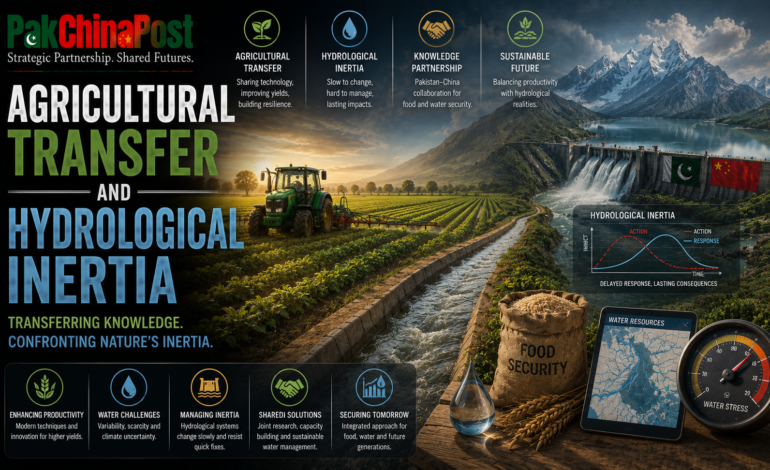
Agricultural Transfer and Hydrological Inertia

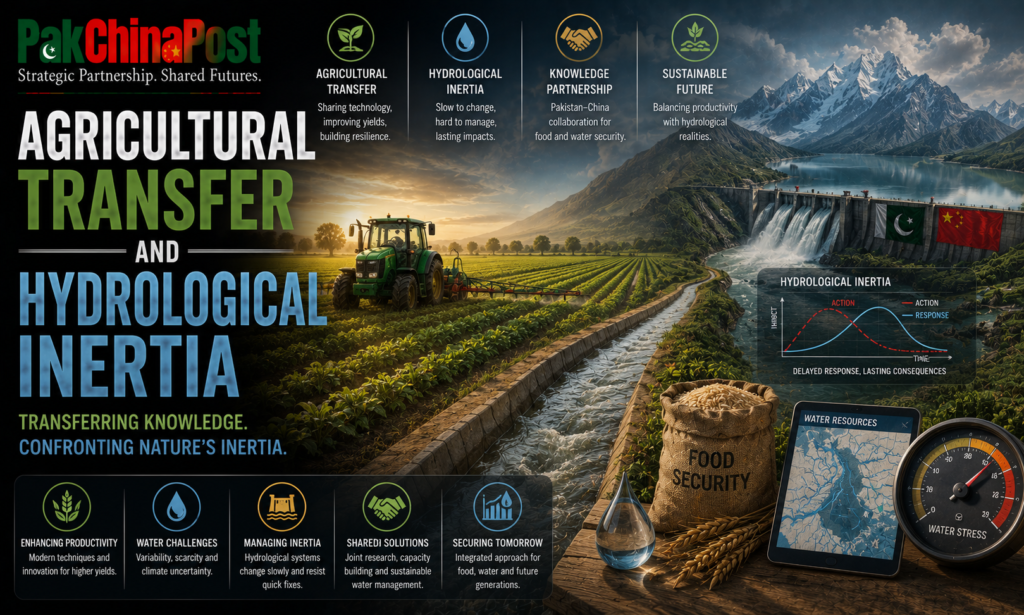
Pakistan’s encounter with agricultural modernization has repeatedly been framed as a problem of productivity shortfall, yet beneath this familiar diagnosis lies a more intricate structural impasse: the persistent inability to translate external technological advances into domestically embedded systems of agrarian transformation. Nowhere is this paradox more visible than in the domain of water-efficient agriculture, where China’s accumulated expertise in precision irrigation, drought-resilient crop engineering, and digitally governed water management has expanded rapidly, while Pakistan’s water-intensive agricultural profile continues to drift along increasingly constrained hydrological limits.
The issue is not a lack of technological availability. Nor is it an absence of diplomatic proximity between the two states. Rather, the bottleneck resides in the institutional architecture through which agricultural knowledge is filtered, adapted, and operationalised. The transfer of agricultural technology is not a transactional event; it is a recursive process requiring absorptive capacity, governance coherence, and a reconfiguration of incentives within domestic farming systems. In Pakistan’s case, these enabling conditions remain uneven, fragmented, and often misaligned with the scale of the ecological challenge.
Water stress, once treated as a cyclical environmental concern, has now assumed the character of a structural constraint on agricultural expansion. Groundwater depletion, erratic monsoon variability, and inefficient canal distribution systems have collectively intensified pressure on a sector that still consumes many national freshwater resources. Yet despite this escalating scarcity, the dominant agricultural model remains anchored in flood irrigation practices and water-intensive crop preferences, a configuration that is increasingly incompatible with long-term hydrological sustainability.
In contrast, China’s agricultural modernization trajectory has been shaped by a sustained emphasis on water efficiency as a strategic resource imperative. Through a combination of drip irrigation scaling, sensor-driven soil monitoring, satellite-assisted crop mapping, and genetically optimized seed varieties, Chinese agricultural systems have progressively reduced water intensity per unit of output while simultaneously increasing yield stability under climate variability. More importantly, these advances have been institutionalised through state-coordinated extension services, integrated research networks, and commercially viable deployment pathways that ensure continuity between innovation and field application.
The relative absence of large-scale adaptation of these technologies in Pakistan points to a deeper governance deficit. Agricultural extension systems remain structurally underpowered, often unable to bridge the gap between research institutions and farming communities. Universities and research centres produce incremental innovations, but their diffusion into rural production systems is constrained by weak commercialization mechanisms, limited farmer training infrastructure, and inconsistent policy signalling regarding crop diversification.
At the heart of this inertia lies a misalignment between water economics and agricultural incentives. Cropping patterns remain heavily skewed towards water-intensive staples, sustained in part by procurement policies and historical pricing structures that do not adequately reflect the scarcity value of water. As a result, technological interventions aimed at water efficiency often encounter an unfavourable incentive environment, where farmers face limited financial justification for transitioning towards precision irrigation systems or alternative crop portfolios.
The institutional fragmentation of water governance further compounds this challenge. Responsibility for irrigation management, agricultural planning, and rural development is dispersed across multiple administrative layers with overlapping mandates and limited coordination. This diffusion of authority produces policy discontinuities that undermine long-term planning. Even when pilot projects in drip irrigation or smart farming demonstrate technical success, their scaling is frequently obstructed by bureaucratic inertia and fiscal discontinuity.
The potential for structured cooperation with China in this domain remains significant but underleveraged. Beyond conventional technology transfer agreements, there exists scope for the development of integrated agrarian modernization corridors focused specifically on water efficiency. Such frameworks could combine Chinese expertise in precision agriculture with Pakistan’s extensive canal irrigation network, creating hybrid systems that optimise both surface water and groundwater usage through digital monitoring and adaptive scheduling mechanisms.
However, the success of such initiatives would depend on a shift away from project-based cooperation towards system-based transformation. Isolated pilot projects, while symbolically important, rarely generate structural change unless embedded within national agricultural planning frameworks. What is required is not the import of technologies alone, but the creation of institutional ecosystems capable of sustaining them.
One critical reform area lies in the reconfiguration of agricultural extension services into digitally enabled advisory platforms. Rather than relying on conventional field officer models, which are often constrained by capacity limitations and logistical inefficiencies, a transition towards AI-assisted agronomic advisory systems could significantly enhance the reach and precision of farmer guidance. These systems, when combined with localized data inputs, can provide real-time irrigation recommendations, crop rotation strategies, and pest management alerts tailored to micro-climatic conditions.
Another essential dimension is the restructuring of water pricing and allocation mechanisms. Without a gradual recalibration of water valuation frameworks, technological efficiency gains will remain partially absorbed by systemic inefficiencies. Introducing transparent water accounting systems at the canal command level could help align usage patterns with availability, while also incentivising conservation-oriented farming practices.
Equally important is the question of seed innovation. Climate-resilient crop varieties, particularly those capable of maintaining yield under reduced water conditions, represent a critical frontier for agricultural sustainability. While Chinese research institutions have made significant progress in this area, the absence of robust intellectual property adaptation frameworks and localized field testing mechanisms in Pakistan limits their effective deployment. Strengthening bilateral seed research partnerships, coupled with domestic trial networks, would be essential to bridge this gap.
The socio-economic dimension of agricultural transformation cannot be overlooked. Smallholder farmers, who constitute the backbone of Pakistan’s agricultural economy, often operate within narrow financial margins that constrain their ability to adopt new technologies. Without targeted subsidy structures, credit facilitation mechanisms, and risk-sharing instruments, technological diffusion will remain uneven and geographically concentrated.
There is also a narrative dimension to agricultural modernization that is frequently underestimated. Public discourse continues to frame agriculture in terms of tradition and cultural continuity, rather than as a technologically dynamic sector requiring continuous adaptation. This discursive framing influences policy prioritisation and shapes political appetite for reform. A recalibration of agricultural narrative towards productivity resilience, resource efficiency, and climate adaptation is therefore necessary to sustain long-term reform momentum.
At a strategic level, the convergence of water stress and technological opportunity presents a rare inflection point. The failure to act decisively on agricultural modernization risks entrenching a cycle of declining yields, rising import dependence, and increasing rural vulnerability. Conversely, a coordinated technology transfer regime anchored in water-efficient agriculture could significantly alter the trajectory of rural development, enhancing both food security and macroeconomic stability.
Ultimately, the question is not whether advanced agricultural technologies exist, but whether the institutional, economic, and governance frameworks required to absorb them can be effectively constructed. Without such alignment, even the most sophisticated innovations will remain externally visible but domestically underutilised. The challenge, therefore, is not technological scarcity, but institutional latency, a condition that continues to define the uneasy interface between environmental necessity and policy execution in Pakistan’s agricultural landscape.
A Public Service Message