
From Signature to Delivery Pakistan China Execution Gap

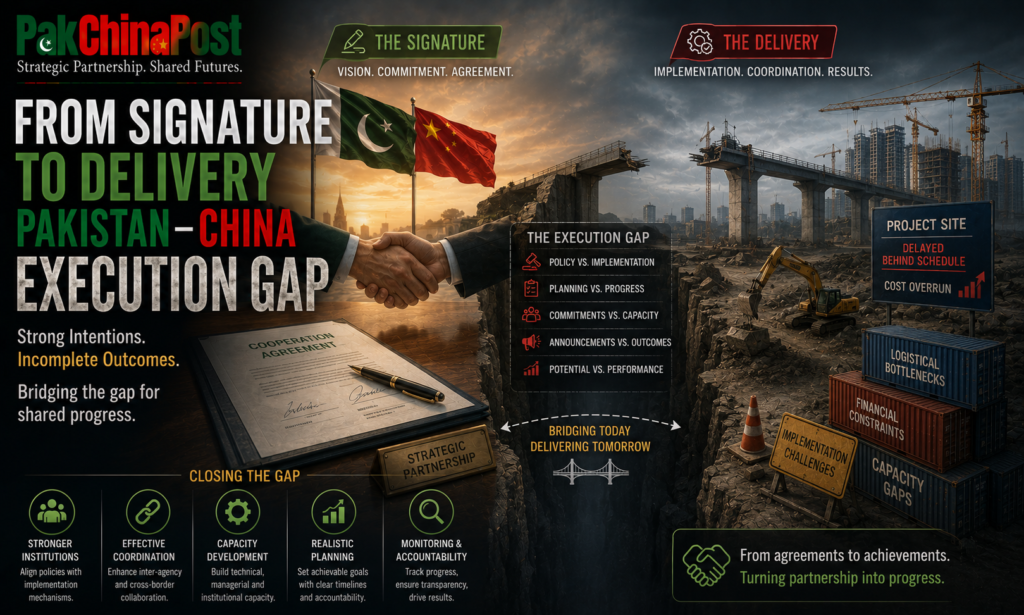
The acceleration of formal agreements between Pakistan and China has become one of the most visible features of bilateral statecraft over the past decade, yet beneath the surface of ceremonial convergence lies a more consequential institutional paradox: the velocity of signing increasingly outpaces the velocity of execution. Memorandums of understanding, framework arrangements, and sectoral cooperation protocols accumulate with procedural ease, but their translation into operational infrastructure, industrial relocation, export enhancement, or measurable socio-economic dividends remains uneven, delayed, and in some cases structurally diluted. This asymmetry is not merely administrative inefficiency in a conventional sense; it reflects deeper design limitations within Pakistan’s governance architecture, where policy articulation and project delivery occupy divergent institutional universes.
At the heart of this divergence is the fragmentation of Pakistan’s execution ecosystem. Decision-making authority is dispersed across federal ministries, provincial departments, regulatory bodies, and autonomous agencies whose mandates frequently overlap but rarely converge into a unified delivery chain. In large-scale bilateral projects involving Chinese capital, engineering, or concessional financing, this dispersion produces transaction drag. Approvals move through layered bureaucratic hierarchies that were not originally designed for time-sensitive infrastructure execution or for the synchronized planning cycles characteristic of Chinese state-linked enterprises. The result is a systemic mismatch between the tempo of Chinese project deployment and the procedural cadence of Pakistani administrative clearance.
This structural friction is further compounded by what can be described as institutional discontinuity. Political transitions in Pakistan often reset priorities, reinterpret existing agreements, or reconfigure oversight mechanisms without fully absorbing ongoing project pipelines into a stable continuity framework. For Chinese counterparts accustomed to long-horizon planning insulated from electoral volatility, such discontinuities introduce uncertainty not necessarily about intent, but about operational predictability. Consequently, even well-financed initiatives enter phases of reassessment, renegotiation, or procedural recalibration, extending timelines beyond original feasibility assumptions.
Another critical dimension lies in the absence of a centralized delivery authority with binding coordination powers. Existing mechanisms for China-Pakistan cooperation are heavily oriented toward negotiation and facilitation rather than execution enforcement. Inter-ministerial committees, project management units, and coordination cells operate as consultative platforms rather than command structures. They can recommend acceleration, highlight bottlenecks, or escalate issues, but they cannot compel resolution across institutional silos. In high-capital infrastructure environments, such soft coordination frameworks are insufficient to resolve hard administrative constraints.
Land acquisition processes illustrate this limitation with particular clarity. Large infrastructure corridors, industrial parks, and energy projects frequently encounter delays due to fragmented land records, contested ownership claims, and provincial-federal jurisdictional ambiguity. While agreements may specify project alignment and investment quantum, the granular reality of land consolidation is governed by local administrative systems that vary widely in efficiency and legal clarity. Without an integrated land governance mechanism aligned with strategic projects, implementation becomes hostage to micro-level procedural disputes.
Similarly, regulatory unpredictability within sectors such as energy, logistics, and manufacturing introduces additional friction. Tariff adjustments, licensing procedures, and compliance requirements are often revised in response to fiscal pressures or institutional restructuring, creating an environment where project assumptions require continuous recalibration. Chinese project developers, operating within tightly scheduled engineering frameworks, are compelled to adapt to shifting regulatory baselines, thereby elongating execution cycles and increasing transaction costs.
Financing architecture also plays a decisive role in the implementation gap. While agreements may be announced with indicative investment figures, the disbursement structure often depends on multi-stage financial approvals, sovereign guarantees, and external compliance assessments. In several cases, funds are tied to milestone completion rather than upfront capital release, creating a dependency loop where delayed execution further delays financing activation. This sequencing inversion weakens momentum and introduces a feedback loop of postponement.
Beyond institutional and financial variables, human capital constraints within project execution agencies present another layer of limitation. Pakistan’s project management capacity in large-scale infrastructure remains uneven, particularly in areas requiring advanced engineering coordination, procurement synchronization, and contract enforcement. While technical expertise exists in pockets, institutional consolidation of such expertise into a unified delivery framework is limited. This results in reliance on external consultants or ad hoc arrangements, which, while functional, do not substitute for embedded execution capability within the state apparatus.
Against this backdrop, the proposition of a dedicated national delivery authority for strategic projects emerges not as an administrative innovation but as a structural necessity. Such an authority would require a mandate distinct from existing planning or coordination bodies. Its defining feature would be execution centrality, not advisory capacity. It would function as a vertically integrated institution with authority over inter-ministerial coordination, timeline enforcement, regulatory synchronization, and dispute resolution for designated strategic projects, particularly those involving Chinese partnership frameworks.
The conceptual design of such an authority would need to transcend conventional bureaucratic models. It would operate on project-based governance principles rather than ministry-based jurisdictional boundaries. Each project would be assigned a unified delivery unit empowered to consolidate approvals, coordinate provincial interfaces, and interface directly with financing and technical partners. Time-bound accountability metrics would be institutionalized, linking senior administrative performance to project completion indicators rather than procedural activity.
Equally important would be the integration of digital governance systems capable of real-time monitoring of project milestones. A centralized dashboard architecture could map progress across procurement cycles, construction phases, financial disbursements, and regulatory clearances. Such transparency would not only enhance internal efficiency but also strengthen external confidence among international partners by reducing informational asymmetry regarding project status.
However, institutional redesign alone would be insufficient without addressing the political economy of execution. Infrastructure delivery in Pakistan operates within a complex matrix of provincial autonomy, federal oversight, and local stakeholder interests. A national delivery authority would therefore require carefully calibrated constitutional and legal backing to ensure it does not become another layer of bureaucratic overlap. Its legitimacy would depend on its ability to harmonize rather than override existing institutional domains, while still retaining enforcement capability in designated strategic zones.
The creation of such an authority would also signal a shift in how Pakistan conceptualizes its partnership with China, moving from agreement-centric diplomacy to outcome-centric governance. In this reorientation, the value of bilateral cooperation would no longer be measured by the number of signed instruments, but by the speed, quality, and sustainability of delivered outcomes. This transition would align with broader global trends in development finance, where performance metrics increasingly define credibility more than formal commitments.
A complementary reform would involve the establishment of a national CPEC performance audit framework, not merely as a statistical exercise but as a governance instrument. Such a framework would require multidimensional indicators that extend beyond conventional economic metrics. Employment generation would need to be disaggregated into direct, indirect, and induced categories. Industrial development would require tracking of backward and forward linkages rather than aggregate output figures. Technology transfer would need qualitative assessment of capability absorption within domestic firms and institutions rather than nominal licensing agreements.
Regional integration outcomes, often cited in abstract terms, would require empirical grounding in logistics efficiency, trade route utilization, and cross-border value chain participation. Energy sector contributions would need evaluation not only in terms of megawatt addition but in terms of grid stability, cost efficiency, and industrial consumption patterns. Without such granular metrics, policy discourse risks remaining anchored in macro-level optimism detached from operational realities.
A credible audit framework would also require institutional independence from implementing agencies. Its analytical autonomy would be essential to avoid conflicts of interest between project promotion and performance evaluation. Ideally, it would combine domestic statistical capacity with external peer review mechanisms drawn from international development finance institutions or independent research consortia. This would enhance methodological robustness and reduce perception gaps between official narratives and ground-level outcomes.
The establishment of such a framework would also serve a strategic communication function. In the absence of transparent performance data, public discourse tends to oscillate between uncritical optimism and generalized skepticism. Both extremes distort policy evaluation and weaken institutional credibility. A structured evidence base would anchor debate in measurable reality, enabling more rational calibration of expectations and policy adjustments.
Ultimately, the persistent gap between agreement and execution is not a failure of intent but a reflection of institutional architecture that has not evolved at the same pace as the scale and complexity of bilateral economic engagement. Pakistan’s challenge is not the absence of strategic partnerships, but the absence of a unified mechanism capable of converting strategic intent into operational delivery at scale and speed.
A national delivery authority, combined with a rigorous performance audit framework, would not resolve all constraints, but it would fundamentally reconfigure the governance terrain on which Pakistan-China cooperation unfolds. It would shift the centre of gravity from negotiation rooms to execution sites, from procedural documentation to measurable outcomes, and from symbolic convergence to substantive transformation.
In an era where infrastructure diplomacy is increasingly judged by delivery efficiency rather than declaratory ambition, the countries that succeed will be those that can align institutional design with execution imperatives. For Pakistan, this alignment is no longer an administrative preference; it is becoming a structural requirement for sustaining the credibility and economic potential of its most consequential external partnership.
A Public Service Message