Pak China Smart Dry Ports Through Predictive Customs Intelligence


Pak China economic cooperation is steadily entering a phase where digital governance, rather than physical infrastructure alone, will increasingly determine the competitiveness of bilateral commerce. Roads, railways and ports remain indispensable, yet the efficiency of freight movement is now shaped as much by algorithms as by asphalt. Every customs declaration, shipping manifest, container scan and financial transaction generates data capable of predicting commercial behaviour long before cargo reaches a border checkpoint. Artificial intelligence, predictive cargo analytics, blockchain authenticated documentation and integrated customs intelligence are consequently reshaping the administration of international trade. The strategic question confronting Islamabad and Beijing is no longer whether to modernise customs systems, but whether they can establish an integrated digital trade ecosystem capable of reducing friction without compromising sovereignty, national security or regulatory oversight. The future of the China Pakistan Economic Corridor will depend increasingly upon intelligent administration rather than additional infrastructure alone.
International logistics has undergone a structural transformation over the past decade. Supply chains previously relied upon sequential documentation processed by multiple agencies operating independently. Customs authorities verified declarations manually, financial institutions authenticated payments separately, shipping companies maintained proprietary databases and border agencies exchanged information only after cargo had arrived. Such fragmentation created delays, administrative duplication, corruption opportunities and commercial uncertainty. Artificial intelligence is dismantling these legacy arrangements by enabling simultaneous risk assessment across multiple datasets. Predictive systems now identify suspicious consignments before loading, estimate inspection requirements during transit and allocate customs resources according to continuously updated risk profiles. Borders therefore evolve from static inspection points into predictive intelligence platforms capable of accelerating legitimate trade while concentrating enforcement upon genuinely suspicious cargo.
For Pakistan, whose exports continue to encounter procedural delays, documentation inconsistencies and institutional fragmentation, digital customs transformation offers opportunities extending beyond administrative convenience. Faster cargo clearance directly improves export competitiveness by reducing inventory costs, lowering insurance premiums and increasing delivery reliability. International manufacturers increasingly prioritise predictable logistics over marginal labour cost differences when selecting production locations. Investors evaluate not merely tariff schedules but also average customs clearance times, documentation reliability and regulatory transparency. Artificial intelligence therefore influences industrial competitiveness as directly as taxation or infrastructure investment.
China has already demonstrated the strategic significance of intelligent customs administration through extensive digital integration across major logistics hubs. Advanced ports increasingly combine automated container handling, biometric verification, artificial intelligence assisted inspections, blockchain authenticated trade documentation and predictive logistics management. Customs officials receive integrated risk assessments generated from shipping history, financial transactions, trade routes, commodity classifications and historical compliance records. Rather than physically inspecting every container, authorities concentrate attention upon statistically significant anomalies identified through machine learning. Such selective enforcement simultaneously strengthens regulatory compliance while reducing unnecessary commercial disruption.
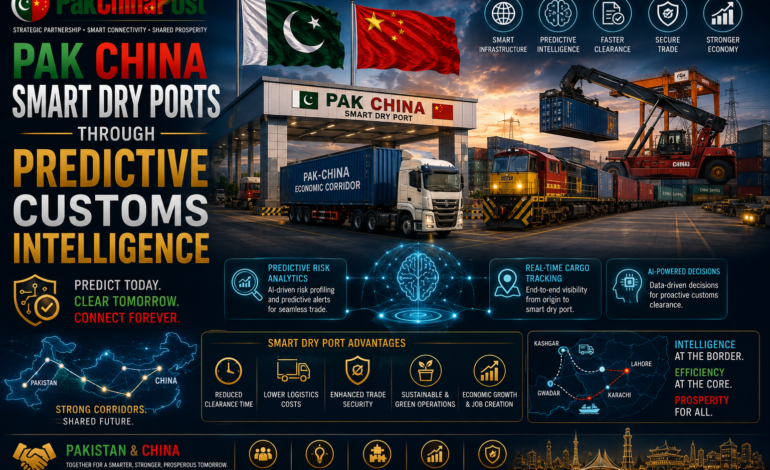
Pakistan possesses an opportunity to integrate elements of these digital capabilities into the evolving architecture of CPEC logistics. Dry ports including those connected with Gwadar, Karachi, Lahore and northern transport corridors could gradually transition from conventional cargo terminals into intelligent logistics nodes capable of exchanging real time information across customs, taxation, banking, transportation and regulatory agencies. Cargo would effectively become digitally visible throughout its journey rather than appearing only upon physical arrival at border checkpoints.
Predictive cargo analytics represents perhaps the most transformative dimension of this evolution. Traditional customs systems primarily respond to events after documentation submission. Artificial intelligence instead forecasts future risks using historical behaviour, commercial patterns and continuously expanding datasets. Machine learning systems analyse exporter history, importer compliance, commodity characteristics, transportation routes, financial settlements, seasonal trade fluctuations and geopolitical developments to generate dynamic risk scores. Customs officers consequently allocate inspection resources according to probability rather than administrative routine.
Such predictive capability substantially enhances institutional efficiency. Low risk shipments experience expedited clearance while higher risk consignments receive enhanced scrutiny before entering commercial circulation. Border agencies therefore improve security without imposing universal delays upon legitimate trade. Pakistan’s customs administration could substantially reduce congestion by integrating predictive analytics into cargo prioritisation systems, especially for high volume trade passing through major ports and border crossings.
Artificial intelligence also offers significant potential for combating customs fraud. Commercial misdeclaration remains a persistent challenge globally. Under invoicing, false commodity classifications, manipulated certificates of origin, duplicate documentation and shell company networks collectively undermine revenue collection while distorting legitimate competition. Conventional audits often detect irregularities only after transactions have concluded. Machine learning algorithms identify suspicious patterns almost immediately by comparing declared values against international price databases, historical trade behaviour, logistics characteristics and comparable commercial transactions. Fraud detection consequently shifts from retrospective investigation towards preventive intervention.
Blockchain authenticated documentation further complements predictive customs intelligence by reducing document manipulation throughout international supply chains. Bills of lading, certificates of origin, insurance records, customs declarations and financial documentation traditionally circulate across multiple institutions with varying authentication procedures. Document forgery, duplicate submissions and administrative discrepancies frequently delay cargo movement while creating opportunities for corruption. Blockchain establishes immutable transaction records accessible to authorised stakeholders while preserving chronological verification throughout the commercial process. Every modification becomes permanently visible, substantially increasing documentary integrity.
For Pakistan and China, blockchain documentation could simplify bilateral customs procedures while improving confidence among exporters, financial institutions and logistics providers. Trade financing often depends upon verified commercial documentation. Immutable digital authentication accelerates financial approval processes while reducing operational risk. Exporters consequently gain improved liquidity through faster document verification, strengthening industrial competitiveness across manufacturing sectors participating in bilateral commerce.
Integrated customs intelligence extends beyond technology itself. Institutional interoperability remains equally important. Customs authorities rarely operate independently. Effective border management requires coordination among immigration services, taxation authorities, food safety regulators, quarantine agencies, banking institutions, transport ministries, intelligence organisations and law enforcement bodies. Artificial intelligence performs optimally when diverse datasets communicate seamlessly across institutional boundaries. Fragmented bureaucracies undermine predictive accuracy by restricting comprehensive situational awareness.
Pakistan therefore confronts an institutional challenge alongside technological modernisation. Multiple agencies currently maintain independent databases employing different technical standards, reporting procedures and legal authorities. Developing integrated customs intelligence requires harmonised digital architecture enabling authorised information exchange without compromising institutional accountability. Governance frameworks must clearly define data ownership, operational responsibilities, privacy protections and oversight mechanisms before technological integration proceeds.
Cross border cooperation with China similarly requires legal harmonisation. Artificial intelligence depends upon consistent data quality. Divergent customs classifications, documentation standards, digital authentication protocols and regulatory definitions reduce predictive effectiveness. Bilateral technical working groups should therefore prioritise standardisation of customs data structures, electronic documentation protocols and digital certification systems. Harmonised information architecture creates the foundation upon which predictive analytics can operate across national jurisdictions.
Digital trade ecosystems increasingly rely upon trusted identity verification. Artificial intelligence cannot reliably assess commercial behaviour without confidence regarding institutional identities. Secure digital identities for exporters, logistics providers, customs brokers, financial institutions and regulatory agencies strengthen algorithmic confidence while reducing impersonation risks. Pakistan should therefore expand secure digital identity infrastructure throughout commercial logistics administration, integrating authentication standards compatible with evolving bilateral trade mechanisms.
Automated inspections constitute another emerging frontier. Artificial intelligence increasingly interprets high resolution cargo imaging generated through advanced scanning systems. Rather than relying exclusively upon manual image interpretation, machine learning identifies concealed anomalies, prohibited goods, undeclared cargo compartments and documentation inconsistencies with growing precision. Human inspectors retain ultimate authority, yet artificial intelligence substantially enhances inspection efficiency by highlighting statistically significant irregularities requiring closer examination.
Such automation becomes particularly valuable during periods of elevated cargo volumes. Manual inspection capacity inevitably faces operational limitations. Artificial intelligence provides scalable analytical capability capable of maintaining consistent performance regardless of shipment volumes. Pakistan’s expanding trade ambitions therefore necessitate investment in intelligent inspection infrastructure alongside conventional customs modernisation.
Commercial certainty remains equally important. Businesses make investment decisions according to predictability rather than merely average processing times. Artificial intelligence enables estimated clearance schedules based upon continuously updated operational conditions. Logistics companies receive predictive forecasts regarding inspection probabilities, border congestion, documentation requirements and expected processing durations. Such transparency allows manufacturers to optimise production schedules while reducing inventory costs throughout integrated supply chains.
The implications extend beyond customs administration into strategic economic resilience. Modern geopolitical competition increasingly employs sanctions, export controls, financial restrictions and regulatory interventions as instruments of statecraft. Countries possessing digitally integrated trade ecosystems demonstrate greater resilience by rapidly reallocating logistics capacity, identifying alternative commercial routes and maintaining operational visibility despite external disruptions. Artificial intelligence strengthens national adaptability by providing policymakers with real time situational awareness across strategic supply chains.
Pakistan should consequently view intelligent customs architecture not merely as an administrative reform but as an element of national economic security. Critical imports including energy equipment, industrial machinery, pharmaceuticals, semiconductors and defence related technologies require uninterrupted logistics management. Predictive customs intelligence enhances visibility across these strategically important supply chains while supporting contingency planning during geopolitical crises.
Nevertheless, substantial challenges accompany digital transformation. Artificial intelligence depends fundamentally upon data quality. Incomplete records, inconsistent documentation, inaccurate commodity classifications and fragmented institutional reporting substantially reduce predictive reliability. Pakistan must therefore prioritise comprehensive data governance before pursuing sophisticated algorithmic deployment. Digitalisation without reliable data risks automating existing inefficiencies rather than eliminating them.
Cybersecurity represents another strategic concern. Customs systems increasingly constitute critical national infrastructure. Successful cyber intrusion could disrupt trade, compromise sensitive commercial information or manipulate customs risk assessments. Artificial intelligence introduces additional vulnerabilities through algorithm manipulation, data poisoning and adversarial machine learning techniques. Bilateral cooperation with China should therefore encompass cyber resilience, secure cloud infrastructure, encryption standards and continuous vulnerability assessments alongside operational digitalisation.
Human capital development remains equally decisive. Artificial intelligence supplements rather than replaces professional judgement. Customs officers require advanced analytical training enabling effective interpretation of machine generated recommendations while recognising algorithmic limitations. Institutional culture must evolve from document processing towards intelligence analysis. Universities, professional academies and specialised customs training centres should therefore integrate artificial intelligence literacy into future workforce development programmes.
Legal frameworks require corresponding adaptation. Existing customs legislation frequently assumes paper documentation, manual verification and sequential administrative procedures. Digital trade ecosystems demand legal recognition of electronic documentation, blockchain authentication, algorithm assisted decision making and cross border digital evidence. Legislative modernisation should proceed concurrently with technological investment to avoid regulatory ambiguity undermining operational implementation.
Financial institutions likewise occupy a central position within intelligent customs ecosystems. Banks increasingly integrate trade finance with digital documentation platforms, enabling automated verification before extending commercial credit. Pakistan’s banking sector should coordinate with customs authorities to establish secure interfaces supporting authenticated documentation while strengthening anti money laundering compliance. Artificial intelligence consequently becomes a shared capability spanning financial regulation, customs administration and commercial logistics.
The private sector must participate actively throughout this transformation. Exporters, freight forwarders, shipping companies and customs brokers generate much of the operational data upon which predictive systems depend. Public private governance mechanisms should therefore encourage standardised data submission, cybersecurity compliance and interoperable digital platforms. Commercial confidence increases when businesses perceive digital governance as facilitating legitimate trade rather than expanding administrative surveillance.
Regional connectivity further amplifies these opportunities. Pakistan occupies a geographically significant position linking Western China, Central Asia, the Arabian Sea and the Middle East. Intelligent customs architecture capable of supporting seamless multimodal logistics would strengthen Pakistan’s attractiveness as a regional transit economy. Transit cargo increasingly requires rapid digital verification rather than repetitive physical documentation across multiple jurisdictions. Predictive customs intelligence therefore enhances regional competitiveness alongside domestic administrative efficiency.
Environmental sustainability also intersects with digital logistics. Delayed cargo clearance contributes to unnecessary fuel consumption, vehicle congestion and warehousing inefficiencies. Artificial intelligence optimises transport scheduling, container allocation and border processing, reducing emissions throughout logistics networks. Smart dry ports consequently support broader environmental objectives while improving commercial performance.
Institutionally, Pakistan and China should establish a permanent bilateral digital customs coordination mechanism bringing together customs authorities, central banks, transport ministries, cybersecurity agencies, standards organisations and technology experts. Such an institution would oversee interoperability standards, algorithm governance, cybersecurity protocols, legal harmonisation and pilot projects before nationwide implementation. Regular technical exercises should test digital resilience under simulated cyber incidents, trade disruptions and emergency logistics scenarios.
Equally important is algorithmic accountability. Artificial intelligence must remain transparent, auditable and subject to human oversight. Commercial operators require confidence that automated risk assessments do not produce arbitrary discrimination or unexplained administrative delays. Independent audit mechanisms should periodically evaluate algorithmic fairness, predictive accuracy and operational effectiveness. Trust constitutes the essential currency of digital trade ecosystems.
Incremental implementation offers greater sustainability than comprehensive nationwide deployment. Selected CPEC logistics corridors could initially serve as experimental environments integrating predictive analytics, blockchain documentation, intelligent inspections and interoperable customs databases. Lessons derived from operational experience would subsequently inform broader national expansion. Such phased implementation reduces institutional disruption while allowing continuous refinement according to practical realities.
Pakistan should additionally invest in sovereign digital infrastructure supporting long term technological independence. Artificial intelligence increasingly depends upon secure data centres, high performance computing capability, resilient communications networks and domestic software expertise. Excessive dependence upon external digital infrastructure could generate future strategic vulnerabilities. Bilateral cooperation with China should therefore emphasise technology transfer, local capability development and indigenous institutional expertise rather than equipment acquisition alone.
The broader significance of intelligent customs administration ultimately extends beyond bilateral trade volumes. Digital governance increasingly defines national credibility within global commerce. Investors, manufacturers and financial institutions evaluate regulatory sophistication alongside macroeconomic indicators when allocating capital. Countries capable of combining efficient border management, transparent regulation, cybersecurity resilience and predictable administrative processes attract higher value investment integrated into advanced manufacturing networks. Pak China cooperation possesses the institutional depth, technological complementarities and strategic incentives necessary to pioneer such transformation across South Asia. Physical infrastructure has already established the foundations of connectivity. The next competitive frontier lies within invisible architecture composed of trusted data, predictive intelligence, interoperable institutions and digitally authenticated commerce. Artificial intelligence alone will not eliminate cross border trade friction, yet when combined with legal modernisation, institutional coordination, cybersecurity resilience, professional capacity building and transparent governance, it can substantially reduce administrative uncertainty while strengthening economic security. Smart dry ports therefore represent far more than automated logistics facilities. They constitute strategic intelligence platforms where commerce, technology and national resilience converge, positioning Pakistan and China to shape a more secure, efficient and trusted digital trading environment amid an increasingly.
A Public Service Message