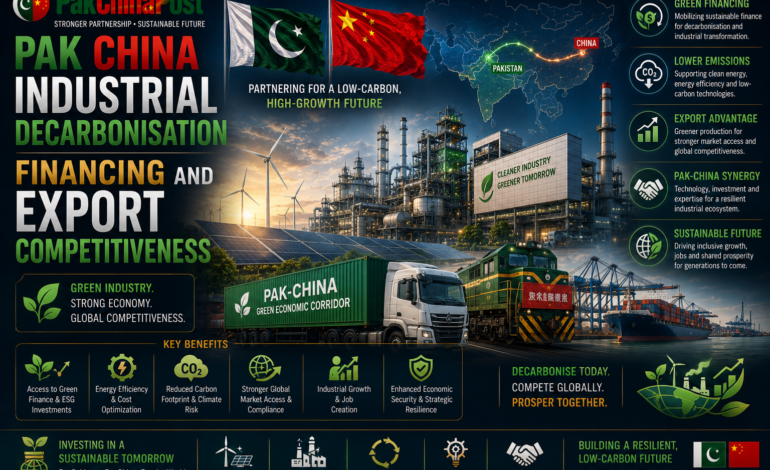
Pak China Industrial Decarbonisation Financing and Export Competitiveness


Pak China industrial cooperation is approaching a decisive inflection point where competitiveness will increasingly be determined not merely by production costs or manufacturing scale but by measurable environmental performance embedded throughout industrial value chains. The international trading environment is rapidly integrating carbon disclosure obligations, emissions accounting frameworks, climate related financial standards and sustainability certification into market access conditions. What previously functioned as voluntary environmental reporting is steadily evolving into an implicit commercial passport governing participation in advanced manufacturing ecosystems. For Pakistan, whose export profile remains heavily concentrated in textiles, leather, agricultural processing, surgical instruments, sports goods and emerging engineering products, this transformation represents not only a regulatory adjustment but an industrial restructuring challenge. For China, already navigating increasingly sophisticated carbon compliance obligations across its export sectors while simultaneously expanding green industrial technologies, cooperation with Pakistan presents an opportunity to construct a resilient manufacturing partnership capable of satisfying evolving international environmental expectations without sacrificing economic dynamism.
The commercial vocabulary surrounding exports is undergoing structural revision. International buyers increasingly evaluate embedded carbon intensity alongside price, quality and delivery schedules. Procurement departments within multinational corporations now require suppliers to demonstrate transparent emissions inventories, renewable energy integration, resource efficiency and environmental governance before long term purchasing contracts are approved. Financial institutions similarly incorporate climate risk assessments into lending decisions, while institutional investors increasingly scrutinise environmental disclosures when allocating industrial capital. Export competitiveness therefore extends beyond manufacturing capability towards verifiable environmental credibility. Nations unable to provide reliable emissions information may gradually encounter commercial disadvantages irrespective of production efficiency.
Pakistan’s industrial landscape reflects considerable diversity but equally substantial environmental heterogeneity. Export oriented textile clusters, cement production, fertiliser manufacturing, steel re rolling operations, ceramics, chemicals and food processing exhibit markedly different energy intensities and emissions profiles. Many industrial facilities continue operating with ageing machinery, limited energy management systems, fragmented environmental monitoring and inconsistent emissions measurement methodologies. While these limitations have historically affected operational efficiency, forthcoming international compliance mechanisms increasingly transform them into commercial liabilities capable of restricting export market penetration.
China’s industrial evolution offers instructive institutional experience rather than a template requiring mechanical replication. Chinese manufacturers have progressively integrated digital emissions monitoring, energy optimisation technologies, industrial electrification, waste heat recovery systems, green financing mechanisms and sophisticated environmental auditing across significant portions of manufacturing activity. Simultaneously, Chinese financial institutions have expanded green credit instruments supporting technological modernisation while provincial authorities increasingly align industrial incentives with carbon reduction objectives. Pakistan can selectively adapt these institutional mechanisms according to domestic economic realities while avoiding regulatory overextension incompatible with existing industrial capacities.
Industrial decarbonisation should not be interpreted narrowly as environmental compliance alone. It represents a comprehensive productivity agenda encompassing energy efficiency, technological upgrading, operational optimisation, resource conservation and manufacturing modernisation. Facilities consuming fewer energy inputs per production unit generally experience reduced operational costs, improved process reliability and enhanced competitiveness irrespective of climate considerations. Consequently, environmental performance increasingly converges with industrial efficiency rather than functioning as an independent regulatory burden.
Energy represents the principal determinant of industrial emissions within Pakistan. Electricity generation remains dependent upon a diversified but evolving energy mix, while industrial heating frequently relies upon natural gas, furnace oil or coal depending upon regional availability and sectoral characteristics. Many factories continue operating equipment installed decades earlier with comparatively poor energy conversion efficiencies. Upgrading motors, boilers, furnaces, compressors, process heating systems and industrial cooling infrastructure can simultaneously reduce emissions and enhance productivity. However, financing constraints frequently prevent enterprises, particularly small and medium manufacturers, from undertaking capital intensive technological replacements despite attractive long term returns.
This financing constraint illustrates where Pakistan China cooperation could produce substantial strategic value. Rather than focusing exclusively upon infrastructure construction, bilateral financial engagement can increasingly support industrial transformation through dedicated green manufacturing facilities combining concessional financing, technology transfer and technical advisory services. Chinese financial institutions possess expanding experience financing environmentally sustainable industrial projects while Chinese equipment manufacturers increasingly specialise in high efficiency production technologies compatible with developing market conditions. Structured financing mechanisms could therefore accelerate industrial modernisation without imposing unsustainable fiscal pressures upon Pakistan.
Carbon accounting represents another emerging competitive requirement demanding institutional attention. Accurate measurement constitutes the foundation upon which all environmental compliance systems depend. Many Pakistani manufacturers presently lack comprehensive emissions inventories extending beyond direct fuel consumption. International reporting standards increasingly require accounting for indirect electricity emissions, supply chain activities, logistics operations, waste management and lifecycle environmental impacts. Establishing credible carbon accounting therefore requires extensive institutional development encompassing technical standards, auditor accreditation, digital reporting platforms and verification procedures capable of satisfying international commercial expectations.
Digital technologies substantially expand opportunities for credible emissions management. Artificial intelligence enables continuous monitoring of industrial energy consumption, predictive maintenance reducing unnecessary emissions, optimisation of production schedules according to electricity availability and automated environmental reporting. Internet connected sensors generate real time operational data while digital twins simulate production adjustments before physical implementation. Blockchain documentation enhances traceability across supply chains, strengthening confidence in environmental disclosures. Pakistan can accelerate digital environmental governance by integrating these technologies into industrial policy rather than treating decarbonisation solely as regulatory compliance.
Export industries confront particularly urgent adaptation requirements because external commercial pressures continue intensifying. European environmental regulations, sustainability procurement frameworks among multinational corporations and investor expectations increasingly converge around transparent climate performance. Textile exports, representing Pakistan’s largest manufacturing sector, already experience expanding requests regarding renewable electricity usage, wastewater treatment, recycled materials, chemical management and greenhouse gas disclosures. Similar expectations increasingly emerge across leather products, engineering goods and agricultural exports. Compliance delays therefore risk gradual commercial displacement rather than immediate market exclusion.
Chinese manufacturing partnerships could facilitate environmental upgrading through integrated industrial ecosystems rather than isolated equipment transfers. Joint ventures may establish demonstration facilities showcasing energy efficient manufacturing processes while vocational institutions develop specialised environmental engineering expertise. Collaborative research centres could adapt low carbon industrial technologies according to Pakistan’s climatic conditions, energy infrastructure and manufacturing characteristics. Such cooperation generates domestic technological capability alongside immediate environmental improvements.
Green industrial finance requires institutional sophistication extending beyond conventional commercial lending. Traditional banking frequently undervalues long term efficiency gains because repayment horizons exceed standard lending preferences. Dedicated environmental credit frameworks incorporating concessional interest rates, extended maturities, technical performance guarantees and blended public private financing can overcome these structural limitations. Green bonds, sustainability linked loans and emissions performance incentives further diversify financing options while attracting international climate investment seeking commercially viable industrial opportunities.
Pakistan’s financial regulators therefore confront increasingly strategic responsibilities. Banking supervision should encourage climate risk assessment without constraining productive lending. Capital markets require credible green financing standards preventing environmental misrepresentation while maintaining investor confidence. Insurance industries similarly require methodologies evaluating climate related operational risks affecting industrial assets. Financial governance consequently becomes inseparable from industrial competitiveness within environmentally regulated international markets.
Environmental disclosure standards equally demand careful calibration. Excessively complex reporting requirements risk overwhelming smaller manufacturers possessing limited technical capacity. Conversely, inadequate disclosure frameworks undermine international credibility and reduce commercial acceptance. Regulatory authorities should therefore implement phased compliance pathways differentiating according to enterprise size, export exposure and industrial sector. Progressive implementation permits institutional learning while minimising economic disruption.
Industrial clusters present particularly attractive opportunities for coordinated decarbonisation. Concentrated manufacturing zones facilitate shared renewable energy infrastructure, collective wastewater treatment, district heating systems, waste recycling facilities and environmental monitoring platforms. Rather than requiring individual enterprises to finance duplicate infrastructure, cluster based investment significantly reduces compliance costs while improving environmental performance. Pakistan’s established textile and manufacturing clusters therefore constitute logical priorities for integrated environmental modernisation programmes.
Electricity market reforms substantially influence industrial decarbonisation prospects. Manufacturers require reliable access to competitively priced renewable electricity if emissions reductions are to remain economically sustainable. Regulatory frameworks permitting direct renewable procurement, power purchase agreements and distributed generation enhance industrial flexibility while stimulating private investment in clean energy infrastructure. China possesses extensive experience integrating renewable generation into industrial production systems, offering valuable operational insights adaptable to Pakistan’s evolving electricity sector.
Industrial supply chains increasingly function as interconnected environmental systems rather than isolated enterprises. Large exporters routinely require emissions information from upstream suppliers producing intermediate goods, packaging materials, transportation services and raw materials. Consequently, environmental expectations cascade throughout domestic manufacturing ecosystems. Small enterprises previously insulated from international sustainability requirements now experience indirect compliance obligations through participation in export supply chains. National policy must therefore extend beyond major exporters towards comprehensive industrial ecosystem transformation.
Technological localisation remains essential for long term competitiveness. Importing advanced equipment without developing domestic maintenance capabilities, engineering expertise or component manufacturing creates enduring external dependence. Bilateral cooperation should therefore emphasise technology absorption, local manufacturing partnerships, engineering education and industrial research institutions capable of progressively internalising environmental technologies. Indigenous capability enhances resilience against future commercial disruptions while supporting broader industrial diversification.
Hydrogen technologies, industrial electrification, advanced heat pumps, carbon capture applications, alternative cement formulations, biomass utilisation and circular manufacturing systems represent longer term technological opportunities requiring sustained research collaboration. Although widespread deployment remains commercially constrained across many sectors, early institutional preparation enables gradual integration as technologies mature and costs decline. Pakistan should therefore maintain technological awareness while prioritising immediately deployable efficiency improvements generating measurable commercial returns.
Carbon markets similarly warrant cautious institutional evaluation. Properly designed emissions trading mechanisms may encourage cost effective environmental improvements while attracting climate finance. However, premature implementation absent robust emissions measurement, regulatory capacity and market oversight risks administrative complexity exceeding commercial benefits. Institutional sequencing therefore assumes considerable importance. Reliable emissions inventories, verification procedures and regulatory competence should precede sophisticated market instruments.
Industrial workforce development constitutes another frequently underestimated dimension of environmental transformation. Engineers, accountants, auditors, production managers and maintenance personnel increasingly require competencies encompassing energy management, environmental reporting, lifecycle assessment and digital monitoring technologies. Universities, vocational institutions and industrial training centres should therefore modernise curricula reflecting emerging commercial requirements. Human capital ultimately determines whether imported technologies generate sustained productivity improvements.
Geopolitical developments further reinforce industrial decarbonisation imperatives. International competition increasingly incorporates environmental standards into broader economic security frameworks. Supply chain diversification strategies adopted by major economies frequently prioritise environmentally reliable manufacturing partners capable of demonstrating transparent production systems. Consequently, environmental credibility increasingly contributes to national economic resilience alongside traditional competitive advantages.
For Pakistan, strategic planning should avoid perceiving carbon compliance exclusively through the prism of external regulatory pressure. Environmental modernisation offers opportunities to reduce energy imports, improve industrial productivity, strengthen export resilience and attract international investment seeking sustainable manufacturing destinations. Reframing decarbonisation as industrial competitiveness rather than environmental obligation encourages broader political and commercial support.
Pak China cooperation possesses distinctive comparative advantages because bilateral engagement combines technological capability, manufacturing experience, financial resources and established industrial relationships. Existing economic cooperation platforms can progressively expand towards green manufacturing partnerships encompassing digital emissions accounting, industrial efficiency programmes, renewable integration, sustainable logistics and environmental certification systems. Such evolution aligns bilateral cooperation with emerging international commercial realities while supporting domestic industrial transformation.
National security institutions should similarly recognise environmental competitiveness as an increasingly significant dimension of economic security. Export contraction arising from environmental non compliance would affect foreign exchange earnings, industrial employment, fiscal stability and strategic resilience. Climate compatible industrial policy therefore contributes indirectly to national security by preserving economic strength under changing international commercial conditions. Establishment planning increasingly requires integrating environmental competitiveness into broader economic resilience assessments.
Policy coherence ultimately determines implementation effectiveness. Ministries responsible for commerce, industries, finance, energy, environment, planning and foreign affairs must coordinate regulatory development rather than pursuing fragmented initiatives generating administrative duplication. Provincial authorities similarly require alignment with national industrial objectives while maintaining flexibility reflecting regional economic characteristics. Institutional interoperability becomes indispensable where environmental governance intersects trade policy, industrial regulation and financial supervision.
The emerging commercial landscape will reward manufacturers capable of demonstrating transparent environmental performance supported by credible institutions, efficient technologies and accessible green finance. Pakistan retains significant opportunities to achieve this transition provided policy responses remain proactive rather than reactive. Industrial decarbonisation should therefore be understood as an investment in export continuity, technological sophistication and long term economic resilience. Within this evolving environment, Pak China cooperation can move beyond conventional infrastructure development towards constructing an integrated industrial ecosystem where environmental credibility strengthens commercial competitiveness, enhances strategic economic security and positions bilateral manufacturing partnerships to prosper within increasingly carbon conscious global markets.
A Public Service Message