

Energy Insecurity Reshapes Global Economy Through Systemic Political Pressures Unfolding

Energy insecurity has ceased to be a peripheral concern of commodity markets and has instead crystallised into a defining axis of global systemic instability, shaping macroeconomic trajectories, recalibrating geopolitical alignments, and intensifying structural vulnerabilities across both advanced industrial economies and fragile developing states.

Sovereignty And Strategic Dependence China Pakistan Economic Autonomy Dilemma

Sovereignty in the twenty first century is no longer a purely juridical condition defined by territorial control or constitutional independence. It has evolved into a more complex and relational construct shaped by financial interdependence, infrastructural embedding, and technological integration. Within this evolving global

Debt Trap Or Development Trap Domestic Capacity Defines CPEC Outcome

The debate over whether Chinese financing under CPEC constitutes a “debt trap” has become one of the most politically charged narratives in contemporary geopolitical discourse on Pakistan’s economic trajectory. Yet this framing, while rhetorically powerful, obscures more than it reveals. It reduces a

Security Before Investment Attacks Instability and Governance Delay CPEC Success
CPEC 2.0 is often presented as a transition from concrete infrastructure toward a more sophisticated phase of industrial cooperation, technological upgrading, and regional integration. Yet beneath this forward-looking narrative lies a far more intractable reality: investment does not arrive in a vacuum of
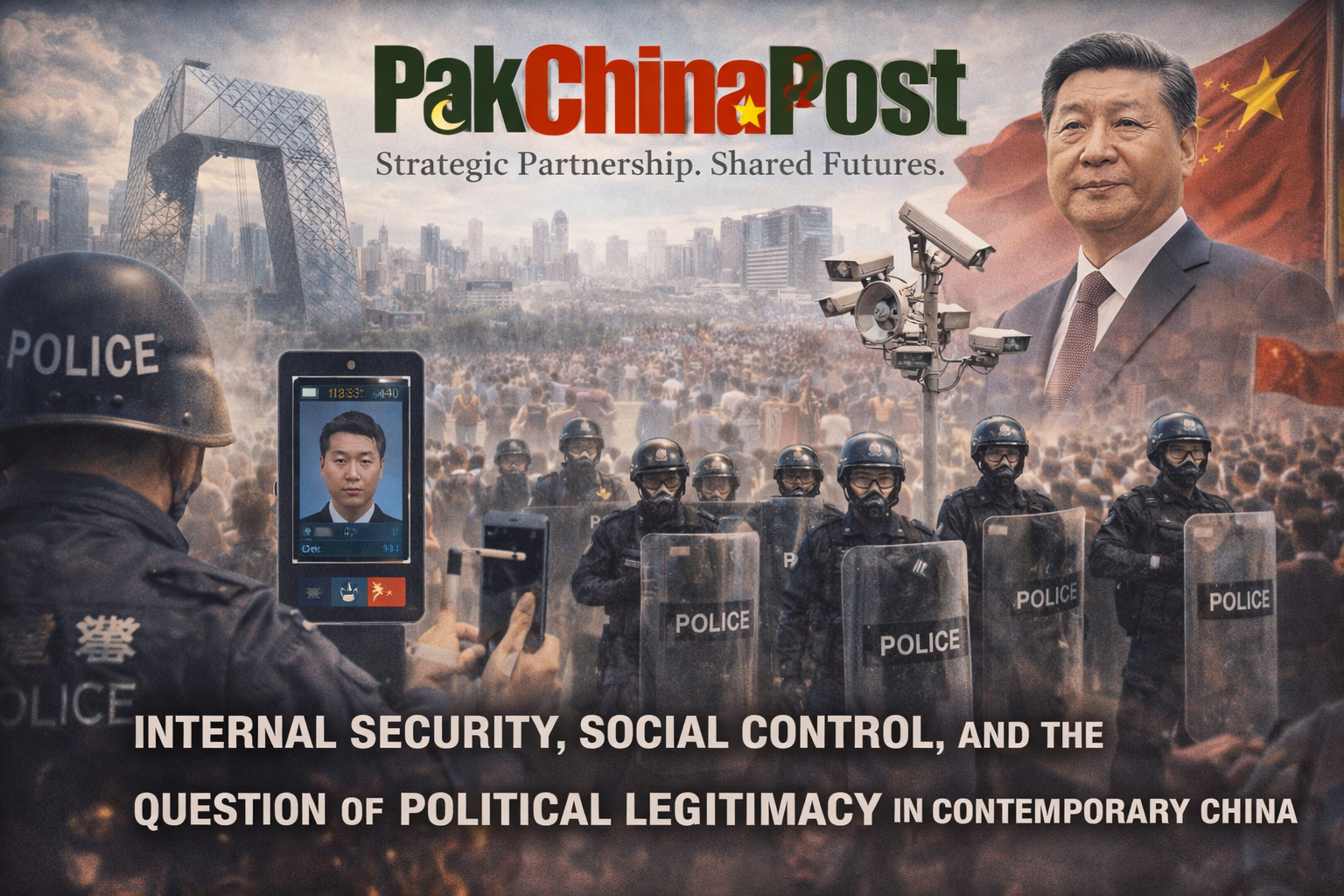
Internal Security, Social Control, and the Question of Political Legitimacy in Contemporary China
The durability of the Chinese political system has long rested on a carefully maintained equilibrium between economic performance, social stability, and centralized authority. In the contemporary era, this equilibrium is being recalibrated through an intensified emphasis on internal security and social control under

Strategic Decoupling and Technological Containment in the Age of Great Power Rivalry
The evolving confrontation between China and the United States has entered a phase that is increasingly defined not by traditional military posturing alone but by a deep and deliberate restructuring of technological and economic interdependence. What was once described as competition within a

China’s Structural Economic Slowdown and the Testing Limits of State Capitalism
China’s economic trajectory has entered a phase that is no longer defined by the certainties of rapid expansion but by the complexities of structural recalibration. For over four decades, the Chinese growth model stood as a remarkable synthesis of state direction and market

Strategic Risks and the Imperative of Cautious Alignment in Pakistan’s Partnership with China
In the contemporary international system, the pursuit of strategic partnerships inevitably entails a duality of opportunity and risk. For Pakistan, the deepening engagement with China presents unparalleled possibilities for economic development, technological advancement, and geopolitical insulation. However, this relationship is not devoid of

Technological Sovereignty and the Strategic Contest for Innovation
In the unfolding architecture of twenty-first century power, technology has emerged as the decisive terrain upon which national strength is measured and geopolitical influence contested. Military capabilities, economic productivity, digital infrastructure, and even ideological narratives increasingly converge within the domain of technological innovation.

China’s Structural Slowdown and the Reinvention of a Civilizational Economy
The contemporary trajectory of China presents one of the most intricate economic transitions in modern history. For four decades the People’s Republic of China embodied the most dramatic economic ascent the world had witnessed since the Industrial Revolution. Entire academic disciplines, policy doctrines,