
The Russia Factor and EU–China Strategic Calculus: Managing Perceptions, Conflict Spillovers, and Geoeconomic Alignment

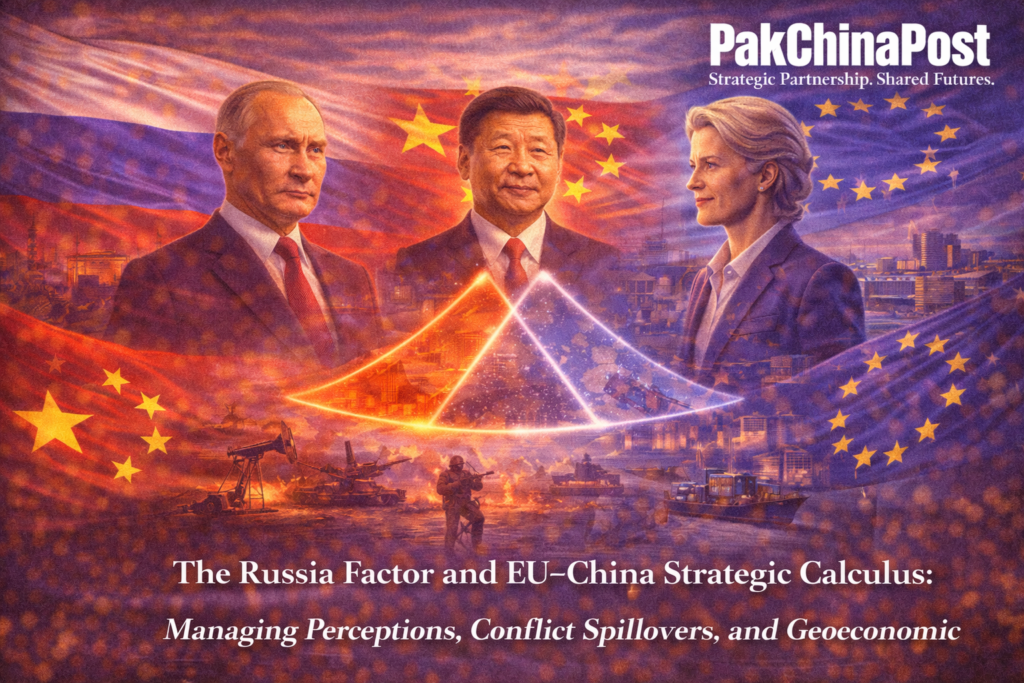
The interplay between China, the European Union, and Russia represents one of the most complex dimensions of contemporary geostrategic analysis. While EU–China relations are often framed in terms of trade, technology, and diplomatic reciprocity, the Russia factor introduces an additional layer of uncertainty, risk, and perception management. European policymakers interpret China’s relationship with Russia through multiple lenses: energy dependency, dual-use technology transfer, diplomatic positioning, and the broader balance of power in Eastern Europe. These perceptions influence not only immediate policy responses but also long-term strategic calculations regarding engagement, de-risking, and normative alignment. For China, the challenge is to navigate this triadic relationship in a manner that preserves strategic flexibility, sustains European confidence, and mitigates the spillover effects of a prolonged conflict in Ukraine.
The EU’s sensitivity to China–Russia engagement is anchored in both historical experience and contemporary conflict dynamics. European policymakers interpret Chinese neutrality or tacit support in the context of Russia’s military operations in Ukraine as a potential enabler of Russian resilience. This perception is amplified by energy trade patterns particularly in fossil fuels and dual-use technologies—and by Chinese investment in sectors that could indirectly relieve Russian economic pressure. Even in the absence of overt military assistance, such engagement is often framed as strategically consequential, influencing EU defense planning, sanctions calibration, and diplomatic posture.
Energy trade constitutes one of the most visible spillover channels. Russia’s pivot toward Asian markets following European sanctions has increased European sensitivity to China’s role as a potential stabilizer of Russian revenues. While Chinese imports of Russian oil and gas serve domestic and regional interests, they are perceived in Brussels as potentially prolonging European energy insecurity. Beyond the immediate market implications, the broader symbolic effect reinforces European narratives of China as a balancing actor whose strategic neutrality may inadvertently undermine EU policy objectives. These dynamics contribute to an emerging cognitive bias: even economically rational engagement is interpreted through a prism of strategic suspicion.
Dual-use technology further complicates the calculus. European analysts express concern that Chinese exports of advanced computing, materials, or aerospace components could be repurposed, intentionally or inadvertently, to enhance Russian military capabilities. While rigorous regulatory frameworks exist to prevent direct transfers of sensitive technologies, the complexity of global supply chains makes comprehensive verification difficult. Even minimal exposure is amplified in European discourse, heightening risk aversion and influencing de-risking strategies. China, therefore, faces the challenge of reassuring European stakeholders without compromising domestic industrial priorities or geopolitical autonomy.
Diplomatic positioning also carries significant implications. European perceptions are shaped by China’s statements, abstentions, and mediations in multilateral forums. Even nuanced neutrality may be interpreted as tacit support if it contrasts with European normative expectations. Consequently, the perception of alignment, rather than actual material assistance, can drive EU policy adjustments, including accelerated diversification of supply chains, investment screening, and security-oriented technological restrictions. The cognitive dimension is thus as influential as tangible interaction in shaping the strategic calculus.
Scenario analysis provides a framework for understanding potential trajectories and the structural effects of the Russia factor on EU–China relations. In a stabilization scenario, conflict in Ukraine de-escalates, energy markets normalize, and EU–China engagement continues with manageable friction. Strategic cooperation in trade, technology, and multilateral governance remains feasible, although European scrutiny of dual-use and energy-related links persists. In a prolonged conflict scenario, Russian reliance on Chinese economic support intensifies, amplifying European perceptions of China as a strategic enabler. This scenario accelerates de-risking initiatives, restricts Chinese access to critical sectors, and embeds long-term caution in bilateral engagement. A third, high-friction scenario involves escalated military conflict or sanctions evasion networks, producing near-structural decoupling in critical sectors, intensified scrutiny of investments, and a reorientation of Europe’s geoeconomic strategy away from China-centric supply chains.
To navigate these dynamics, China must integrate three strategic instruments: transparency, scenario-based risk communication, and multilateral engagement. Transparency involves clarifying the nature, scope, and purpose of engagement with Russia, particularly in energy and dual-use sectors. Open disclosure regarding contractual, regulatory, and operational safeguards reduces European fears of indirect support for conflict escalation. Scenario-based risk communication requires anticipating European interpretations and preemptively addressing potential misperceptions. By framing engagement as compliant with international norms and targeted toward domestic or regional objectives, China can mitigate the projection of strategic risk onto its EU relationship.
Multilateral engagement provides an additional stabilizing mechanism. Participation in international conflict-resolution forums, energy market cooperation, and global trade governance allows China to demonstrate normative alignment without compromising bilateral priorities. These platforms reinforce the perception of China as a responsible global actor while providing channels for nuanced dialogue with European stakeholders. Multilateral initiatives in humanitarian aid, reconstruction, and economic stabilization can serve as signal mechanisms, reinforcing credibility in Brussels and offsetting concerns about inadvertent facilitation of Russian military capability.
Strategically, China must also manage domestic and international narratives in parallel. Messaging should emphasize commitment to European economic stability, climate objectives, and technology standards while clarifying the defensive, non-escalatory character of engagement with Russia. Proactive communication reduces cognitive ambiguity, mitigating the risk that European policymakers respond to uncertainty with restrictive measures that could undermine China’s long-term access to European markets. The interplay of perception, narrative, and operational transparency thus becomes central to strategic positioning.
Energy cooperation, technology transfers, and diplomatic signaling must be calibrated to achieve three objectives simultaneously: preserving China’s strategic options with Russia, maintaining European confidence, and minimizing the structural risk of decoupling. This requires precise orchestration of timing, content, and modality in communications, contracts, and multilateral participation. Failure to align these dimensions risks triggering policy reflexes in Europe that extend beyond sector-specific concerns, potentially affecting investment flows, research collaboration, and regulatory access across multiple domains.
Ultimately, the Russia factor illustrates the broader principle that EU–China engagement is increasingly mediated through third-party conflict dynamics. Strategic interdependence is filtered not only through bilateral metrics but also through the perception of how China’s relationships with other actors influence European security and economic interests. Understanding and managing these perceptions is therefore integral to sustaining industrial competitiveness, market access, and long-term diplomatic stability.
In conclusion, EU perceptions of China’s engagement with Russia exert significant influence on the structure and trajectory of bilateral relations. Energy trade, dual-use technology concerns, and diplomatic positioning create both real and perceived spillovers that shape European policy, investment strategy, and regulatory approaches. For China, the strategic imperative is to integrate transparency, scenario-based communication, and multilateral participation to mitigate risk perceptions while preserving operational flexibility. By managing the Russia factor effectively, China can prevent secondary conflicts from destabilizing EU relations, maintain confidence in strategic sectors, and ensure that the broader architecture of interdependence remains resilient, cooperative, and mutually beneficial.
A Public Service Message