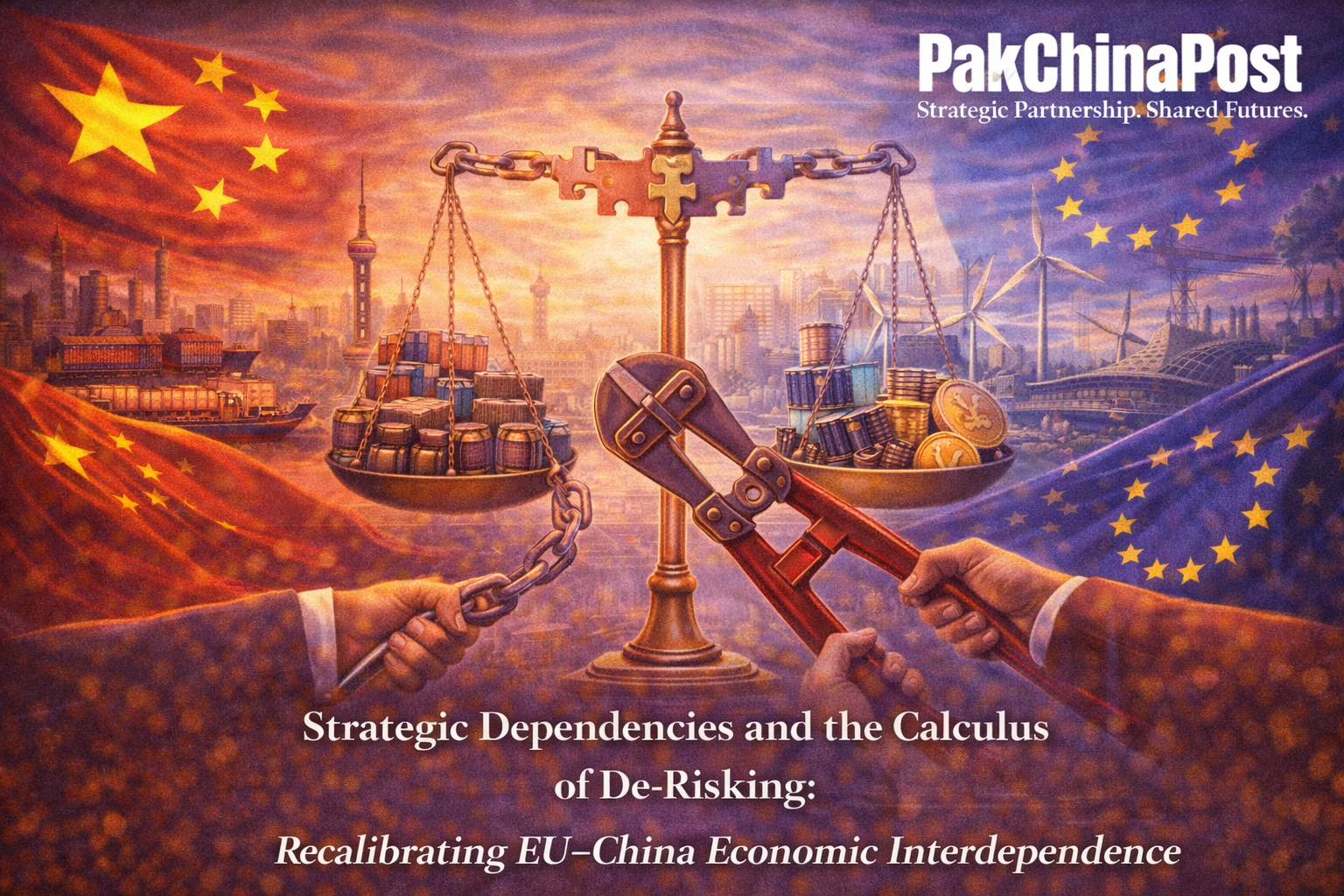

Perception, Narrative, and Cognitive Geopolitics: Shaping European Discourse on China


By Dr. M Ahsan Sardar
In the contemporary European Union–China landscape, strategic interaction extends far beyond conventional trade and investment calculus. Increasingly, cognitive dimensions—perceptions, narratives, and discourse—play a pivotal role in shaping policy choices, regulatory frameworks, and bilateral trust. European anxieties surrounding technological dependency, economic leverage, and political influence reflect not only material interdependence but also the power of narrative framing. Concerns regarding coercive economic practices, surveillance technologies, and asymmetric political engagement have crystallized into domestic discourse that influences parliamentary deliberations, media coverage, and public opinion. For China, addressing these cognitive dynamics is as critical as navigating tariffs, export restrictions, or supply chain realignments. Soft power, strategic communication, and public diplomacy are essential tools for bridging perception gaps without undermining sovereignty or appearing propagandistic.
European perceptions of dependency and security threat are influenced by multiple structural and symbolic factors. Technological integration, particularly in digital infrastructure, has heightened the salience of cybersecurity concerns. The deployment of 5G networks by Chinese providers, the proliferation of surveillance technologies, and the integration of AI-based systems into public services have created a narrative in European discourse that frames Chinese technology not only as an economic competitor but also as a potential vector for strategic influence. Academic analyses, media reporting, and political commentary converge on the notion that technological asymmetry equates to vulnerability. Even where material risks are managed through regulatory safeguards, the perception of systemic dependency drives policy and public sentiment.
Narratives of economic coercion further complicate the European cognitive landscape. Instances of selective trade measures, export restrictions on rare earths, and investment review processes are frequently interpreted as instruments of strategic leverage rather than regulatory normalcy. These interpretations are amplified by the transatlantic security discourse, in which alignment with U.S. assessments reinforces the perception of a coordinated Western response to Chinese influence. The result is a discourse ecosystem in which European actors may overestimate coercive potential while underappreciating the mutual benefits of economic engagement. The cognitive weight of such narratives shapes domestic debates, influences parliamentary oversight, and constrains the policy bandwidth available to executive authorities.
Political influence narratives intersect with these economic and technological concerns. European policymakers are attentive to perceived attempts to shape domestic public opinion, regulatory standards, or policy orientation. Although actual leverage is limited by institutional constraints, the perception of asymmetric influence whether real or imagined heightens sensitivity to Chinese engagement. This heightened scrutiny produces both self-reinforcing caution and the potential for policy overreaction, particularly in high-visibility sectors such as infrastructure, critical technology, and industrial partnerships.
China’s strategic challenge, therefore, lies in reshaping cognitive frameworks without triggering defensive reflexes. Perception management must be grounded in credibility, transparency, and demonstrable alignment with European priorities. Soft power instruments academic exchanges, joint research initiatives, cultural collaboration, and international cooperation on sustainability offer avenues to demonstrate commitment to shared objectives. These instruments are most effective when they address European societal concerns rather than serve purely as promotional tools; they should highlight collaboration in tangible sectors such as green energy, technological standardization, or public health infrastructure.
Public diplomacy plays a critical role in this endeavor. Engagement with European civil society, think tanks, and professional associations creates channels for nuanced understanding of Chinese policy objectives and operational methods. By facilitating informed discourse, China can counteract sensationalized narratives and highlight cooperative contributions to European challenges. Strategic communication must avoid overtly propagandistic framing; instead, it should focus on evidence-based demonstration of industrial, technological, and environmental partnership. The goal is to shift perceptions from zero-sum threat assessments toward recognition of interdependent opportunity.
Narrative competition is not merely reactive; it is also proactive. China can leverage international forums and joint initiatives to shape framing on issues where European anxieties are most pronounced. For instance, collaborative projects in climate governance, renewable energy deployment, and high-tech research provide opportunities to foreground mutual benefits while demonstrating operational transparency. This approach reframes interdependence as resilience-enhancing rather than vulnerability-inducing, directly addressing European cognitive concerns.
An additional dimension involves engagement with media and academic narratives. Misperceptions often arise from partial reporting or selective emphasis on risk. Targeted engagement with journalists, policy analysts, and scholars can provide context for Chinese industrial and technological policies, illustrating regulatory rigor, environmental compliance, and adherence to international standards. By embedding nuanced information in public discourse, China reduces the asymmetry of perception that fuels mistrust and mitigates the amplification of worst-case scenarios.
Scenario analysis underscores the stakes of effective perception management. In an optimistic scenario, sustained strategic communication and soft power engagement reduce European overestimation of coercive capability, facilitating cooperation in infrastructure, digital standards, and climate initiatives. In a neutral scenario, perception gaps persist but are managed through procedural engagement and selective collaboration. In a pessimistic scenario, narratives of coercion and dependency crystallize, prompting structural decoupling, exclusion from strategic sectors, and institutionalized mistrust. The trajectory is heavily influenced not by material capacity alone but by the effectiveness of cognitive framing and narrative alignment.
China’s strategy must integrate three interlocking mechanisms. First, demonstrable operational transparency in sensitive sectors mitigates perception gaps without requiring strategic concession. Second, co-created initiatives joint research, collaborative production, and multilateral engagement provide tangible evidence of mutual benefit. Third, targeted narrative engagement through public diplomacy, media collaboration, and academic exchange reshapes cognitive frameworks in Europe, aligning perceived interests with material interdependence.
Importantly, the emphasis on perception management does not negate the need for robust industrial and technological policy. Structural engagement, supply chain embedding, and localized co-investment reinforce the credibility of narrative strategies. European policymakers are more receptive to trust-building when tangible contributions employment, technological advancement, and regulatory compliance demonstrate alignment with stated objectives. Cognitive and material strategies are mutually reinforcing, creating a synergistic effect that stabilizes bilateral engagement even in a climate of geopolitical uncertainty.
The ultimate objective is to cultivate a resilient equilibrium in which Europe perceives interdependence not as coercive leverage but as a structured, mutually beneficial framework. By bridging perception gaps, China preserves market access, sustains industrial competitiveness, and safeguards the credibility of its international engagement. Conversely, failure to manage narratives risks amplifying defensive policies, accelerating de-risking, and entrenching structural separation, irrespective of material interdependence.
In conclusion, perception management and narrative competition are central dimensions of EU–China relations. Strategic engagement must recognize that European concerns extend beyond quantifiable dependencies into the cognitive domain, where narratives shape policy, regulatory orientation, and public opinion. Soft power, public diplomacy, and evidence-based strategic communication constitute the primary instruments for aligning perception with operational reality. By integrating narrative strategy with industrial, technological, and multilateral engagement, China can navigate European anxieties, foster mutual trust, and stabilize the architecture of interdependence, ensuring that the bilateral relationship remains cooperative, resilient, and strategically balanced.
A Public Service Message