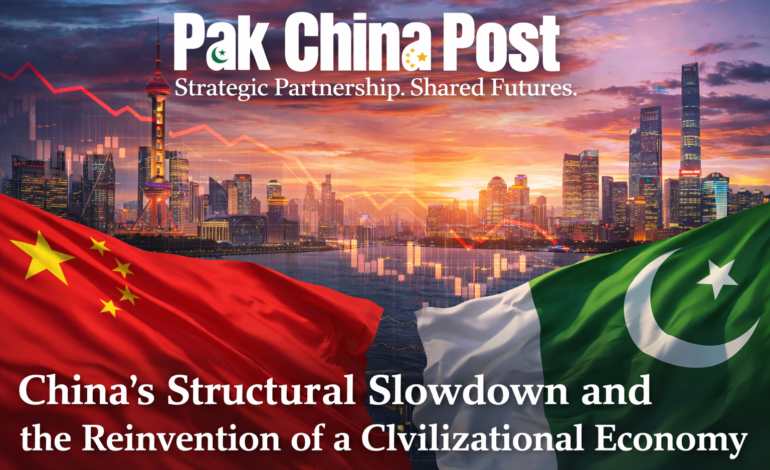
China’s Structural Slowdown and the Reinvention of a Civilizational Economy


The contemporary trajectory of China presents one of the most intricate economic transitions in modern history. For four decades the People’s Republic of China embodied the most dramatic economic ascent the world had witnessed since the Industrial Revolution. Entire academic disciplines, policy doctrines, and geopolitical calculations were reorganized around the assumption of an inexorable Chinese rise. Yet history rarely moves in straight lines. In the present decade China stands at the threshold of a profound structural transformation, confronting the delicate and often perilous passage from hyper-growth to mature economic equilibrium.
The challenge confronting Beijing is not merely cyclical stagnation or temporary volatility. Rather, it is a deeper structural recalibration of the very model that produced China’s rise. The old architecture of expansion was founded upon export-driven manufacturing, colossal infrastructure investment, and an almost unparalleled mobilization of labor and capital. For many years this model delivered double-digit growth rates, lifted hundreds of millions from poverty, and transformed China into the gravitational center of global manufacturing networks. Yet economic paradigms, like political empires, eventually encounter the limits of their own success.
China’s leadership now acknowledges that the previous model has reached diminishing returns. Growth targets have already moderated significantly, with policymakers projecting expansion around four and a half to five percent, the lowest target in decades. Such figures would be celebrated in most advanced economies, yet for China they symbolize the transition from acceleration to stabilization, from expansion to consolidation.
At the heart of this slowdown lies a complex constellation of structural pressures. The first is demographic. China’s population is aging at a pace that rivals the demographic transformations once experienced by Japan and several European economies. For decades China benefited from a demographic dividend, a vast reservoir of young workers migrating from rural landscapes into urban industrial centers. This human engine powered factories, logistics networks, and construction projects across the nation. Today that demographic advantage is gradually dissipating. Birth rates have declined, life expectancy has increased, and the labor force is beginning to contract.
An aging society exerts multifaceted pressures upon an economy. Consumption patterns evolve, productivity growth slows, and fiscal burdens increase as pension and healthcare systems expand. The demographic transition therefore forces China to search for new engines of growth that rely less upon labor quantity and more upon technological sophistication and productivity gains.
A second structural tension emerges from the legacy of China’s property sector. For many years real estate development functioned as an informal pillar of economic expansion. Vast urban skylines, sprawling residential complexes, and ambitious municipal infrastructure projects became visual symbols of China’s modernization. Yet the property market’s explosive expansion also generated vulnerabilities. Debt accumulated within local governments, developers assumed aggressive financial positions, and speculative investment distorted housing prices in major cities.
When the property sector began to cool, the reverberations spread across the broader economy. Construction slowed, local government revenues contracted, and household wealth perceptions were affected. The Chinese leadership therefore faces the delicate task of stabilizing the sector without reigniting the speculative excesses that created systemic risk.
Yet it would be intellectually superficial to interpret China’s slowdown merely as decline. In many respects the current transition reflects a deliberate strategic choice. Beijing increasingly emphasizes what policymakers describe as “high quality development,” a concept that prioritizes innovation, environmental sustainability, and technological sophistication rather than sheer numerical growth.
This strategic recalibration carries profound implications for global economic geography. China no longer seeks to remain simply the world’s factory producing inexpensive goods for Western consumers. Instead it aims to ascend the technological hierarchy, mastering advanced manufacturing, artificial intelligence, biotechnology, and next-generation digital infrastructure. The recently articulated national strategy places particular emphasis on integrating artificial intelligence across multiple sectors of the economy, a move designed to counter demographic pressures and enhance productivity. (Reuters)
Such a transformation offers considerable advantages. A technology-driven economy possesses greater resilience, higher value creation, and deeper integration into the knowledge economy of the twenty-first century. By nurturing domestic innovation ecosystems China can reduce dependence upon external technologies and cultivate indigenous capabilities across strategic industries.
Moreover, a slower but more balanced growth trajectory may ultimately enhance long-term stability. Hyper-growth often generates inequality, environmental degradation, and financial excess. By contrast, moderate expansion combined with structural reform can produce a more sustainable economic architecture. In this sense China’s current transition mirrors earlier transformations experienced by Japan during the late twentieth century and South Korea during its own maturation phase.
However, the path toward such a transformation is fraught with formidable challenges. Economic transitions of this magnitude rarely occur without friction. The shift from investment-driven growth to consumption-oriented expansion requires profound institutional adjustments. Household consumption in China has historically remained lower than in many developed economies, partly because citizens maintain high savings rates due to concerns about healthcare, education, and retirement security. Encouraging domestic consumption therefore requires expanding social welfare systems and cultivating consumer confidence.
Another complication arises from the relationship between state control and market dynamism. China’s extraordinary economic rise was achieved through a distinctive hybrid model combining strategic state planning with market experimentation. As the economy becomes more technologically sophisticated, however, innovation increasingly depends upon intellectual freedom, entrepreneurial creativity, and decentralized experimentation. Balancing these dynamics constitutes one of the most subtle governance challenges confronting the Chinese state.
Furthermore, China’s economic transition unfolds within an increasingly complex international environment. Global trade patterns are shifting, supply chains are diversifying, and geopolitical rivalries are intensifying. Export markets that once absorbed vast quantities of Chinese manufactured goods are themselves undergoing industrial restructuring. Consequently China must simultaneously transform its domestic economic model while adapting to a less accommodating global landscape.
Nevertheless, the Chinese leadership appears determined to navigate this transition with strategic patience. Rather than pursuing aggressive stimulus measures designed to artificially inflate growth figures, policymakers increasingly emphasize structural reform and technological upgrading. Such an approach reflects a long-term perspective rooted in civilizational thinking rather than short-term political cycles.
In evaluating China’s structural slowdown it is therefore essential to distinguish between cyclical pessimism and strategic transformation. The end of an old growth model does not necessarily herald decline. It may instead represent the birth of a more sophisticated economic paradigm capable of sustaining prosperity in a complex global environment.
China’s history provides numerous precedents for such transformations. From imperial dynasties adapting to shifting trade routes to modern reforms initiated in the late twentieth century, the Chinese state has repeatedly demonstrated an extraordinary capacity for institutional reinvention. The present economic transition may therefore represent not a crisis of decline but a passage toward a new developmental phase.
Yet success is far from guaranteed. The magnitude of China’s economy ensures that even modest fluctuations reverberate across global markets. Financial stability, employment generation, technological innovation, and social cohesion must all be maintained simultaneously during the transition. Failure to manage these variables could produce economic stagnation reminiscent of Japan’s lost decades.
Ultimately the question confronting China is whether it can achieve what few nations have accomplished, the transformation from an investment-driven industrial powerhouse into a technologically sophisticated consumption economy without sacrificing social stability or geopolitical influence. The answer will shape not only China’s future but the architecture of the global economic system itself.
China now stands at a historical crossroads where the legacy of extraordinary growth converges with the necessity of profound transformation. The coming decade will reveal whether the world’s second largest economy can convert structural slowdown into strategic renewal, turning the end of one developmental epoch into the beginning of another.
A Public Service Message