
Localizing CPEC Growth Through Provinces And Skilled Inclusion


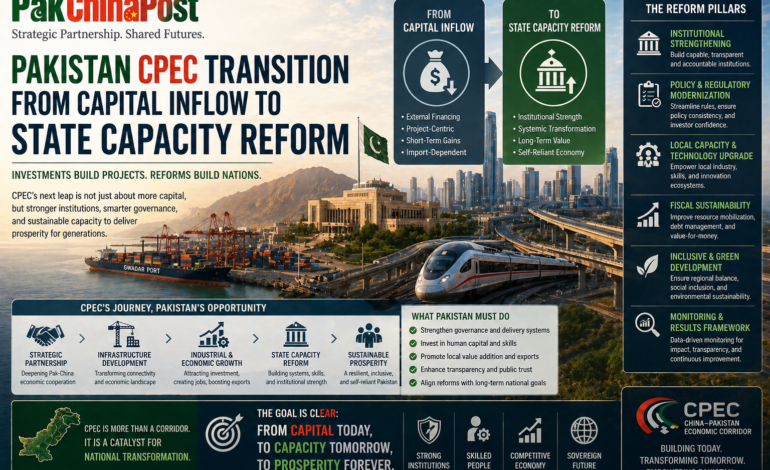
Pakistan’s experience with large scale external investment has consistently revealed a central paradox. Capital inflows can be negotiated at the highest diplomatic level, yet their developmental dividends are ultimately determined at the lowest levels of institutional execution. The China Pakistan Economic Corridor has intensified this paradox by introducing a scale of investment and ambition that exceeds the absorptive capacity of Pakistan’s existing governance architecture. As the initiative shifts from infrastructure delivery toward industrial relocation, agricultural modernization, and digital integration, the question of localization has moved from political rhetoric to structural necessity.
The dominant feature of early CPEC implementation was its centralized character. Decision making, financing structures, and project prioritization were heavily concentrated within federal institutions, with limited substantive participation from provinces beyond administrative facilitation. This model may have been efficient for fast tracking energy and transport infrastructure, but it is increasingly misaligned with the second phase of CPEC, where economic outcomes depend on localized ecosystems of production, labor, and entrepreneurship rather than isolated megaprojects.
Localization in this context does not simply mean geographic dispersion of projects. It refers to the integration of investment into provincial economies in a manner that generates endogenous growth dynamics. This requires provinces to become not passive recipients of federal decisions, but active economic actors capable of shaping industrial priorities, managing labor markets, and aligning education systems with sectoral demand. Without this shift, CPEC risks reinforcing regional disparities rather than reducing them.
One of the most persistent weaknesses in Pakistan’s development model has been the limited economic agency of provinces. Fiscal dependence on federal transfers, weak industrial planning capacity, and fragmented regulatory frameworks have constrained provincial governments from fully participating in large scale economic transformation. CPEC has, in many ways, amplified this structural imbalance. While provinces host key infrastructure projects, they often lack authority over investment design, technology selection, and value chain integration. This creates a disconnect between where development occurs and where development is governed.
A more balanced model requires a recalibration of federal provincial relations within the CPEC framework. Provinces must be formally integrated into investment decision making through structured mechanisms that go beyond consultation. This includes participation in project design, industrial zoning, labor allocation, and revenue sharing arrangements. Without institutionalized provincial ownership, localization remains symbolic rather than substantive.
The role of Special Economic Zones illustrates this tension clearly. Conceived as engines of industrial growth, SEZs under CPEC have often been criticized for limited integration with local economies. In many cases, they operate as enclaves with weak linkages to domestic supply chains and minimal engagement with small and medium enterprises. This enclave tendency undermines the transformative potential of SEZs, which should function as nodes of technology transfer, skill development, and industrial clustering.
For SEZs to become genuinely localized growth engines, their governance must shift from federal control toward hybrid models involving provincial authorities and private sector stakeholders. Incentive structures should be tied not only to foreign investment inflows but also to local employment generation, domestic supplier integration, and export performance. In this sense, SEZs should be evaluated not as isolated industrial parks but as ecosystems of economic transformation.
Small and medium enterprises occupy a particularly critical position in this localization agenda. Despite their numerical dominance in Pakistan’s economic structure, SMEs remain structurally disconnected from large scale investment flows. Financing constraints, regulatory burdens, and limited access to technology have prevented SMEs from integrating into CPEC related value chains. Yet it is precisely this segment that holds the greatest potential for employment generation and inclusive growth.
A localized CPEC strategy must therefore prioritize SME integration as a central policy objective rather than a peripheral concern. This requires targeted credit mechanisms, simplified regulatory regimes, and deliberate inclusion of SMEs in procurement and supply chain networks associated with Chinese investment projects. Without this integration, the benefits of large scale capital inflows will remain concentrated in a narrow industrial base, limiting broader developmental impact.
Labor skilling represents another critical dimension of localization. The shift from infrastructure based investment to industrial and technological cooperation demands a workforce capable of operating in increasingly complex production environments. However, Pakistan’s labor market remains characterized by low productivity, weak vocational training systems, and limited alignment between education outputs and industrial needs.
This mismatch creates a structural bottleneck in the localization of CPEC gains. Even when industrial opportunities are created, the domestic labor force is often insufficiently prepared to absorb them. Addressing this requires a fundamental rethinking of human capital development as an integral component of economic policy rather than a social sector priority. Vocational training, technical education, and industry linked certification programs must be aligned with emerging sectors such as manufacturing automation, logistics management, renewable energy systems, and digital infrastructure services.
China’s own experience with industrial upgrading offers relevant lessons in this regard. Its economic transformation was not driven solely by capital accumulation but by sustained investment in human capital development aligned with industrial policy. Pakistan’s challenge is to replicate this alignment within its own institutional constraints, ensuring that labor skilling becomes an integral part of CPEC phase two implementation rather than an auxiliary initiative.
Provincial disparities further complicate the localization agenda. Economic geography within Pakistan is highly uneven, with significant differences in industrial base, infrastructure quality, and human capital distribution across provinces. Without targeted regional strategies, CPEC risks reinforcing existing asymmetries rather than addressing them. Provinces with relatively stronger administrative capacity may attract disproportionate investment, while less developed regions remain marginalized.
To counter this tendency, a more deliberate spatial development strategy is required. This would involve mapping industrial zones across provinces based on comparative advantage, resource endowment, and labor availability. It would also require coordinated infrastructure planning that connects less developed regions to major economic corridors. In this sense, localization must be understood not only as provincial inclusion but as spatial balancing of economic opportunity.
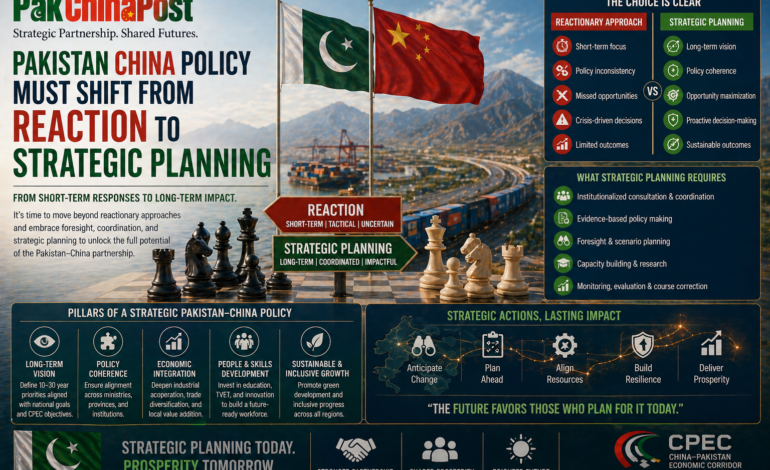
The governance architecture supporting CPEC must also evolve to support this localization agenda. At present, institutional responsibilities are fragmented across multiple agencies, leading to coordination inefficiencies and policy inconsistencies. A more integrated institutional framework is needed to align federal, provincial, and private sector actors around shared development objectives. This includes harmonizing regulatory standards, streamlining approval processes, and improving data sharing mechanisms.
Digital governance tools could play a significant role in enhancing this coordination. Real time monitoring of project implementation, labor deployment, and supply chain integration would allow for more responsive policy adjustments and improved accountability. Without such systems, localization efforts risk being undermined by information asymmetries and administrative delays.
At a broader level, localization also has political implications. Economic inclusion is closely linked to perceptions of fairness and legitimacy in development processes. If CPEC benefits are perceived to be concentrated in specific regions or elite segments, it risks generating political tensions that could undermine long term stability. Conversely, a more inclusive distribution of benefits can strengthen national cohesion and reinforce the legitimacy of external partnerships.
The challenge, therefore, is not simply technical but political economy oriented. Localization requires balancing efficiency with equity, central coordination with provincial autonomy, and foreign investment with domestic inclusion. These tensions cannot be resolved through administrative adjustments alone. They require a redefinition of development priorities within Pakistan’s broader economic strategy.
In conclusion, the future of CPEC as a transformative development initiative depends on its ability to move beyond infrastructure delivery toward embedded economic integration. This integration must be grounded in provincial empowerment, SME inclusion, labor skilling, and spatial balance. Without these elements, CPEC will remain a corridor of connectivity rather than a catalyst for inclusive growth.
The central policy imperative is clear. Pakistan must transition from a centralized investment absorption model to a decentralized development ecosystem in which provinces, enterprises, and workers are active participants in value creation. Only through such a shift can external capital be transformed into internal capability, and only then can the promise of CPEC evolve from infrastructure diplomacy into genuine economic transformation.
A Public Service Message