Pakistan China Policy Must Shift from Reaction to Strategic Planning


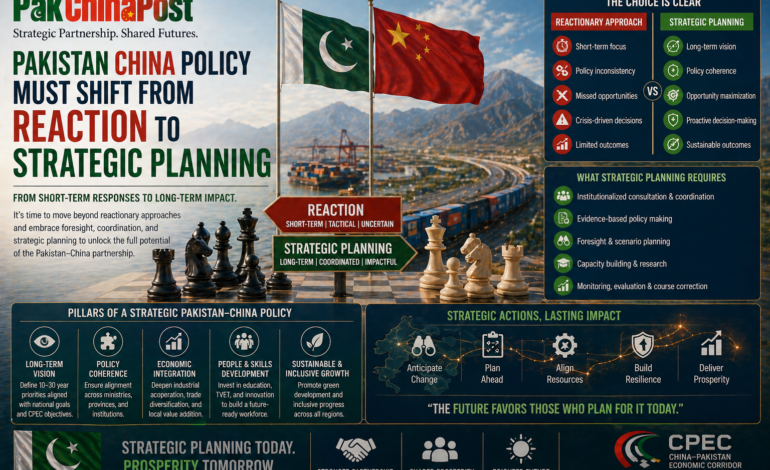
Pakistan’s engagement with China has entered a phase where historical improvisation is no longer sufficient to manage contemporary economic complexity. The China Pakistan Economic Corridor, once framed primarily as a portfolio of infrastructure projects, has evolved into a multi dimensional platform spanning industrial relocation, energy restructuring, agricultural modernization, digital infrastructure, and regional connectivity. Yet Pakistan’s policy architecture remains largely anchored in reactive decision making, shaped by short term financing pressures and episodic diplomatic engagement rather than long term strategic design.
This structural mismatch between the scale of bilateral cooperation and the depth of domestic planning represents one of the most critical constraints on Pakistan’s development trajectory. While China operates through long horizon planning systems that integrate economic, technological, and geopolitical objectives into coherent multi decade frameworks, Pakistan continues to rely on fragmented institutional mechanisms that respond to immediate challenges without embedding them within a durable national strategy. The result is a policy environment characterized by discontinuity, reactive negotiation, and limited institutional learning.
The absence of a coherent ten year China policy is not merely an administrative gap. It is a strategic vulnerability. In the absence of a long term framework, Pakistan negotiates each project, agreement, and financing arrangement in isolation, without fully integrating them into a broader national transformation agenda. This leads to duplication of effort, inconsistent priorities, and missed opportunities for structural economic upgrading. It also weakens Pakistan’s negotiating position, as policy incoherence reduces the ability to articulate clear national priorities in bilateral engagements.
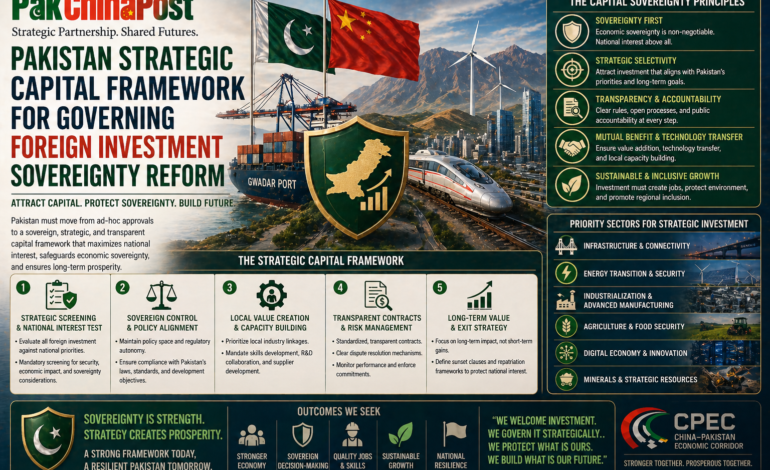
A strategic China policy must begin with a fundamental shift in conceptual framing. Pakistan must move from viewing China engagement as a series of bilateral projects to understanding it as an integrated economic transformation partnership. This requires embedding China related cooperation within Pakistan’s own national development strategy rather than treating it as a parallel diplomatic track. In practical terms, this means aligning all CPEC and related initiatives with macroeconomic objectives such as export diversification, industrial upgrading, fiscal sustainability, and human capital development.
One of the most pressing requirements of such a policy is institutional consolidation. At present, China related economic engagement is dispersed across multiple ministries, planning bodies, provincial departments, and special purpose entities. This fragmentation creates coordination failures and dilutes accountability. A centralized strategic coordination mechanism is required to unify policy direction, monitor implementation, and ensure alignment with long term national objectives. This mechanism should function not as a ceremonial body but as an operational hub with authority over cross sectoral planning and interagency coordination.
Equally important is the need to introduce a structured policy horizon. A ten year China policy should not be a static document but a dynamic framework updated through periodic strategic reviews. It should define clear sectoral priorities, including industrial relocation targets, energy transition pathways, digital infrastructure development, and agricultural modernization benchmarks. Each of these sectors should be linked to measurable outcomes such as employment creation, export earnings, technology transfer, and productivity growth.
Industrial policy alignment is particularly critical. China’s evolving economic structure, characterized by rising labor costs and technological upgrading, presents opportunities for relocation of intermediate manufacturing and labor-intensive industries. However, Pakistan’s ability to attract and retain such industries depends on its domestic policy environment. Issues such as regulatory unpredictability, land acquisition in efficiencies, inconsistent taxation regimes, and weak dispute resolution mechanisms significantly undermine investor confidence. A strategic policy must therefore prioritize regulatory harmonization and institutional predictability as core economic instruments.
Energy cooperation also requires strategic reframing. While CPEC energy projects have addressed immediate supply shortages, the long-term challenge is energy system transformation. Pakistan’s future energy policy must align with global transitions toward renewables, grid modernization, and decentralized energy systems. Continued reliance on fossil fuel-based generation risks locking the country into high-cost energy structures that undermine industrial competitiveness. A ten-year framework should therefore prioritize renewable integration, energy efficiency, and grid resilience as central pillars of China Pakistan energy cooperation.
Digital infrastructure represents another emerging frontier where strategic planning is urgently required. As China expands its technological footprint globally, Pakistan must carefully calibrate its engagement to ensure technological upgrading without compromising data sovereignty or regulatory autonomy. This requires clear policy frameworks governing data governance, digital infrastructure ownership, cybersecurity standards, and technological interoperability. Without such frameworks, digital cooperation risks creating long term structural dependencies.
Agricultural modernization is often overlooked in strategic discussions, yet it remains one of the most transformative potential areas of China Pakistan cooperation. China’s advances in precision agriculture, irrigation efficiency, and agri value chain development offer significant opportunities for Pakistan’s underperforming agricultural sector. However, translating these opportunities into outcomes requires institutional coordination between research institutions, provincial governments, and private sector actors. A strategic policy must therefore integrate agricultural transformation into broader industrial and technological planning frameworks.
Another critical dimension of strategic planning is fiscal sustainability. Large scale external financing, if not carefully managed, can create long term debt vulnerabilities. A ten year China policy must therefore incorporate debt management frameworks that ensure transparency, sustainability, and alignment with revenue generation capacities. This includes improving project appraisal mechanisms, strengthening fiscal oversight institutions, and ensuring that external borrowing is tied to productive capacity expansion rather than consumption smoothing.
Geopolitical risk management is also an essential component of long term planning. Pakistan’s position within a complex regional environment requires careful balancing of economic partnerships, security considerations, and diplomatic relationships. A strategic China policy must therefore integrate geopolitical scenario planning to anticipate external shocks, regional instability, and shifting global economic dynamics. This requires strengthening analytical capacity within policy institutions and developing forward looking strategic assessment tools.
Human capital development must be placed at the center of any long term framework. Without skilled labor, technological transfer and industrial relocation cannot produce meaningful transformation. Pakistan’s education and vocational training systems must be aligned with the demands of emerging industrial sectors. This includes technical training in manufacturing, engineering, digital systems, logistics, and energy management. A strategic policy must therefore integrate education reform into economic planning rather than treating it as a separate social sector issue.
Perhaps most importantly, a ten year China policy must redefine the role of the state in economic transformation. The state must transition from a reactive facilitator of external agreements to a proactive architect of economic strategy. This requires strengthening planning institutions, improving interagency coordination, and enhancing data driven decision making. It also requires political continuity in economic policy, ensuring that long term strategies are not disrupted by short term political cycles.
The transformation from reactive bilateralism to strategic economic planning is not merely a technical adjustment. It represents a fundamental shift in governance philosophy. It requires moving beyond project based thinking toward system based thinking, beyond short term gains toward long term structural transformation, and beyond fragmented decision making toward integrated national planning.
In conclusion, Pakistan’s China policy must evolve from a collection of reactive responses into a coherent strategic framework that guides all dimensions of bilateral engagement. Only through such a transformation can Pakistan fully leverage the opportunities presented by CPEC and broader China Pakistan cooperation. Without it, the country risks remaining locked in a cycle of episodic engagement without structural transformation.
The central imperative is therefore clear. Pakistan must institutionalize a ten-year strategic China policy that integrates economic, technological, fiscal, and geopolitical dimensions into a unified national framework. Only then can bilateral cooperation move from transactional arrangements to transformational outcomes, and only then can Pakistan reposition itself from a reactive participant to a strategic architect of its own development trajectory.
A Public Service Message