Pakistan Strategic Capital Framework For Governing Foreign Investment Sovereignty Reform


Pakistan’s expanding engagement with Chinese capital has reached a structural stage where traditional foreign investment policy tools are no longer adequate to manage the scale, complexity, and strategic sensitivity of incoming financial and technological flows. What was once framed as development assistance or infrastructure financing has increasingly evolved into a multidimensional form of strategic capital engagement, spanning energy systems, transport corridors, digital infrastructure, industrial zones, and resource extraction. This transformation requires a corresponding evolution in Pakistan’s regulatory philosophy, from passive investment facilitation toward active governance of capital as a strategic national asset.
The central policy dilemma is no longer whether Pakistan should attract foreign investment, but how it should govern investment that has direct implications for sovereignty, economic structure, and long term technological dependency. In the absence of a coherent framework, capital inflows risk producing fragmented development outcomes, institutional asymmetries, and strategic vulnerabilities in key sectors. This is particularly significant in the context of deepening economic integration with China under the China Pakistan Economic Corridor, where investment is not merely financial but infrastructural, technological, and geopolitical in nature.
Pakistan’s current regulatory architecture is not designed for this level of complexity. Investment oversight is distributed across multiple ministries, regulatory bodies, provincial authorities, and project specific entities, each operating with partial mandates and limited coordination. This fragmentation creates inefficiencies in project approval, weakens contract enforcement, and reduces the state’s ability to align foreign investment with national development priorities. More critically, it limits Pakistan’s capacity to distinguish between commercially beneficial investment and strategically sensitive capital inflows that require heightened scrutiny and governance.
The absence of a unified strategic capital framework has led to a governance gap in which large scale investments are approved through ad hoc mechanisms without comprehensive assessment of long term economic, fiscal, and security implications. This creates a structural imbalance between the scale of incoming capital and the institutional capacity to manage its systemic impact. Over time, such imbalances can translate into fiscal vulnerabilities, technological dependencies, and reduced policy autonomy in key sectors.
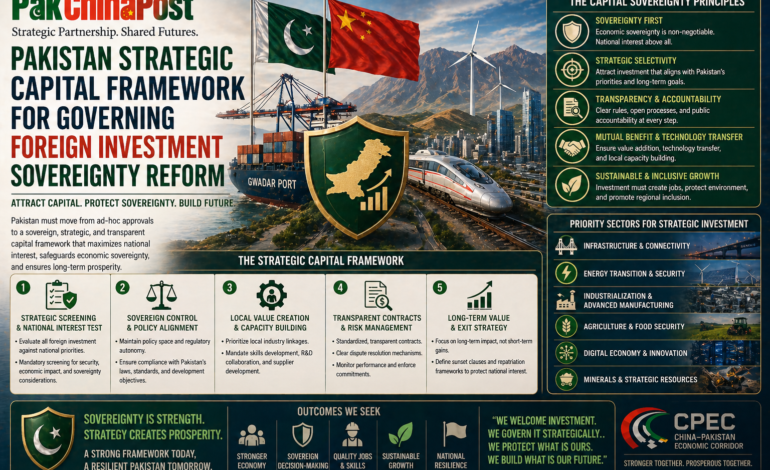
A restructured approach requires the establishment of a sovereign investment governance architecture that treats foreign capital not as a uniform category but as a differentiated set of strategic inputs. Not all investment carries the same implications for national sovereignty or economic transformation. Infrastructure financing, industrial relocation, digital systems, and extractive industries each have distinct governance requirements. A modern policy framework must therefore incorporate sector specific regulatory logic rather than relying on generalized investment facilitation regimes.
At the center of this proposed transformation is the need for a centralized strategic institution responsible for coordinating, regulating, and monitoring foreign investment in critical sectors. Such an institution could take the form of a Pakistan Strategic Investment Authority, designed to operate with cross sectoral jurisdiction over high impact investment domains. Its mandate would extend beyond approval functions to include strategic alignment, risk assessment, contract standardization, and long term monitoring of investment outcomes.
This institutional mechanism would serve multiple functions. First, it would consolidate fragmented regulatory oversight into a unified platform, reducing inefficiencies and improving coordination between federal and provincial entities. Second, it would introduce a structured framework for evaluating the strategic significance of investment projects, particularly in sectors such as energy, telecommunications, transport infrastructure, mining, and digital systems. Third, it would ensure that investment agreements are aligned with national development priorities rather than negotiated in isolation.
One of the key dimensions of strategic capital governance is sector classification. A clear distinction must be drawn between open sectors where foreign investment can be encouraged with minimal restrictions and strategic sectors where state oversight is essential due to their implications for sovereignty, security, or systemic stability. Energy infrastructure, data networks, digital platforms, and large scale logistics systems fall into the latter category. These sectors require enhanced regulatory scrutiny, performance monitoring, and contractual safeguards to ensure that national interests are preserved.
Digital infrastructure represents one of the most critical emerging domains in this regard. As Pakistan integrates more deeply into global digital ecosystems, questions of data sovereignty, cybersecurity, and technological dependency become increasingly important. Foreign investment in telecommunications, cloud infrastructure, and data management systems cannot be treated as conventional commercial activity. It requires a governance framework that ensures domestic control over sensitive data, regulatory transparency in algorithmic systems, and long term technological interoperability standards.
Energy investment under CPEC has already demonstrated both the benefits and limitations of large scale external financing. While energy projects have alleviated short term supply shortages, they have also created long term fiscal commitments and structural dependencies that require careful management. A strategic capital framework must therefore integrate energy investments into broader national energy transition planning, ensuring alignment with renewable energy targets, grid modernization, and cost efficiency objectives.
Another critical component of sovereign capital governance is local content integration. Foreign investment must not operate as an isolated enclave but must be structurally linked to domestic industries, supply chains, and labor markets. This requires regulatory mechanisms that incentivize local procurement, technology transfer, and workforce integration. Without such mechanisms, investment risks generating limited spillovers into the domestic economy, thereby constraining its developmental impact.
Debt transparency and fiscal accountability are equally essential elements of the proposed framework. Large scale foreign investment often involves complex financing structures, including sovereign guarantees, public private partnerships, and long term repayment obligations. Without robust transparency mechanisms, such arrangements can create hidden fiscal liabilities that constrain future policy flexibility. A sovereign investment framework must therefore include standardized disclosure requirements, parliamentary oversight mechanisms, and independent audit functions to ensure fiscal sustainability.
The role of provincial governments must also be reconsidered within this framework. While strategic investment governance requires centralized coordination, implementation occurs primarily at the provincial level. This creates a need for structured federal provincial integration in investment governance. Provinces must be granted defined roles in project selection, land management, labor regulation, and industrial planning, while maintaining alignment with national strategic objectives. This balanced approach ensures both coherence and localization within the investment ecosystem.
Risk management represents another critical dimension of strategic capital governance. Foreign investment in critical sectors carries not only economic risks but also geopolitical and technological risks. A comprehensive framework must therefore incorporate scenario based risk assessment tools that evaluate potential vulnerabilities arising from external shocks, political instability, or technological disruption. This requires strengthening institutional capacity for economic intelligence, policy forecasting, and strategic analysis within government structures.
The introduction of a strategic capital framework also necessitates a shift in regulatory philosophy. The objective is not to restrict foreign investment but to enhance its developmental quality and strategic alignment. Excessive liberalization without governance mechanisms can lead to fragmented development outcomes, while excessive restriction can deter beneficial capital inflows. The challenge lies in achieving a calibrated balance that preserves investment attractiveness while safeguarding national interests.
China’s role as Pakistan’s largest source of infrastructure and industrial investment makes this regulatory evolution particularly significant. As economic engagement deepens, the complexity of managing bilateral capital flows increases. A structured governance framework would not only enhance Pakistan’s ability to manage Chinese investment more effectively but also improve the quality and sustainability of bilateral economic cooperation. It would provide clarity, predictability, and institutional stability for both sides.
At a broader level, the governance of strategic capital reflects a fundamental transition in global economic relations. Investment is no longer purely financial; it is increasingly embedded in technological systems, data networks, and geopolitical alignments. Countries that fail to adapt their regulatory frameworks to this new reality risk losing policy autonomy in critical sectors. Pakistan’s challenge is therefore not unique, but it is particularly acute given its level of external dependence and institutional fragmentation.
The establishment of a sovereign investment governance framework would represent a significant step toward addressing this challenge. It would enable Pakistan to transition from passive recipient of foreign capital to active manager of strategic economic engagement. This shift would enhance policy coherence, improve investment outcomes, and strengthen long term economic resilience.
In conclusion, the future of Pakistan’s engagement with foreign capital, particularly Chinese investment, depends on its ability to develop a coherent, institutionalized, and strategically informed governance framework. Without such a framework, investment will continue to produce uneven outcomes and limited structural transformation. With it, Pakistan can transform external capital into a driver of sustainable development, technological upgrading, and economic sovereignty.
The central policy imperative is therefore clear. Pakistan must establish a comprehensive strategic capital governance system that integrates regulatory oversight, fiscal accountability, sectoral classification, and provincial coordination into a unified institutional architecture. Only through such reform can foreign investment be fully aligned with national development objectives, and only then can economic sovereignty be preserved in an era of deepening global interdependence.
A Public Service Message